Austin Gallery
Studio & ToolsSeptember 8, 202610 min read

Best Electric Kilns for Home Use (2026): 120V and 240V Picks

Your electrical panel picks your kiln before you do. Eight electric kilns for a garage, spare room, or basement, sorted by 120V plug-in vs 240V, firing range, chamber size, controller, and venting.

By Justin Park · How we research

★ Our Top Pick

Paragon Xpress E12A Fire Brick Kiln (Sentry 3-Key, 120V 15A)

Paragon Xpress E12A Fire Brick Kiln (Sentry 3-Key, 120V 15A)

The deepest plug-in chamber here, with a digital controller, for low-fire and glass.

$2,300.00rated 4.6/5 in our review

Not sure yet? Compare all 8 picks below ↓

The best electric kiln for home use is the one your electrical panel can actually run. Kilns split into two worlds: 120-volt kilns that plug into a normal outlet, and 240-volt kilns that need an electrician to add a dedicated circuit. The plug-in world tops out around a shoebox chamber and, with one exception, low-fire temperatures. The 240-volt world is where cone 6 stoneware, full shelves, and weekly production live. Decide which world you are in and the shortlist shrinks to two or three kilns.

We sorted eight picks by power, chamber size, firing range, controller, and venting. Paragon and Skutt, with decades of parts support, take the top spots; Amazon-native brands earn a place only where they offer capacity per dollar nobody else does. For the wider field see our main electric kiln guide, and pair your kiln with a wheel from our home-studio pottery wheel guide. Every link goes to Amazon with our affiliate tag; we earn a small commission, at no cost to you, when you buy through us.

Pick Your Kiln by Outlet, Clay, and Space

Your situationWhat you needJump to the pick
Standard outlet, low-fire clay or glass, biggest load possible120V, 2000°F, deep chamberParagon Xpress E12A
Standard outlet, stoneware, small pieces and glaze tests120V, cone 6 to 10Paragon Xpress Q11A
Garage, electrician's circuit, weekly stoneware on full shelves240V, cone 10, 7 cu ftSkutt KMT 1027
Can add a small 240V circuit, want cone 6 for about $1,000240V, 20A, 0.6 cu ftWYDDDARY 0.6 cu ft
Same, but you write glaze schedules with holds and slow cooling240V, programmableWYDDDARY 0.88 cu ft
Not sure you will keep firing; jewelry, tiles, small pieces120V benchtop, under $450VEVOR 1650W
Glass, enamel, or metal clay rather than pottery120V fiber kilnParagon SC3
Any kiln indoors or in an attached garageDowndraft ventSkutt Envirovent

On temperatures: cone 06 to 04 low-fire is roughly 1830°F to 1950°F, cone 6 stoneware about 2230°F, cone 10 about 2345°F. A 2000°F kiln is a low-fire and glass kiln; a kiln rated 2300°F or higher is a real stoneware kiln. Our cone chart and note on clay shrinkage and absorption explain why the right cone matters.

Best Overall 120V Plug-In KilnOur Pick

Power

120V, 15 amps (plug-in)

Max temp

2000°F (low-fire, glass)

Chamber

8.5" W x 12" D x 6.75" H

Controller

Sentry 3-key digital

Pros

  • Standard 120V outlet
  • Biggest plug-in chamber here
  • Decades of Paragon parts support

Cons

  • Not a stoneware kiln
  • Expensive for low-fire
  • Needs a dedicated circuit

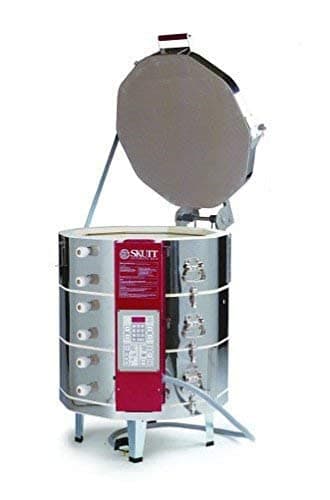
Most people shopping for a home kiln have one hard constraint, a regular outlet and no rewiring, and the Xpress E12A is built for exactly that person. It draws 15 amps at 120 volts and gives you a firebrick chamber 8.5 inches wide, 12 deep, and 6.75 tall, the deepest interior of any plug-in kiln here. The three-key Sentry controller ramps, holds, and shuts off on its own.

The number that decides it: 2000°F covers low-fire earthenware (cone 06 to 04 is roughly 1830°F to 1950°F), glass, china paints, and metal clay. It does not reach cone 6 stoneware at about 2230°F; for that, see the Q11A or the 240V kilns below.

Our Pick

The deepest firebrick chamber you can run from a standard outlet: 8.5 by 12 by 6.75 inches, a digital Sentry controller, and a 2000°F ceiling for low-fire pottery, glass, and decals.

A spare room or garage with a regular outlet, no electrician, and earthenware or glass in the kiln.

What we don't like

2000°F rules out cone 6 stoneware, and 15 amps wants a circuit of its own.

Best 120V Test Kiln (Cone 10 on a Plug)Also Great

Power

120V, 12 amps (plug-in)

Max temp

2350°F (cone 10 range)

Chamber

6" W x 6" D x 6.25" H

Controller

Sentry 3-key digital

Pros

  • Cone 10 capable on a standard outlet
  • Gentle 12-amp draw
  • Ideal glaze-test kiln

Cons

  • Six-inch cube
  • Slow to top temperature
  • Not for production

If your clay is stoneware, the E12A cannot vitrify it, and this is the plug-in kiln that can. The Q11A is rated to 2350°F, which puts cone 6 comfortably inside its range and cone 10 at the edge, on 12 amps at 120 volts.

The trade is size: a load is a couple of mugs, a stack of test tiles, or a few small sculptural pieces. Potters use kilns like this to test glazes before committing a full load, and that is the honest job description.

Also Great

The rare plug-in kiln rated to 2350°F, cone 10 territory, on 12 amps at 120 volts. The 6 by 6 by 6.25 inch chamber makes it a test and small-work kiln.

Stoneware potters who want to test glazes and fire small pieces at home without a 240V circuit.

What we don't like

Three mugs fill it, and firing to the top of its range on a household circuit is slow.

Best Full-Size 240V Studio KilnUpgrade Pick

Power

240V, 48 amps, single phase

Firing range

Cone 10

Chamber

About 7 cubic feet

Controller

Skutt touchscreen

Pros

  • Full-size cone 10 kiln
  • Sectional rings for moving and service
  • Lid lifter and cool-touch handle

Cons

  • Needs a 48-amp 240V circuit
  • Big, heavy, expensive
  • Overkill for occasional firing

Walk into any teaching studio and the kiln with the Skutt badge is probably a 1027. This is the touchscreen version: a ten-sided chamber of roughly seven cubic feet that fires to cone 10, built in sections so two people can move it and an element can be replaced without replacing the kiln. The listing states the requirement plainly: 240 volts, 48 amps, single phase, a dedicated circuit sized above the draw by an electrician.

The home-studio details are in the lid: a counterweighted lifter that raises it with a finger and a powder-coated handle that stays cool at temperature. Plan the room around it, with clearance on every side and the downdraft vent at the bottom of this list.

Upgrade Pick

The kiln in the back of most teaching studios, with a touchscreen. Roughly seven cubic feet, cone 10, sectional, with Skutt's counterweighted lid lifter. It needs a 240V, 48-amp single-phase circuit.

Weekly stoneware on full shelves, and permission to have an electrician add a circuit to a garage.

What we don't like

The price before the electrician and the electrician after; far more kiln than a monthly firer needs.

Best Value 240V Kiln (Cone 6 for About $1,000)

Power

220V single phase, 2.5kW, 11.5A (listing: 2P 20A breaker)

Max temp

2336°F (1280°C)

Chamber

10.8" diameter x 9" deep, 0.6 cu ft

Elements

MoSi2 rods, hexagonal chamber

Pros

  • Cone 6 with headroom on a 20-amp circuit
  • About ten cups per load
  • Separate control box

Cons

  • Unproven brand
  • Confirm 240V compatibility
  • Not a segment programmer

This is the kiln for the potter who has done the math on the Skutt and decided a thousand dollars and a 20-amp circuit sounds better than five thousand and a 60-amp one. The hexagonal chamber is 10.8 inches across and 9 deep, roughly ten cups per the listing, and the 2336°F rating clears cone 6 with margin, so this is a stoneware kiln in a way the plug-in Paragons are not.

Two cautions. The brand exists mostly as an Amazon storefront, so plan on sourcing elements yourself someday, and it is listed at 220 volts; North American split-phase runs at 240, so confirm that tolerance with the seller first.

A 0.6 cubic foot hexagonal kiln rated to 2336°F on 220V single phase at 11.5 amps. The listing says about ten cups per load, the line between a test kiln and a small production kiln, for a thousand dollars.

Cone 6 potters who can add a small 240V circuit (the listing calls for a two-pole 20-amp breaker).

What we don't like

An Amazon-native brand, listed at 220V rather than 240V, with a basic button controller.

Austin Art Insider

Free weekly guide to galleries, exhibitions & collecting in Austin.

Best Programmable Mid-Size 240V Kiln

Power

220V single phase, 3.5kW

Max temp

2372°F (1300°C)

Chamber

0.88 cu ft, about 35 cups per listing

Controller

32-segment programmable

Pros

  • 32-segment programs with holds and slow cooling
  • Elements on five sides
  • Casters and hydraulic lid rods

Cons

  • Amazon-native brand
  • Circuit size not stated
  • Ceiling firings wear elements

The feature that separates a hobby kiln from a studio kiln is a controller you can program in segments, and this is the cheapest kiln here that has one. Thirty-two segments means a real schedule: a slow candle to drive off water, a fast ramp, a hold at the top, then a controlled cool for glazes that need it. Five-sided elements heat the 0.88 cubic foot chamber evenly.

The build suits a garage: a top-hinged lid on hydraulic rods, a locking latch with a fiber gasket, a side cooling fan, and four lockable casters so you can roll it out to fire and back to park the car. Treat it as a cone 6 kiln with headroom and the elements will last.

A step up in every direction: 0.88 cubic feet, a 32-segment programmable controller, elements on five sides, a 2372°F rating, casters, and hydraulic lid rods. The most kiln per dollar here for a weekly firer.

Potters who write glaze schedules with holds and slow cooling and have a 240V circuit sized for 3.5 kilowatts.

What we don't like

Same brand caveat, and the listing gives kilowatts rather than a breaker size.

Best Budget 120V Kiln (Under $450)Budget Pick

Power

120V plug-in, 1650W

Max temp

2192°F (1200°C)

Chamber

8" x 5" x 6"

Controller

PID, 9 stages, 1 to 60 minute timer

Pros

  • Programmable stages at a fraction of the price
  • Fits a workbench
  • Stainless exterior, built-in ventilation

Cons

  • Below cone 6 on paper
  • Small chamber
  • Modest heat retention

Plenty of people searching for a home kiln are really asking whether they should buy one at all, and this is the kiln to answer that with. For $439.90 you get 1650 watts, a PID controller with nine programmable stages so it ramps, holds, and shuts off on its own, and a chamber that takes a handful of small pieces, a rack of test tiles, or a tray of enamel work.

Read the temperature honestly: 2192°F is 1200°C. Cone 04 earthenware is comfortably inside that; cone 6 stoneware at about 2230°F is not, and running any kiln at its ceiling burns out elements. Treat it as a low-fire and glass kiln and it will serve.

Budget Pick

A benchtop plug-in kiln with a PID controller, nine programmable stages, an 8 by 5 by 6 inch chamber, and a 2192°F ceiling, for under $450. The cheapest way here to fire low-fire clay, glaze tests, or small glass and metal work.

Anyone deciding whether they will actually fire at home, or whose work is small: jewelry, tiles, enamel.

What we don't like

2192°F lands below cone 6, and a stainless box holds heat less well than firebrick.

Best Glass, Enamel, and Metal Clay Kiln

Power

120V, 15 amps (plug-in)

Max temp

2000°F

Chamber

7.75" W x 8" D x 7.75" H, ceramic fiber

Controller

Sentry 3-key digital

Pros

  • Fiber heats fast for glass and enamel
  • Standard outlet
  • Larger than the SC2 in our main guide

Cons

  • Delicate around kiln furniture
  • Not a stoneware kiln
  • Pricier than the Q11A

Not everyone searching for a home kiln is a potter, and the SC3 is for the glass fusers, enamelists, and metal clay artists who are better served by fiber than brick. Ceramic fiber has almost no thermal mass, so the chamber comes up fast and cools fast, which is what fused glass and enamel want. It is larger in every direction than the Paragon SC2 in our main electric kiln guide.

What it is not is a pottery kiln. Fiber walls scuff when you drag shelves and posts across them, and the ceiling means no stoneware. If your work is all glass, this is the better instrument; if it is split with clay, buy the Q11A.

The alternative to a pottery kiln for glass, enamel, and silver clay: a ceramic-fiber chamber 7.75 by 8 by 7.75 inches that heats fast and evenly, a Sentry controller, and a 120V 15-amp plug.

Glass fusers, enamelists, and metal clay artists who want a fiber kiln rather than a pottery kiln pressed into service.

What we don't like

Fiber scuffs under pottery shelves, it will not fire stoneware, and it costs more than the higher-firing Q11A.

Best Kiln Vent (Budget for This)

Type

Downdraft vent

Fits

Popular top-loading kilns

Mount

Spring-loaded collection cup under the kiln

Exhaust

Ducted outdoors

Pros

  • Removes fumes, odors, and vapors
  • Spring-loaded cup keeps a seal
  • Fits most top-loaders

Cons

  • Real expense on top of the kiln
  • Needs an exterior wall
  • Oversized for benchtop kilns

Every kiln on this page produces fumes, and where those fumes go is the difference between a kiln you enjoy at home and one you dread turning on. A downdraft vent pulls air through small holes in the kiln floor, mixes it with room air in the collection cup, and pushes it through a hose outdoors. The room stays clear, and the kiln atmosphere stays oxidizing for cleaner glaze colors.

For the benchtop kilns here, a window fan drawing air out of the room is the usual answer. For anything with a lid you load shelves into, budget the vent with the kiln, and add a HEPA air purifier for the dust side of a ceramics room.

Not a kiln, but the part of a home setup people skip and regret. A downdraft vent pulls fumes out through the kiln floor and pushes them outdoors, so the garage does not fill with the smell of wax, sulfur, and glaze.

Anyone with a kiln inside the house or an attached garage, and everyone with a full-size kiln.

What we don't like

$695 of vent that needs an exterior wall within hose reach, and oversized for benchtop kilns.

How we
chose

We ranked kilns for home use in the order a home buyer faces the questions: power first, 120V plug-in versus 240V with the amperage stated in each listing; firing range against real clay, comparing each rated maximum with cone 04, cone 6, and cone 10;chamber size as stated; controller type, with segment programmers over single-setpoint boxes because automatic shut-off matters most in your house; and brand support and venting, where Paragon and Skutt's decades of parts supply earned the top spots and Amazon-native brands earned theirs on capacity per dollar with that trade-off stated. Ratings are editorial estimates, not compiled from customer reviews. Prices were verified in stock on Amazon on September 8, 2026.

Share this guide

Share

Common Questions

Frequently Asked Questions

Have art
to sell?

Austin Gallery specializes in selling inherited art, estate collections, and fine art with zero upfront fees. Get a free evaluation today.