Reference · Updated September 2026
Kiln electrical requirements: volts, amps, breakers and wiring explained
What a pottery kiln asks of your electrical panel, in the order an electrician will ask about it: voltage and phase, the breaker rule, the wire gauge table, the receptacle, the dedicated circuit, and the clearances. Ends with the checklist to hand over.
By the Austin Gallery editors · September 8, 2026
The quick answer
Real pottery kilns run on 240V single phase on a dedicated two-pole circuit sized at 125 percent of the kiln's rated amps (a 40 A kiln gets a 50 A breaker and 6 AWG copper; a 48 A kiln gets 60 A). Most mid-size kilns plug into a NEMA 6-50R; smaller ones use 6-30 or 6-20; some of the largest are direct wired. Keep the kiln 12 to 18 inches from walls per the manual. These are typical values. Your kiln manual and a licensed electrician govern, and the work needs a permit.
A kiln is the single largest electrical load most homes ever add, and it runs at nearly full current for eight to twelve hours at a stretch. That is why the rules below are stricter than for a range or a dryer, and why every kiln manufacturer prints the same instruction: a dedicated circuit, installed by a licensed electrician, to the specifications in the manual. This page explains what those specifications mean so the conversation with the electrician goes quickly and the quote is for the right job. What that job costs is worked through in how much does a kiln cost.
120V vs 240V, single phase vs three phase
| Supply | Connection | Kilns it powers | Notes |
|---|---|---|---|
| 120V, single phase | Standard wall outlet (NEMA 5-15 or 5-20) | Up to about 1,800 W; small test, jewelry and glass kilns | Paragon SC2 is listed at 1,680 W, 120V, 14 A, with a standard 5-15 plug. Wants a 15 or 20 A circuit to itself. |
| 240V, single phase | Dedicated two-pole circuit, NEMA 6-20, 6-30, 6-50, or hardwired | Roughly 3 kW to 12 kW; every real pottery kiln | Skutt publishes the KM-1027 at 48 A on 240V single phase, which is 11.52 kW. |
| 208V, single or three phase | Commercial and school panels | Same models, different element sets | A 240V element set on 208V delivers about 75 percent of its rated power. Order the kiln for the voltage you have. |
| 240V or 480V, three phase | Commercial and industrial panels | Large studio and production kilns | Lower current per conductor for the same power. Never a home installation. |
120V kilns are the small plug-in chambers for test tiles, jewelry, and glass. They top out around 1,800 W, the practical limit of a household 15 or 20 A circuit. Under the 80 percent continuous-load guideline that is 1,440 W on a 15 A circuit and 1,920 W on a 20 A circuit. The Paragon SC2, listed at 1,680 W and 14 A, ships with a standard 5-15 plug and Paragon specifies a dedicated circuit; many electricians put it on a 20 A circuit for the headroom.
240V single phase is standard US residential service: two hot legs, each 120V to neutral and 240V to each other. A kiln uses the two hots and a ground and no neutral, which is why kiln receptacles are three-wire. Three phase is a commercial service with three hot legs, and a three-phase kiln spreads the same wattage across more conductors at lower current each. The kiln's elements are wired for one or the other at the factory; you order the version that matches the building.
208V is the trap. Many schools and commercial spaces have 208V service, not 240V. Element power scales with the square of voltage, so a 240V element set fed 208V delivers (208 ÷ 240)² = 0.751, about 75 percent of its rated power. The kiln will fire slowly and may never reach cone 6. Order the kiln for 208V if that is what the panel supplies, and confirm the voltage with a meter before ordering.
Amperage and breaker sizing: the 125 percent rule
The National Electrical Code treats any load that runs for three hours or more as a continuous load, and NEC 210.19 and 210.20 require the branch circuit conductors and the overcurrent device to be rated at no less than 125 percent of a continuous load. A kiln firing is a continuous load by definition. So the breaker calculation is: kiln nameplate amps × 1.25, rounded up to the next standard breaker size. The equivalent statement, which you will see in kiln manuals, is that the kiln may draw no more than 80 percent of the breaker rating.
| Kiln nameplate | × 1.25 | Breaker | Typical copper conductor |
|---|---|---|---|
| 14 A | 14 × 1.25 = 17.5 A | 20 A | 12 AWG copper |
| 18 A | 18 × 1.25 = 22.5 A | 25 A (30 A if 25 A is unavailable) | 10 AWG copper |
| 24 A | 24 × 1.25 = 30.0 A | 30 A | 10 AWG copper |
| 30 A | 30 × 1.25 = 37.5 A | 40 A | 8 AWG copper |
| 40 A | 40 × 1.25 = 50.0 A | 50 A | 6 AWG copper |
| 48 A | 48 × 1.25 = 60.0 A | 60 A | 6 AWG copper at 75°C, or 4 AWG NM-B |
| 55 A | 55 × 1.25 = 68.75 A | 70 A | 4 AWG copper |
Worked example with a published rating: Skutt lists the KM-1027 at 48 amps on 240V single phase. 48 × 1.25 = 60, so it needs a 60 A two-pole breaker, and 48 × 240 = 11,520 W is the power the circuit must carry for the length of a firing. A kiln listed at 40 A gets 40 × 1.25 = 50, a 50 A breaker, which is the reason the NEMA 6-50 receptacle is the most common kiln outlet. The breaker also has to be the brand and series the panel accepts: Siemens Q250 for Siemens panels, Square D HOM250 for Homeline, Eaton BR250 for BR panels, each around $19 to $21.

The 50 A two-pole breaker
For Siemens and compatible QP-type panels only. The correct breaker for a 40 A nameplate kiln on a 6-50R receptacle. Your electrician will confirm the panel series before installing.
Wire gauge by amperage
Conductor size follows the breaker, with one catch that trips people up. The NEC ampacity table for copper has three temperature columns, and which one applies depends on the cable. Ordinary NM-B (Romex) cable is limited to the 60°C column by NEC 334.80, even though its conductors are rated 90°C. Individual THHN conductors in conduit can use the 75°C column, because breaker and receptacle terminations are rated 75°C. That is why a 60 A kiln circuit is 6 AWG in conduit but 4 AWG in NM-B.
| Copper size | 60°C (NM-B cable) | 75°C (THHN in conduit) | Common kiln breaker it serves |
|---|---|---|---|
| 14 AWG | 15 A | 20 A | 15 A |
| 12 AWG | 20 A | 25 A | 20 A |
| 10 AWG | 30 A | 35 A | 30 A |
| 8 AWG | 40 A | 50 A | 40 A |
| 6 AWG | 55 A | 65 A | 50 A |
| 4 AWG | 70 A | 85 A | 70 A |
| 3 AWG | 85 A | 100 A | 80 A |
| 2 AWG | 95 A | 115 A | 90 A |
Ampacities from NEC Table 310.16 for copper, not more than three current-carrying conductors, 30°C ambient. The last column shows the breaker a kiln installer typically pairs with each size; 6 AWG serves 50 A in NM-B and 60 A in conduit. Aluminum conductors need to be two sizes larger and are uncommon for kiln circuits.
Two adjustments the electrician will make. Voltage drop: on a long run the conductor goes up a size so the kiln sees close to full voltage; a kiln fed low voltage fires slowly, as in the 208V case. Ambient temperature: cable through a hot attic is derated, which can also push the size up. A 35 foot run of 6/3 copper NM-B was about $146 and a 125 foot spool about $420 when we checked in September 2026, which is why run length is the first thing a quote depends on.
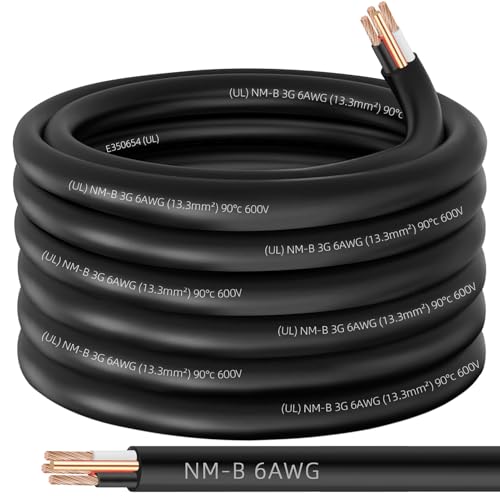
The cable for a 50 A kiln circuit
6 AWG copper, three conductors plus ground, which covers a 50 A kiln circuit at the 60°C column. Most kilns only use two hots and ground; 6/2 would do, but 6/3 is what is usually stocked. Confirm the length and size with the electrician before ordering.
Receptacle types: NEMA 6-50, 6-30, 6-20
| Receptacle | Rating | Wiring | Kilns | How to recognize it |
|---|---|---|---|---|
| NEMA 6-15 | 15 A, 250V | 2 hot + ground, 3 wire | Small 240V kilns under 12 A nameplate | Two horizontal slots plus round ground |
| NEMA 6-20 | 20 A, 250V | 2 hot + ground, 3 wire | 240V kilns up to 16 A nameplate | One horizontal and one T-shaped slot; accepts 6-15 plugs too |
| NEMA 6-30 | 30 A, 250V | 2 hot + ground, 3 wire | 240V kilns up to 24 A nameplate | Slot pattern unique to 30 A, 250V, plus ground; the small studio kiln plug |
| NEMA 6-50 | 50 A, 250V | 2 hot + ground, 3 wire | 240V kilns up to 40 A nameplate; some 48 A kilns, where the manual specifies it | Two larger vertical slots plus ground. The welder plug; most mid-size kilns ship with a 6-50P cord |
| Direct wire | Sized to the kiln | 2 hot + ground, in conduit or cable | Some larger kilns, when the manual specifies it | No plug. The cable lands in a disconnect or junction box |
The kiln nameplate column applies the 80 percent rule to the receptacle rating: a 50 A receptacle serves a kiln up to 40 A, a 30 A receptacle up to 24 A, a 20 A receptacle up to 16 A. Normally the receptacle rating matches the circuit. Kilns rated above 40 A land in an awkward zone where the 60 A circuit they need outranks the 50 A receptacle, and manufacturers handle it differently: Skutt lists its 48 A KM-1027 with a 6-50 receptacle on a 60 A breaker, while some other large kilns are direct wired. The manual and your local inspector settle it for your model. All of the 6-series receptacles are 250V, two hots and a ground. The four-wire NEMA 14-50 on ranges and EV chargers adds a neutral the kiln does not use, and the plugs are not interchangeable, so do not let a “50 amp outlet” be installed without saying which one.
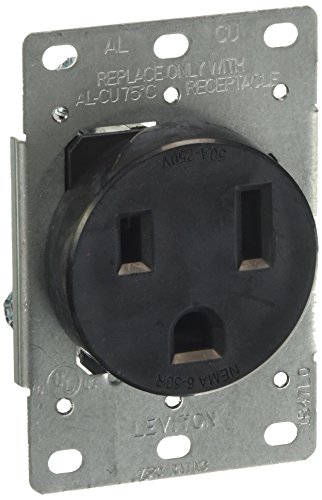
The standard kiln receptacle
Most CommonThe 6-50R that most mid-size 240V kilns plug into. Flush mount, industrial grade, two hots plus ground. Pair it with a 50 A two-pole breaker and 6 AWG copper.

For kilns up to 24 A
The smaller studio kiln receptacle: 30 A on a 30 A two-pole breaker with 10 AWG copper. Only for kilns whose manual specifies a 6-30P plug and a nameplate of 24 A or less.
Why a kiln needs its own circuit
A kiln draws close to its nameplate for hours on a circuit that already has only 20 percent of headroom, so a second load on the same breaker means nuisance trips at best and hot conductors at worst. A breaker that trips five hours into a glaze firing ruins the load. And every major manufacturer requires a dedicated circuit, so an installation that ignores the manual risks the warranty. Extension cords are out for the same reason; the kiln's own cord is the only cord in the circuit.
Distance from walls and clearances
A firing kiln radiates heat from its jacket for the whole schedule. Manufacturers typically specify a minimum of 12 inches (Paragon, for its small kilns) to 18 inches (Skutt) between the kiln and any wall or combustible surface, on all sides including behind the control box and above the lid. The floor should be concrete, tile, or another non-combustible surface, never carpet or a wood deck. Leave room under the kiln for a downdraft vent and a clear path to the receptacle and the breaker. The manual's clearance table overrides these typical figures.
The checklist to hand an electrician
Bring this list, the kiln manual, and a photo of the nameplate. It turns a vague “I need an outlet for a kiln” into a scope the electrician can quote in one visit.
- Kiln make and model, and a photo of the nameplate: volts, phase, amps, watts.
- The exact receptacle or direct-wire method the manual specifies (for example NEMA 6-50R), and the cord length the kiln ships with.
- Breaker size: kiln amps × 1.25, rounded up to the next standard size. Confirm the panel brand so the two-pole breaker matches.
- Copper conductor size for that breaker at the 60°C column if NM-B cable is used, or the 75°C column for THHN in conduit, and the run length so voltage drop can be checked.
- A dedicated circuit: nothing else on it, no shared neutral, no extension cords, no adapters.
- Where the kiln will sit: distance to the panel, whether the wall is finished, and whether the run is through attic, crawlspace, or surface conduit.
- Whether the panel has two adjacent free slots and enough service capacity for the added load, or needs a subpanel or service upgrade.
- Clearance: the manual's minimum distance from walls and combustibles (Paragon lists 12 inches for its small kilns, Skutt 18 inches for its kilns), plus space for a downdraft vent.
- A 120V outlet nearby for the vent motor and the controller if the kiln uses a separate plug for it.
- Ask for the permit and inspection. It protects the warranty and the homeowner's insurance.
Once the circuit is in, the operating questions move to the kiln itself: what cone to fire to is in the kiln cone temperature chart, why fired work comes out smaller is in the clay shrinkage and absorption chart, the kilns worth the circuit are in the best kilns guide, and the wheel to feed the kiln is priced in how much does a pottery wheel cost and compared in the best pottery wheels guide.
Frequently asked questions
What size breaker do I need for a kiln?
Multiply the amps on the kiln's nameplate by 1.25 and round up to the next standard breaker size. Kilns fire for more than three hours, which makes them a continuous load under the National Electrical Code, and NEC 210.19 and 210.20 require the circuit to be rated at least 125 percent of a continuous load. A 24 amp kiln needs a 30 amp breaker; a 40 amp kiln needs 50; a 48 amp kiln, such as Skutt's published rating for the KM-1027 on 240V single phase, needs 60. Your kiln manual states the required breaker; follow it and have a licensed electrician confirm.
Do kilns run on 120V or 240V?
Both exist, but they are different products. Kilns up to about 1,800 watts run on a standard 120V household outlet; the Paragon SC2, for example, is rated 1,680 W at 14 amps. Every kiln large enough to fire a load of pottery runs on 240V single phase and needs its own two-pole circuit. Schools and commercial buildings often have 208V rather than 240V, and the kiln must be ordered with elements for that voltage.
What wire gauge does a kiln need?
It depends on the breaker, the cable type, and the run length. From NEC Table 310.16 for copper: a 20 amp circuit uses 12 AWG, 30 amp uses 10 AWG, 40 amp uses 8 AWG, 50 amp uses 6 AWG, and 60 amp uses 6 AWG THHN in conduit at the 75°C column or 4 AWG if NM-B cable is used, because NM-B is limited to the 60°C column where 6 AWG is rated only 55 amps. Long runs need a size larger to keep voltage drop down. The electrician makes the final call.
What outlet does a kiln use?
Most mid-size 240V kilns ship with a NEMA 6-50P plug and need a 6-50R receptacle, the same one used for welders. Smaller 240V kilns use NEMA 6-30 or 6-20. All three are 250V, three-wire receptacles with two hots and a ground and no neutral. Do not confuse the 6-50 with the four-wire NEMA 14-50 used for ranges and EV chargers; the plugs do not interchange. Kilns above 40 amps vary: Skutt lists its 48 amp KM-1027 with a 6-50 receptacle on a 60 amp breaker, while some other large kilns are direct wired. The manual specifies which.
Does a kiln need its own circuit?
Yes. A kiln draws close to its full rated current for hours, so anything else on the same circuit pushes the total past what the breaker and wire are rated for. Kiln manufacturers require a dedicated circuit, and the NEC's continuous-load rule already sizes that circuit with only the kiln in mind. The vent motor and controller, if separately plugged, go on an ordinary 120V outlet.
Can I plug a kiln into a dryer outlet?
Usually not, and not without an electrician looking at it. A dryer outlet is typically 30 amps on a NEMA 10-30 or 14-30 receptacle, which has a neutral a kiln does not use, and the 30 amp rating only suits a kiln of 24 amps or less. Adapters that change the plug do not change the breaker or the wire behind it. If the kiln's nameplate is under 24 amps and the manual allows a 6-30, an electrician can often replace the receptacle and confirm the circuit; otherwise it is a new circuit.
What is the difference between single phase and three phase for kilns?
Single phase is what homes have: two hot conductors 240V apart. Three phase, found in commercial buildings, uses three hot conductors and delivers the same power at lower current per conductor, which is why large studio kilns are offered in three-phase versions. The same kiln model has different element wiring for each, so a single-phase kiln cannot be moved onto three-phase service by changing the plug. Order for the service you have.
How far should a kiln be from the wall?
Follow the manual. Kiln manufacturers specify a minimum distance from any wall or combustible surface, usually 12 to 18 inches (Paragon lists 12 inches for its small kilns; Skutt specifies 18 inches for its kilns), on all sides including behind the control box, plus clearance above for the lid and for a downdraft vent under the kiln. The floor should be concrete or another non-combustible surface. The clearance is about the heat the kiln jacket radiates for hours, not about the wiring.
This page describes typical requirements for reference. It is not an electrical design. Your kiln's manual, the current edition of the National Electrical Code as adopted in your jurisdiction, and a licensed electrician govern every installation. Austin Gallery is an Amazon affiliate; product links are affiliate links and we may earn a commission at no cost to you. Prices verified September 8, 2026. See our full affiliate disclosure.