Reference · Updated August 2026
Clay shrinkage and absorption rates
What named commercial clay bodies actually shrink and absorb, straight from the makers' published specs, plus the 10 cm test-bar method with the arithmetic worked through so you can measure your own.
By the Austin Gallery editors · Updated August 2026
Most pottery clay shrinks about 11% to 15% from wet to fired, with porcelain at the top of the range and earthenware fired cool at the bottom. Laguna publishes 14.75% for its #550 cone 10 porcelain; Standard Clay publishes 12.5% for its 306 stoneware at cone 6; Standard's 104 red earthenware shrinks just 6.0% at cone 06. There is no universal figure, because shrinkage is a property of a specific body at a specific cone. The practical rule for sizing is one line of arithmetic: throw size = finished size ÷ (1 minus shrinkage), so a 12 inch platter in a 12% body starts at 13.64 inches, not 13.44.
Shrinkage and absorption by clay body
Every number in this table is the manufacturer's own published figure for that named body at that cone. They are not universal constants and they are not interchangeable between brands. Where a body is rated across a range, both ends are listed, because the same bag of clay produces different numbers depending on how hard you fire it.
| Clay body (manufacturer) | Type | Fired to | Shrinkage | Absorption |
|---|---|---|---|---|
| Standard Clay 104 Red with Grog | Earthenware | Cone 06 | 6.0% | 12.0% |
| Standard Clay 104 Red with Grog | Earthenware | Cone 4 | 11.0% | 2.0% |
| Standard Clay 417 Red Earthenware | Earthenware | Cone 04 | 11.0% | 3.5% |
| Standard Clay 417 Red Earthenware | Earthenware | Cone 02 | 12.0% | 1.4% |
| Laguna B-Mix 5 (WC401) | Stoneware | Cone 5 | 12% | 2.3% |
| AMACO No. 38 White Stoneware | Stoneware | Cone 5 | 13% | 7% |
| Standard Clay 378 Speckled | Stoneware | Cone 6 | 11.5% | 4.0% |
| Standard Clay 306 Stoneware | Stoneware | Cone 6 | 12.5% | 2.0% |
| Standard Clay 551 V.P. Porcelain | Porcelain | Cone 6 | 13.0% | 0.3% |
| Laguna B-Mix 10 (WC379) | Stoneware | Cone 10 | 13% | 1% |
| Standard Clay 378 Speckled | Stoneware | Cone 10 | 13.0% | 1.0% |
| Standard Clay 306 Stoneware | Stoneware | Cone 10 | 14.0% | 0.5% |
| AMACO No. 38 White Stoneware | Stoneware | Cone 10 | 15% | 1.4% |
| Laguna #550 Porcelain (WC631) | Porcelain | Cone 10 | 14.75% | 0.3% |
Published specs, attributed to their source: Standard Clay 104, 417, 306, 378, 551 V.P. Porcelain; Laguna B-Mix 5, B-Mix 10, #550 Porcelain; AMACO No. 38 White Stoneware. Manufacturers publish these as averages and some state a tolerance; treat them as the starting point for your own test, not as a guarantee.
Typical ranges by clay type
| Clay type | Shrinkage | Absorption | What it means |
|---|---|---|---|
| Earthenware, fired in its own low-fire range | 6.0% to 12.0% | 1.4% to 12.0% | Absorption falls fast as an earthenware body is pushed up its range. Standard 104 goes from 12.0% absorption at cone 06 to 2.0% at cone 4. |
| Mid-range stoneware at cone 5 to 6 | 11.5% to 13% | 2.0% to 7% | The wide absorption spread is the story: a body rated cone 5-10 is not necessarily mature at cone 5. |
| High-fire stoneware at cone 10 | 13% to 15% | 0.5% to 1.4% | More shrinkage than mid-range, and near-vitrified. |
| Porcelain at its rated cone | 13.0% to 14.75% | 0.3% | The most shrinkage and the least absorption of anything in the table. |
These ranges are the spread across the specific named bodies in the table above, not a survey of all clay. A body outside these ranges is not necessarily wrong; it is a different formulation. For a separate, independently sourced view of the firing step alone, Digitalfire gives typical dry-to-fired shrinkage as roughly 3-4% or less for earthenwares, 5-6% for stonewares, 7-8% for whitewares and above 10% for vitreous porcelains. Note those are dry-to-fired figures, so they are not comparable to the wet-to-fired totals manufacturers publish.
The three stages: wet, leather-hard, bone dry, fired
Clay shrinks twice, for two different reasons, and knowing which is which explains most cracking.
Drying shrinkage happens between wet and bone dry. Water sits between the clay particles; as it leaves, the particles pull together and the piece gets smaller. Leather-hard is the midpoint of this stage, firm enough to trim and handle but still losing water, and it is where most of the risk lives, because if one part of a piece dries faster than another it shrinks faster too and something has to give. Bone dry is the end of it: a bone-dry pot has stopped shrinking and will not shrink again until it is fired.
Firing shrinkage happens in the kiln, and it is a different mechanism entirely. Digitalfire describes it as the matrix densifying: the body begins to form glass, the particles fuse, the open pores close, and the piece contracts again. This is also, not coincidentally, the same process that drives absorption down. Shrinkage and vitrification are two readings of one event.
The reason this matters commercially is simple. Total shrinkage decides what size to make things, and the bigger the piece the bigger the error: a 3% miscalculation on a mug is invisible, and the same 3% on a 20 inch platter is more than half an inch. It also decides whether a lid fits a jar after both have shrunk, whether a tile fits its grid, and whether a set of bowls nests.
How to measure your own clay's shrinkage
This is the standard test and it costs almost nothing. Do it once per clay body per cone you fire, keep the bars, and label them.
- Roll a flat bar of clay at your normal working wetness. Ceramic Arts Network suggests roughly 14 by 4 by 0.7 centimeters; Digitalfire's protocol rolls bars to 3/8 inch thick and cuts them 4¼ by 1 inch. Either works. Make three, not one, so you can average and so a single warped bar does not decide your studio math.
- Scribe a line exactly 10 cm long down the middle, with a crisp mark at each end. Digitalfire uses a metal template that stamps two impressions whose outer edges are exactly 10 cm apart. A steel rule and a needle tool are fine. The 10 cm is the whole trick: it makes the arithmetic trivial later.
- Dry the bars slowly and evenly to bone dry, then measure the line again and write it down.
- Fire the bars to the cone you actually fire at, standing them at an angle rather than flat on the shelf, with a witness cone. Measure the line one last time.
The arithmetic, worked through
Say a bar goes 10.0 cm wet, 9.4 cm bone dry, 8.8 cm fired. Because the line started at 10 cm, every 0.1 cm lost is 1%, which is the shortcut Ceramic Arts Network gives: subtract the measured length from 10 and divide by 0.1.
If your three bars disagree by more than a few tenths of a percent, something in the process varied, usually wetness at the time of marking or an uneven dry. Average them and move on, but a wide spread is itself worth noticing.
What the test actually needs
None of this is expensive, and a caliper plus a gram scale covers both tests. Affiliate links, so we may earn a commission at no cost to you.
 General Tools 147 Digital Caliper (0 to 6 in, metric and imperial)The right tool for reading a test bar. Digitalfire's protocol calls for measuring fired bars to 0.1 mm, which a tape measure cannot do and a caliper can.View on Amazon →
 Etekcity 0.1 g Digital ScaleAbsorption is a weight test, not a length test. You need dry weight and soaked weight to a tenth of a gram.View on Amazon →
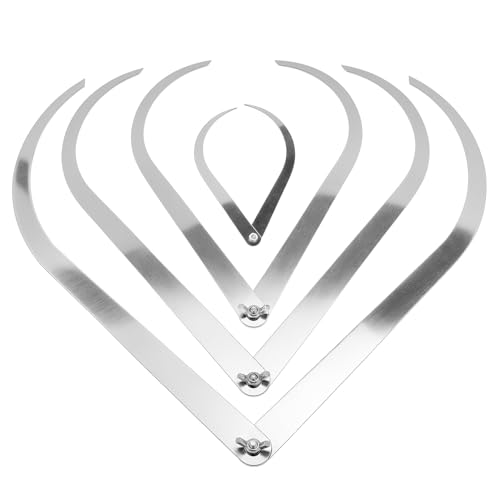 QWORK Bent-Leg Pottery Calipers, 4-Piece SetBent-leg calipers transfer an inside diameter to an outside one, which is how you match a lid to a jar that will both shrink.View on Amazon →
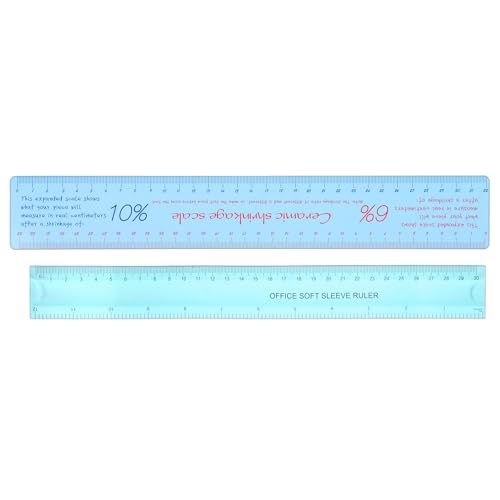 Ceramic Shrinkage Scale Rulers (2-Pack)A shrink ruler is pre-stretched by a fixed percentage so you can measure the wet piece and read the fired size directly. Only useful if its percentage matches your tested body, so test first.View on Amazon →
 AMACO No. 38 White Stoneware, 50 lbThe cone 5-10 body in the table above: 13% shrinkage and 7% absorption at cone 5, 15% and 1.4% at cone 10, per AMACO's own spec.View on Amazon →
 Laguna #550 Porcelain, Cone 10The highest shrinkage in our table at 14.75%, and 0.3% absorption. Beautiful, translucent, and unforgiving about sizing.View on Amazon →
 AMACO Low Fire Terra Cotta No. 77, 50 lbA low-fire earthenware for practicing the test on a body that stays porous, where absorption matters most for what you can make with it.View on Amazon →
Sizing your work: the platter example
Here is the question the whole page exists to answer. You want a finished platter 12 inches across. Your clay tested at 12% total shrinkage. How wide do you throw it?
The formula
Wet size = finished size ÷ (1 - shrinkage)
12 ÷ (1 - 0.12) = 12 ÷ 0.88 = 13.64 inches. Throw the rim at about 13 5/8 inches wet and it comes out of the glaze firing at 12.
The mistake almost everyone makes first is adding the percentage instead of dividing: 12 × 1.12 = 13.44 inches, which fires down to 11.8 and leaves you a fifth of an inch short. The percentage is taken off the wet size, so you have to work backward from the finished one. On a mug the difference is invisible. On a platter, or on a lid that has to seat, it is the difference between a set and a pile of seconds.
| Your clay's shrinkage | Throw at (decimal) | Throw at (nearest 1/16) |
|---|---|---|
| 10% | 13.33 in | 13 5/16 in |
| 11% | 13.48 in | 13 1/2 in |
| 12% | 13.64 in | 13 5/8 in |
| 12.5% | 13.71 in | 13 3/4 in |
| 13% | 13.79 in | 13 13/16 in |
| 14% | 13.95 in | 14 in |
| 14.75% | 14.08 in | 14 1/16 in |
| 15% | 14.12 in | 14 1/8 in |
Wet dimensions for a 12 inch finished piece, calculated as 12 ÷ (1 - shrinkage) and rounded. Fractions are rounded to the nearest sixteenth for practical use at the wheel. Substitute your own tested percentage rather than borrowing one.
Two footnotes from actual practice. Trimming removes clay after you have measured, so measure the rim after trimming, not before. And bent-leg calipers exist precisely for the lid-and-jar problem: set them on the wet gallery, transfer to the wet lid, and both shrink at the same rate so the fit survives the kiln. Shrink rulers work on the same principle, pre-stretched by a set percentage so the wet measurement reads as the fired size, but they only help if the ruler's percentage matches your tested body.
A body with published numbers at both ends of its range
Test ThisAMACO publishes 13% shrinkage and 7% absorption at cone 5, and 15% and 1.4% at cone 10. One bag, two very different pots, which makes it the clearest illustration of why the cone you fire to is part of the spec.
Absorption and vitrification: the companion number
Shrinkage tells you what size to make things. Absorption tells you whether the thing you made actually works. It is the percentage of its own dry weight that a fired piece takes up in water, and it is the direct read on vitrification, the point at which enough glass has formed in the body to close the pores.
Writing in Ceramics Monthly, Dave Finkelnburg cites the USITC definition of stoneware as a fired ceramic that can absorb no more than 3% of its dry weight of water, measured by ASTM test C373, and states flatly that vessels made of underfired clays will leak. He gives the other boundary too: stoneware fired to significantly less than 1.5% water absorption is likely overfired, which is where slumping and bloating start. So for functional stoneware there is a usable window rather than a single target, roughly 1.5% to 3%.
The clearest illustration in our table is AMACO's No. 38 White Stoneware. AMACO rates it cone 5 to 10 and publishes 7% absorption at cone 5 and 1.4% at cone 10, while noting best results at cone 10. Fired at the bottom of its own stated range, that body is nowhere near the 3% functional standard: a mug made from it and fired to cone 5 is a porous mug wearing a glaze. The clay is not the problem; the cone is. This is why the cone you actually reach, not the one on the controller display, is the number that decides whether a pot is finished.
How to test absorption
Weigh a fired, unglazed test bar dry, get it thoroughly wet, and weigh it again. Absorption is the weight gained divided by the dry weight, times 100. The two published protocols differ in how aggressively they saturate the bar, and it is worth knowing which one produced any number you are comparing against.
- Boil method. Digitalfire boils the bars steadily for 5 hours, then soaks them for 19 hours before the final weighing, and calculates absorption as boiled weight minus fired weight, divided by fired weight, times 100. This is the closer analogue to the ASTM standard and gives the more complete number.
- Soak method. Richard Zakin and Frederick Bartolovic, in Electric Kiln Ceramics, immerse an unglazed tile of 2 by 2 inches or larger for 24 hours or more, sponge off the surface water, and reweigh: immersed weight minus original weight, divided by original weight, times 100. Their worked example takes a tile from 9.4 to 9.8 grams for 4.2% absorption.
A simple soak will generally read lower than a boil, because boiling drives water into pores that a cold soak leaves as trapped air. If you are comparing your result against a manufacturer's published spec, the manufacturer almost certainly used a standardized boil-based test, so use the boil method for a fair comparison and treat a soak number as a fast indicator rather than a match.
Free to use
Put this shrinkage chart on your site
Teaching a ceramics class or running a studio blog? Copy the snippet below to embed the summary chart. It is self-contained and renders anywhere. The only ask is that you keep the small credit link back here.
Click inside the box, select all (⌘A / Ctrl-A), and copy.
Sources
- Standard Clay Company product pages for bodies 104, 417, 306, 378 and 551 V.P. Porcelain. Published shrinkage and absorption at each rated cone.
- Laguna Clay & Glaze Co. product pages for #550 Porcelain (WC631), B-Mix 5 (WC401) and B-Mix 10 (WC379).
- AMACO, White Stoneware No. 38. Shrinkage and absorption published at both cone 5 and cone 10.
- Digitalfire, SHAB Shrinkage/Absorption Test and Firing Shrinkage. Test-bar protocol, the 10 cm marking template, the boil-and-soak absorption procedure, the firing-shrinkage formula, and the note that drying and firing percentages cannot be added.
- Dave Finkelnburg, “Techno File: Stoneware Maturity,” Ceramics Monthly. The USITC 3% stoneware definition via ASTM C373, and the overfiring threshold below 1.5%.
- Richard Zakin with Frederick Bartolovic, “Techno File: Testing Clay Bodies,” Ceramics Monthly, adapted from Electric Kiln Ceramics (The American Ceramic Society). Test tile dimensions, the 10 cm line shortcut, and the soak-method absorption formula.
Questions
How much does clay shrink?
Across the named clay bodies in the chart on this page, total shrinkage from wet to fired runs about 11% to 15% for stoneware and porcelain fired at their rated cone, and as little as 6% for an earthenware fired at the cool end of its range. Porcelain shrinks the most: Laguna publishes 14.75% for its #550 cone 10 porcelain. There is no universal number, because shrinkage belongs to the specific clay body, so use your supplier's published spec or test your own bar.
How much does clay shrink from wet to dry?
Drying shrinkage is the first half of the total and is usually the larger single step. It happens as the water between clay particles leaves and the particles pull together, and it is finished by the time the piece is bone dry. Manufacturers publish total shrinkage rather than a drying-only figure, which is why measuring your own bar at all three stages, wet, bone dry, and fired, tells you something the spec sheet does not.
How do I calculate clay shrinkage?
Mark a line exactly 10 cm long on a wet test bar, dry it, fire it, then measure the line again. Ceramic Arts Network gives the shortcut: subtract the fired length in centimeters from 10, then divide by 0.1 to get the percentage. Because the line started at 10 cm, every 0.1 cm lost equals 1% shrinkage, so a line measuring 8.8 cm means 12% total shrinkage.
What size do I throw a 12 inch platter?
Divide the finished size by 1 minus the shrinkage, expressed as a decimal. At 12% shrinkage that is 12 divided by 0.88, which is 13.64 inches, so throw it at about 13 5/8 inches. Do not add 12% to 12 inches: that gives 13.44 and comes out small, because the percentage is taken off the wet size, not added to the fired one.
What is clay absorption and why does it matter?
Absorption is the percentage of its own dry weight that a fired piece soaks up in water, and it is the practical measure of whether the clay actually vitrified. Writing in Ceramics Monthly, Dave Finkelnburg cites the USITC definition of stoneware as a fired ceramic that absorbs no more than 3% of its dry weight of water, tested by ASTM C373, and notes that vessels made of underfired clays will leak. Absorption, not shrinkage, is what tells you a mug will hold coffee for a decade.
What absorption percentage should my pots be?
For functional stoneware, below 3% is the commonly cited standard, per the USITC definition Finkelnburg quotes in Ceramics Monthly. He also flags the other end: stoneware fired to significantly less than 1.5% water absorption is likely overfired, and risks slumping or bloating. Porcelain sits far lower again, with both Laguna and Standard publishing 0.3% for their porcelain bodies. If your body is at 5% when its label says cone 10, Finkelnburg's point applies: it will be relatively weak and will likely leak.
Why do my clay body's numbers differ from another potter's?
Because shrinkage and absorption are properties of a specific formulated body at a specific cone, not of clay in general. Standard Clay's 306 stoneware is 12.5% shrinkage and 2.0% absorption at cone 6, and 14.0% and 0.5% at cone 10: the same bag of clay, two different sets of numbers, decided entirely by how hard you fire it. On top of that, your heat work differs from theirs, which is the subject of our cone chart.
Is the shrinkage formula the same everywhere?
For total wet-to-fired shrinkage, yes: everyone divides the change in length by the original wet length. For the firing-only step, sources genuinely differ on the divisor. Digitalfire publishes firing shrinkage as the dry length minus the fired length divided by the fired length, while the common studio method divides by the dry length. Digitalfire also notes something worth knowing either way: you cannot simply add drying and firing percentages to get total shrinkage, because they have different starting points. Measure the wet bar and the fired bar directly and you avoid the argument entirely.
Are these affiliate links?
Some are. Austin Gallery is an Amazon affiliate, so if you buy through a product link here Amazon pays us a small commission at no extra cost to you. Every shrinkage and absorption figure on this page comes from the clay manufacturer that publishes it, and is attributed to that manufacturer by name. See our full affiliate disclosure.
Keep reading
- The kiln cone temperature chart: the companion reference. Absorption is decided by heat work, so the cone you actually reach is half of every number on this page.
- The best kilns for pottery, glass and ceramics: reaching cone 10 reliably is a hardware question before it is a technique question.
- The best pottery wheels: where the wet dimension gets set in the first place.
- Gifts ceramicists actually use: calipers and a decent scale are on the short list.
- Pottery classes in Austin: a studio has already tested its house clay, which is a real shortcut.
All shrinkage and absorption percentages are the published specifications of the manufacturer named beside them (Standard Clay Company, Laguna Clay & Glaze Co., AMACO) and apply to that body at that cone only. They are averages, not guarantees, and they will not transfer to a different brand's clay. Test method, formulas and the boil-based absorption procedure follow Digitalfire and Ceramics Monthly as cited above; where sources give different formulas, both are shown rather than averaged. Compiled by the Austin Gallery editors, August 2026. Austin Gallery may earn a commission from product links on this page at no cost to you.