Key Takeaways
- Yosl Bergner was one of Israel's most important painters, exploring themes of displacement, memory, and cultural identity
- Born in Vienna, raised in Melbourne, settled in Tel Aviv — his life journey deeply informed his artistic vision
- Bergner's work commands strong prices at auction, particularly his figurative and still life paintings
In the constellation of 20th-century Jewish artists, Yosl Bergner occupies a distinctive position. Born in Vienna, raised in Warsaw, an immigrant to Melbourne during the war years, and finally a long-term resident of Israel, Bergner lived a life marked by displacement and survival. His paintings and prints—suffused with Jewish folklore, surreal imagery, and deep melancholy—bear witness to the upheavals of modern history.
In This Article
His art carries symbolism, humanity, and dream-like narrative—a voice shaped by history and resilience.
A Childhood in Motion
Yosl Bergner was born in 1920 in Vienna, Austria, into a family steeped in Yiddish literary culture. His father, Melech Ravitch, was one of the most important Yiddish poets of the 20th century. This literary heritage would profoundly influence Bergner's own artistic development.
Yosl Bergner was born in 1920 in Vienna, Austria, into a family steeped in Yiddish literary culture.
The family soon moved to Warsaw, Poland, where Bergner spent his childhood immersed in the vibrant Yiddish-speaking Jewish culture of interwar Poland. This world—the shtetl life, the traditions, the community—would provide the imagery and emotional vocabulary for much of his later work.
But this world was also under threat. As the political situation in Europe deteriorated, Bergner's father arranged for him to emigrate to Australia in 1937. The young artist would never see Warsaw again; most of the Jewish community he left behind would perish in the Holocaust.
The Melbourne Years
In Melbourne, Bergner found both refuge and artistic community. He quickly became involved with other immigrant artists and intellectuals, forming connections that would support his development as a painter.
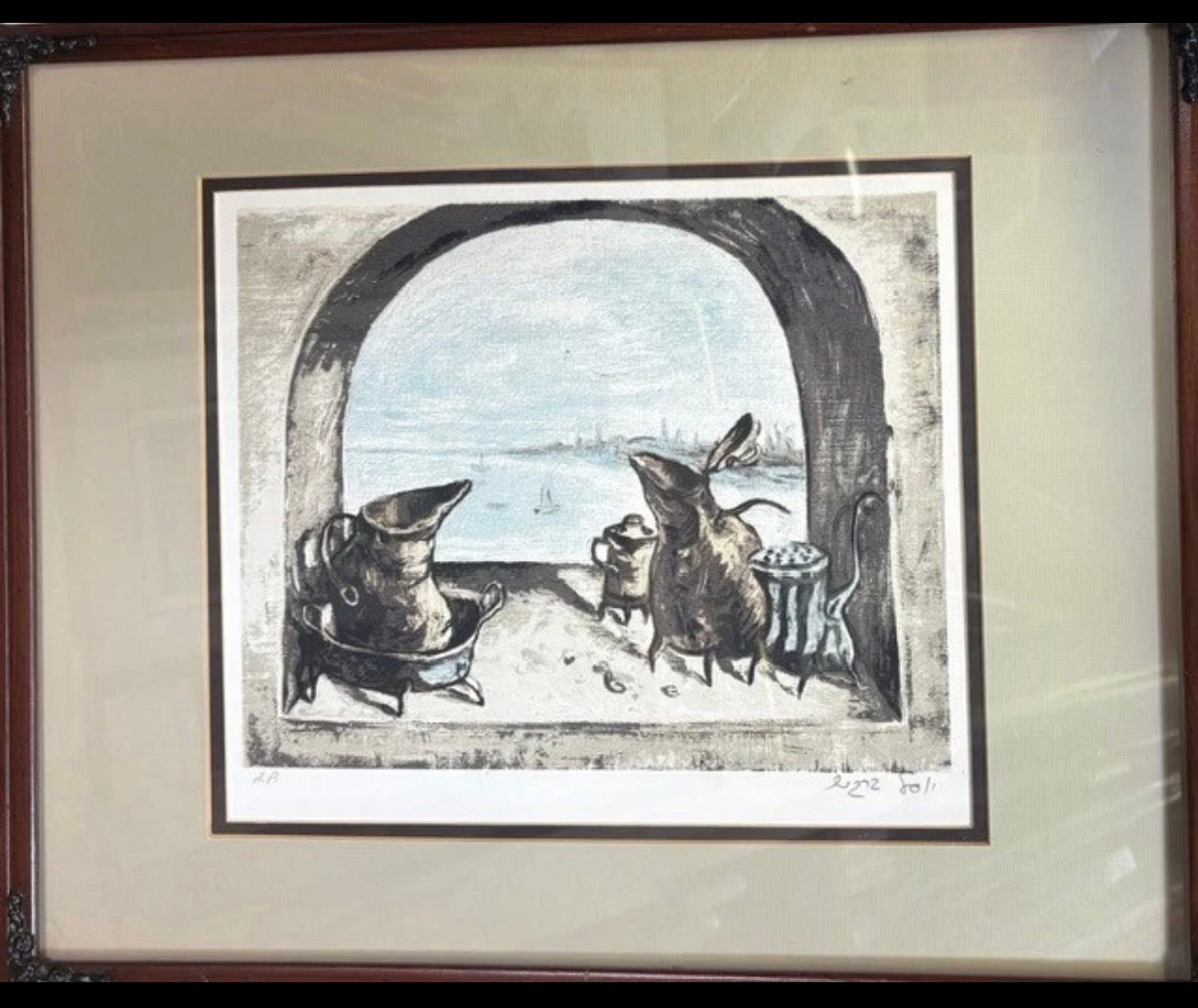 Serigraph by Yosl Bergner (c. 1970). Available in our collection.
The National Gallery of Victoria holds Bergner's work from this period, including the painting "House backs, Parkville" (c. 1938), now part of the Joseph Brown Collection. These early Australian works show a young artist grappling with new landscapes while carrying the weight of European memory.
Australia during the war years was far from the conflict, but news of the destruction of European Jewry reached the immigrant community. For Bergner, knowing that the world of his childhood was being systematically destroyed must have shaped everything he painted.
Understanding Modern Jewish Art
Israel and Artistic Maturity
In 1950, Bergner emigrated to Israel, where he would spend the rest of his life. In the new Jewish state, he found a community of artists similarly engaged with questions of Jewish identity, memory, and survival.
His Israeli work developed the surrealist tendencies that had begun to emerge in Melbourne. Figures float through dreamlike spaces. Objects carry symbolic weight. The shtetl life of his childhood—now utterly destroyed—reappears as memory and imagination.
These paintings are not nostalgic in any simple sense. They acknowledge the impossibility of return while insisting on the importance of remembrance. The floating figures and dislocated objects suggest displacement as an ongoing condition, not just a historical event.

Visual Language: Symbolism and Dream
Bergner's mature style blends elements of surrealism, expressionism, and folk art. His imagery draws on Jewish folklore—the golem, the wandering figures of Chagall-like fantasy—while remaining distinctly his own.