Key Takeaways
- Oscar de Mejo brought a European eye to American folk scenes, creating naive paintings of historical and everyday subjects
- His work has appeared in The New Yorker and is collected by institutions including the Museum of American Folk Art
- De Mejo's whimsical, colorful style makes his work accessible to both new and seasoned collectors
When Oscar de Mejo arrived in America as an Italian immigrant with degrees in Law and Political Science, few would have predicted that he would become one of the most beloved naive artists of the 20th century. Yet his colorful, whimsical paintings and lithographs—depicting Americana and European scenes with charm, wit, and an unmistakable personal vision—would find their way into major collections including the Whitney Museum and Brooklyn Museum.
De Mejo's art radiates joy. His scenes of dancing couples, village celebrations, and historical tableaux transport viewers to a world of simple pleasures and human connection.
From Trieste to America: An Unlikely Journey
Oscar de Mejo was born in 1911 in Trieste, Italy, a city that has historically straddled the boundary between Italian and Central European cultures. This cosmopolitan origin would later inform his art, which freely combines Italian folk traditions with American subject matter.
Oscar de Mejo was born in 1911 in Trieste, Italy, a city that has historically straddled the boundary between Italian and Central European cultures.
His early life took unexpected turns. De Mejo earned degrees in both Law and Political Science—hardly the typical training for an artist. After World War II, he emigrated to America, where he married the Italian film star Alida Valli and began building a new life.
Art had been his "constant obsession since boyhood," as he would later tell interviewers, but it was in America that this obsession found full expression.
The Naive Style: Sophisticated Simplicity
De Mejo's work belongs to the tradition of naive or folk art—a style characterized by apparent simplicity, flat perspective, and bold color. But the term "naive" can be misleading. De Mejo was a highly educated man who chose this style deliberately.
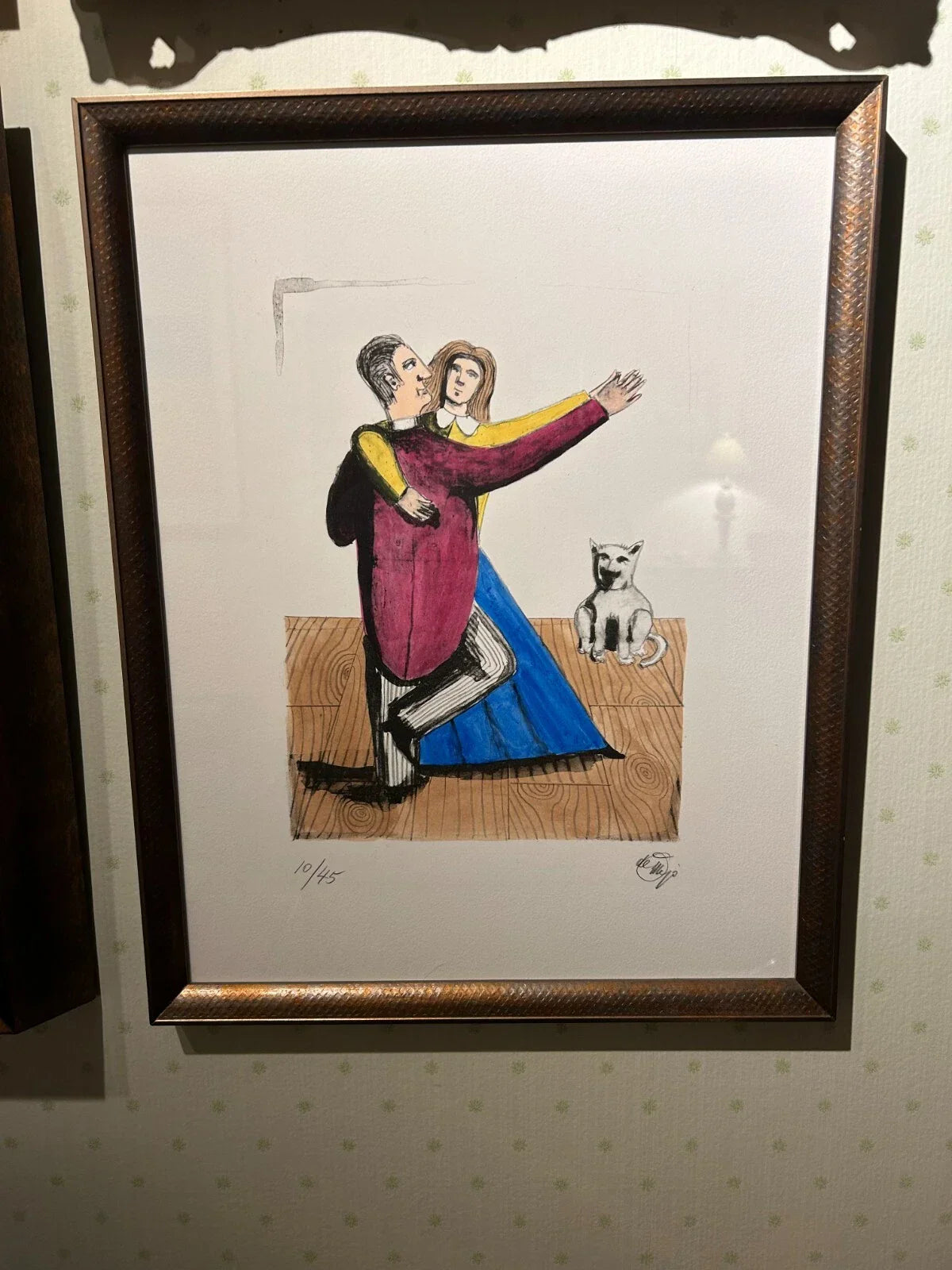 "Tango" - Hand-signed and numbered lithograph 10/45. Available in our collection.
What naive art offers is directness—a way of communicating that bypasses the complications of academic technique to speak directly to the viewer's emotions. De Mejo exploited this quality brilliantly, creating scenes that feel simultaneously childlike and wise.
His paintings often feature groups of figures engaged in communal activities: dancing, celebrating, working together. These crowd scenes, rendered in his characteristic flat perspective, create a sense of community and shared humanity.
Understanding Folk Art Traditions
The American Subject
Though born in Italy, de Mejo became a painter of American life. His subjects include Fourth of July celebrations, small-town gatherings, historical scenes from American history, and the everyday rituals of American community life.
This immigrant's-eye view of America gives his work a particular quality. De Mejo saw America freshly, without the weight of native-born familiarity. His celebrations of American life feel genuine rather than ironic, affectionate rather than critical.
Austin Art Insider
Free weekly guide to galleries, exhibitions & collecting in Austin.
His historical paintings—depictions of the American Revolution, Civil War, and other pivotal moments—combine historical research with whimsy. Soldiers march in orderly rows, cannons smoke, flags wave—all rendered with the flat perspective and bright colors of folk art.
The I Ching and Artistic Intuition
De Mejo was known for his interest in the occult, particularly the I Ching, the ancient Chinese book of divination. According to accounts, he even chose his art dealer, Ken Nahan, according to the I Ching's advice.
This spiritual dimension of his personality—the willingness to trust intuition and the irrational—connects to his artistic practice. Naive art, by definition, operates outside the rational systems of academic art training. It follows its own logic.
Museum Collections and Recognition
De Mejo's work has been recognized by major American museums. The Whitney Museum of American Art and the Brooklyn Museum both hold examples of his work in their permanent collections.
The Butler Institute of American Art has presented exhibitions of his work, and his paintings and prints continue to be sought by collectors who appreciate his unique vision.
Current exhibitions, including "AMERICA: Through the Heart and Eyes of Oscar De Mejo" at the Jamestown-Yorktown Foundation, demonstrate ongoing institutional interest in his work.
The Tango: Dance and Joy
The lithograph offered by Austin Gallery—"Tango"—exemplifies de Mejo's characteristic style and preoccupations. A dancing couple dominates the composition, their figures rendered with the bold lines and hand-applied color typical of his work.
A small dog observes the dancers—a whimsical detail that adds charm and humor. The limited edition of 45 prints is small by contemporary standards, ensuring relative rarity.
The limited edition of 45 prints is small by contemporary standards, ensuring relative rarity.
Caring for Original Prints
Collecting Oscar de Mejo
For collectors, de Mejo represents an opportunity to acquire museum-quality naive art at accessible price points. While major paintings can command significant prices at auction, lithographs like "Tango" remain within reach.
Factors to consider:
Edition Size: Smaller editions are generally more valuable.
Signature: De Mejo signed his prints in pencil.
Condition: Look for prints with clean margins and unfaded colors.
Subject Matter: Dancing scenes and Americana are particularly sought after.
Currently Available: Tango
Austin Gallery is pleased to offer "Tango," a hand-signed and numbered lithograph:
- Edition: 10/45
- Medium: Lithograph with hand-applied color
- Dimensions: 17 x 13.5 inches (image), 19 x 15.5 inches (framed)
- Condition: Very good
- Signed: Yes
- Framed: Yes, under plexiglass
- Price: $500
View this work in our collection →
Sources:
- Whitney Museum of American Art
- Brooklyn Museum Collections
- Butler Institute of American Art
- Jamestown-Yorktown Foundation
- MutualArt Biography Database
- Patinae Gallery Records
Naive Art
Art created by self-taught or academically untrained artists, characterized by a childlike simplicity, bold color, and unconventional perspective. Not to be confused with folk art, which is rooted in cultural tradition.
Consignment
Have Art You Want to Sell?
Free appraisals, zero upfront fees, nationwide service from Austin, Texas.