Austin Gallery
Artist Profiles12 min read

Burghild Eichheim-Keller: The German Modernist Who Mastered Geometric Abstraction

Discover Burghild Eichheim-Keller, the German modernist whose 1960s color serigraphs embody the refined precision of post-war geometric abstraction.

By Austin Gallery

Burghild Eichheim-Keller: The German Modernist Who Mastered Geometric Abstraction

Key Takeaways

  • Burghild Eichheim-Keller was a German Modernist who developed a distinctive geometric abstraction style
  • Her work reflects the Bauhaus tradition of merging art, design, and mathematical precision
  • Eichheim-Keller's paintings are gaining recognition among collectors of post-war European abstraction

In the landscape of post-war European abstraction, certain artists carved out distinctive territories through sheer technical mastery and unwavering commitment to their vision. Burghild Eichheim-Keller stands among these figures—a German artist whose color serigraphs from the 1960s represent some of the most refined examples of geometric abstraction produced during that transformative decade.

Her work embodies the intellectual rigor and formal discipline that characterized the best of mid-century European modernism, while maintaining a warmth and accessibility that sets her apart from more austere practitioners of the geometric tradition.


The Context: Post-War German Art Renaissance

To understand Burghild Eichheim-Keller's significance, we must first understand the extraordinary moment in which she emerged. The Germany of the late 1950s and early 1960s was undergoing a cultural rebirth. The devastation of war had left not only physical ruins but also an artistic void—the Nazi regime had branded modernist art as "degenerate," driving many of Germany's finest artists into exile or silence.

To understand Burghild Eichheim-Keller's significance, we must first understand the extraordinary moment in which she emerged.

As the Federal Republic rebuilt, a new generation of artists sought to reconnect with the modernist traditions that had been suppressed. They looked to the Bauhaus legacy, to international movements like Concrete Art, and to the emerging Zero Group in Düsseldorf, which proclaimed a new beginning—a "Zone Zero" that would clear away the debris of the past.

The Zero Group, founded in 1957 by Heinz Mack, Otto Piene, and later joined by Günther Uecker, declared in their 1963 manifesto: "Zero is silence. Zero is the beginning. Zero is round. Zero spins. Zero is the moon. The sun is Zero. Zero is white. The desert Zero." This spirit of radical renewal permeated German art circles.


Early Life and Artistic Formation

Burghild Eichheim-Keller was born in 1936 in Bad Urach, a picturesque spa town nestled in the Swabian Alps of southwestern Germany. This region, known for its natural beauty and long tradition of fine craftsmanship, would prove formative in shaping her aesthetic sensibilities.

Growing up in post-war Germany, Eichheim-Keller came of age during a period of intense cultural reconstruction. The Wirtschaftswunder—Germany's "economic miracle"—brought not only material prosperity but also a renewed appetite for contemporary art. Museums reopened, galleries flourished, and collectors sought works that represented Germany's reintegration into the international art world.

Eichheim-Keller trained in the rigorous German tradition, developing the technical precision that would become her hallmark. Unlike artists who worked spontaneously, allowing accident and gesture to guide their hands, she approached each composition with the methodical care of an architect or engineer.


The Serigraph Medium: Technical Excellence

Eichheim-Keller's choice of serigraph—also known as silk-screen printing—as her primary medium reveals much about her artistic philosophy. Unlike painting, which allows for spontaneous gesture and correction, serigraphy demands meticulous planning and precise execution.
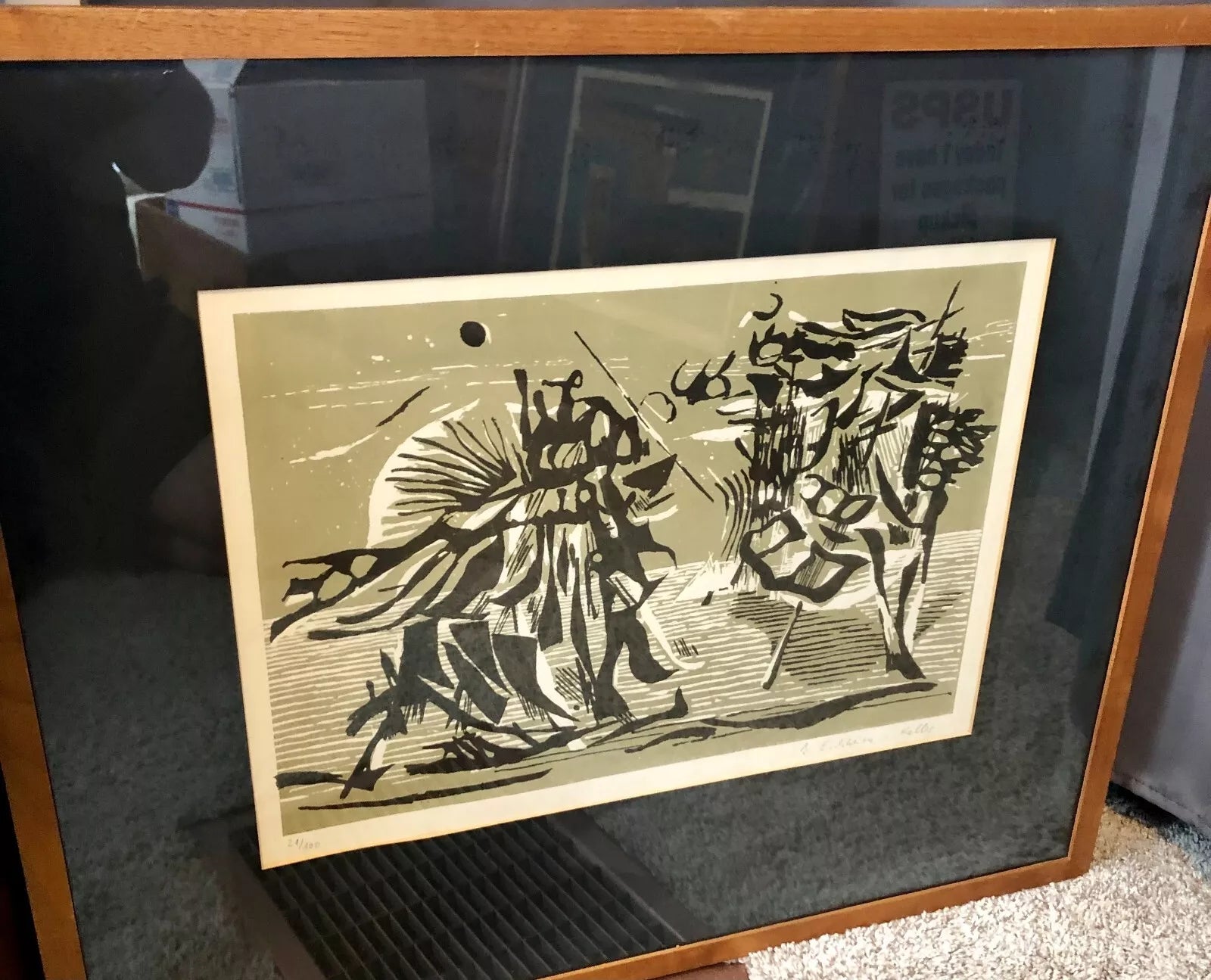
Abstract Geometric Composition by Burghild Eichheim-Keller "Abstract Geometric Composition" (1960s) - Signed and numbered color serigraph 21/100. Available in our collection.

The serigraph process requires creating separate screens for each color layer. For a print with five colors, the artist must prepare five screens, each precisely aligned with the others. The ink is pushed through fine mesh onto the paper below, building the image layer by layer. A single misregistration—the failure of one layer to align precisely with others—can ruin an entire print run.

This technically demanding medium suited Eichheim-Keller's temperament perfectly. Her prints reveal an almost mathematical precision in their construction, yet they never feel cold or mechanical. The slight variations inherent in hand-pulled prints give each impression its own subtle character.

The Printmaking Tradition

The serigraph medium has a distinguished history in 20th-century art. Andy Warhol would later make it famous for his Pop Art imagery, but European artists had been exploring its potential for geometric abstraction since the 1950s. Josef Albers, whose "Homage to the Square" series became perhaps the most celebrated exploration of geometric color relationships, worked extensively in print media.

Eichheim-Keller understood that prints offered something paintings could not: the ability to disseminate carefully conceived images to a broader audience while maintaining artistic control over each impression. Each print in an edition is not merely a copy but an original work, signed and numbered by the artist's hand.

Essential Tools for Collectors


The Visual Language: Form, Color, and Balance

What distinguishes Eichheim-Keller's work from other geometric abstractionists of her era is her particular sensitivity to color relationships. While many of her contemporaries worked in high-contrast palettes—bold primary colors against white or black grounds—Eichheim-Keller often employed more nuanced harmonies.

Austin Art Insider

Free weekly guide to galleries, exhibitions & collecting in Austin.

Her color choices tend toward the earthy and organic: olive greens, warm ochres, soft grays, and muted blues. These palettes give her geometric forms a warmth and approachability that more severe practitioners of the style often lack. The effect is contemplative rather than aggressive, inviting sustained attention rather than demanding immediate response.

The geometric forms themselves—circles, squares, triangles, and their various combinations and intersections—are arranged with careful attention to visual weight and spatial rhythm. Nothing in an Eichheim-Keller print feels arbitrary or accidental. Each element occupies its position through necessity, contributing to a whole that would be diminished by any addition or subtraction.

The Mathematics of Beauty

Eichheim-Keller's compositions often suggest underlying mathematical relationships without making them explicit. Unlike some geometric artists who worked from strict formulas—the golden ratio, the Fibonacci sequence—she seems to have relied on trained intuition, a sense of rightness developed through years of practice.

This intuitive approach distinguishes her from more programmatic abstractionists. The Swiss Concrete artists, for example, often derived their compositions from mathematical systems. Eichheim-Keller's work feels more human, more breathing, even as it maintains rigorous formal discipline.


Influences and Contemporaries

The 1960s saw an explosion of geometric abstraction across Europe and America. In Germany, the Zero Group was exploring light, movement, and monochrome. In France, the Nouvelle Tendance movement gathered artists committed to programmatic, often kinetic approaches. In America, Hard-Edge painters like Ellsworth Kelly and Frank Stella were reducing painting to its essential elements.

Eichheim-Keller absorbed these influences while developing her own voice. Her work shows awareness of Josef Albers's color studies—particularly his exploration of how colors interact and transform when placed adjacent to one another. The Bauhaus legacy, transmitted through Albers and others, informed her understanding of design principles and the relationship between art and craft.

Yet she remained distinctly European in sensibility, preferring the intimate scale and contemplative mood of the print to the monumental canvases favored by American abstractionists. Her work invites close viewing, rewarding attention to subtle relationships that might be lost in larger formats.

The Josef Albers Connection

No discussion of mid-century geometric abstraction can ignore Josef Albers, whose influence extended from his Bauhaus teaching through his decades at Yale. His "Homage to the Square" series, begun in 1950 and continued until his death in 1976, demonstrated how seemingly simple geometric arrangements could yield infinite complexity through subtle color modulation.

Eichheim-Keller clearly studied this work. Her prints share Albers's interest in color interaction—how adjacent colors influence perception, how warm and cool tones create spatial illusions of depth and recession. But where Albers maintained strict compositional formulas, Eichheim-Keller allowed herself greater variety, exploring asymmetrical arrangements and more complex geometric relationships.


The Market for Mid-Century Prints

For collectors, Eichheim-Keller's work represents an exceptional opportunity. While the most celebrated names of mid-century abstraction—Albers, Kelly, Stella—command prices well into six figures, work by artists like Eichheim-Keller remains accessible to collectors of more modest means.

This accessibility is not a reflection of quality but of art market dynamics. The major auction houses and blue-chip galleries have focused attention on a relatively small number of artists, leaving others equally accomplished but less promoted waiting to be discovered.

Factors that make Eichheim-Keller's prints attractive to collectors include:

Rarity: Edition sizes of 100 prints means relatively few impressions exist.

Quality: Technical excellence in printing and preservation of color vibrancy.

Historical significance: Documented participation in the mid-century geometric abstraction movement.

Aesthetic appeal: Work that rewards daily viewing and integrates well into contemporary interiors.


Caring for Works on Paper

Prints require specific conservation considerations. Unlike paintings on canvas, works on paper are particularly sensitive to environmental conditions.

Light: Limit exposure to direct sunlight and strong artificial light. UV-filtering glazing is essential.

Humidity: Maintain consistent humidity levels between 40-60%. Fluctuations cause paper to expand and contract, potentially leading to cockling or tears.

60%

Humidity: Maintain consistent humidity levels between 40

Framing: Use acid-free materials throughout. The mat, backing, and any adhesives should be archival quality.

Handling: Always wear cotton gloves when handling unframed prints. Skin oils can cause permanent staining.


Currently Available: Abstract Geometric Composition

Austin Gallery is pleased to offer a signed and numbered color serigraph by Burghild Eichheim-Keller:

  • Title: Abstract Geometric Composition
  • Date: 1960s
  • Medium: Color serigraph
  • Edition: 21/100
  • Dimensions: 25 x 23 inches
  • Condition: Good
  • Signed: Yes, in pencil
  • Price: $250

This work exemplifies Eichheim-Keller's mature style: balanced geometric forms in a harmonious palette of earth tones, executed with the precision and clarity that distinguish her best work. The relatively low edition number (21 of 100) and the artist's pencil signature authenticate this as a carefully produced limited edition from the height of her career.

The relatively low edition number (21 of 100) and the artist's pencil signature authenticate this as a carefully produced limited edition from the height of her career.

View this work in our collection →


Sources:

  • Christie's, "Heroes of Zero: The Art Collective That Inspired a Generation"
  • Guggenheim Museum, "ZERO: Countdown to Tomorrow, 1950s–60s"
  • Artland Magazine, "Art Movement: Zero Group"
  • D. Wigmore Fine Art, "Homage to the Square: Albers' Influence"
  • German Federal Archives, Post-War Cultural Reconstruction Documentation

Geometric Abstraction

An art form using geometric shapes — circles, squares, triangles — arranged in non-representational compositions. Distinguished from organic abstraction by its emphasis on mathematical order and precision.

Share

Explore Our Collection

View All

Further Reading


Related Articles