Key Takeaways
- H. Andrew Freeth was one of Britain's finest 20th-century etchers, capturing everyday scenes with extraordinary precision
- His portraits and architectural etchings are held by the British Museum and Royal Academy
- Freeth's prints remain affordable relative to their quality — a strong value for print collectors
When Hubert Andrew Freeth won the Prix de Rome in engraving in 1936, he joined an elite lineage of printmakers whose technical mastery and artistic vision had been recognized by one of the most prestigious awards in European art. Over the following five decades, Freeth would justify that early promise many times over, eventually earning election to the Royal Academy and creating a body of work that now resides in major collections from the National Portrait Gallery to the Victoria and Albert Museum.
His etchings—intimate, technically brilliant, deeply humane—offer windows into British life during a period of profound transformation. They deserve to be far better known than they are.
Freeth was born on December 29, 1912, in Birmingham, the industrial heart of England. This origin would prove significant: throughout his career, Freeth remained committed to depicting the people and places of the industrial Midlands—the so-called "Black Country"—with a respect and affection that elevated everyday subjects to the level of art.
Freeth was born on December 29, 1912, in Birmingham, the industrial heart of England.
He studied at Birmingham College of Art, where he developed the foundational skills in drawing that would underpin all his later work. The Birmingham School of Art had a strong tradition of teaching classical techniques, and Freeth absorbed these lessons thoroughly.
The Prix de Rome and European Training
The Prix de Rome in engraving, which Freeth won in 1936-37, provided him with extended study at the British School in Rome. This experience proved transformative. In Rome, Freeth immersed himself in the printmaking traditions of the Italian Renaissance and Baroque periods, studying the works of masters who had elevated etching and engraving to the highest levels of artistic expression.
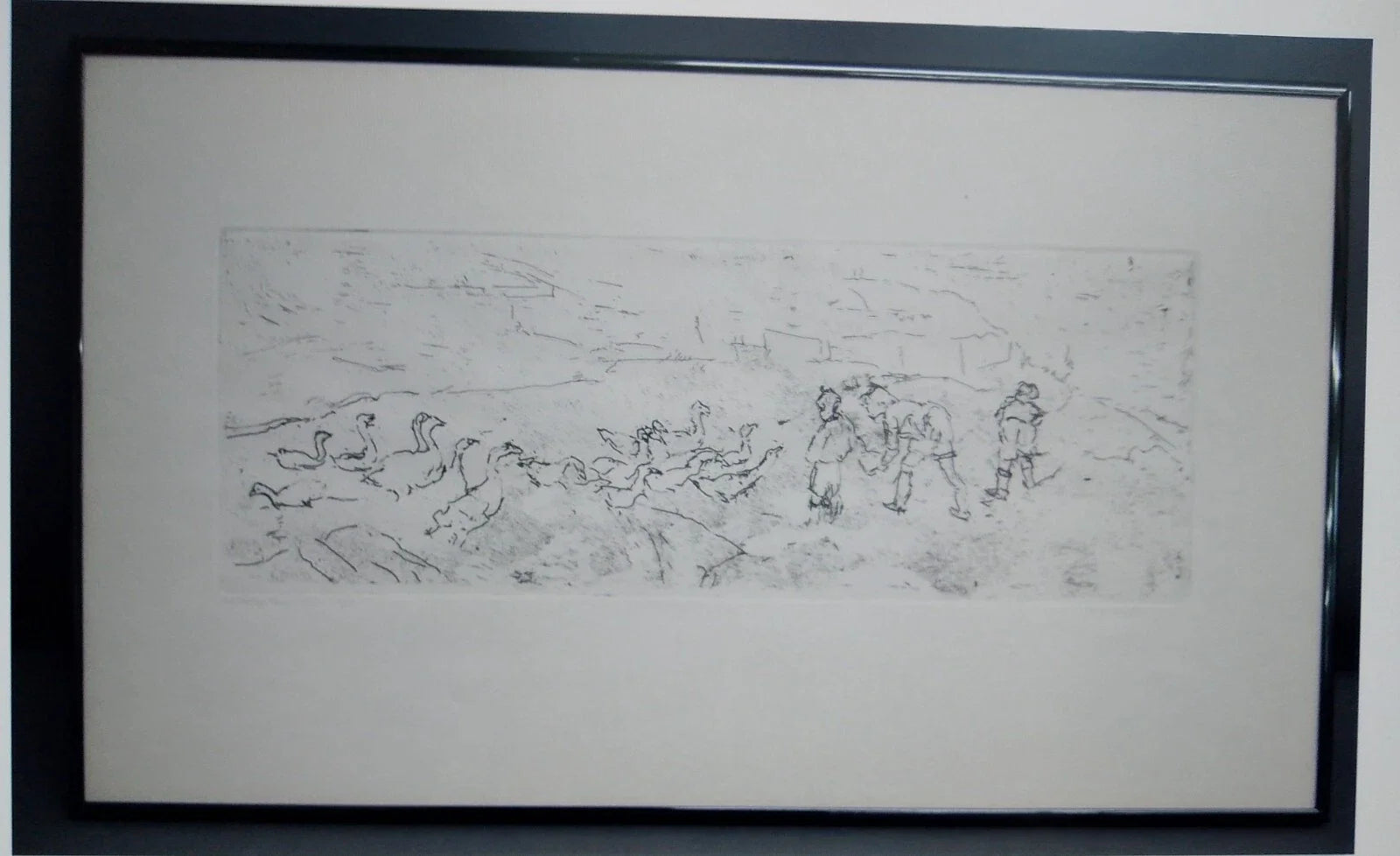 "Children and Geese" - Signed and numbered etching 31/50. Available in our collection.
The technical knowledge Freeth acquired in Rome—the understanding of how acid bites into copper, how ink sits in incised lines, how paper receives an impression—would serve him throughout his career.
Essential Printmaking Resources
War Service: Official Artist to the RAF
From 1942 to 1945, Freeth served in the Royal Air Force as an official war artist. This role—documenting the activities and personnel of the RAF through drawing and painting—provided him with unique access to the men and women who fought the air war.
Austin Art Insider
Free weekly guide to galleries, exhibitions & collecting in Austin.
The war artist's task was challenging: to create work that was both documentary and artistic, that captured the truth of military life while meeting the aesthetic standards of fine art. Freeth's training in portraiture served him well here.
The Royal Academy and Institutional Recognition
Freeth's election to the Royal Academy represents the highest honor available to a British artist. The RA, founded in 1768, has counted among its members virtually every significant British artist of the past two and a half centuries.
Election to the Academy—which requires nomination and approval by existing members—represents a judgment by one's peers that an artist has achieved lasting significance. For Freeth, this recognition validated a lifetime of dedicated work.
Understanding British Art History
The Black Country Subjects
What makes Freeth's work so compelling is his focus on ordinary people engaged in ordinary activities. He made the workers, families, and landscapes of the industrial Midlands his primary subject matter.
This was a conscious artistic choice with political and social dimensions. In an era when many British artists looked to London or to abstract international styles, Freeth remained committed to representing the people and places of his native region.
His etchings of Black Country life—workers at their trades, children at play, market scenes, industrial landscapes—constitute a valuable historical record as well as works of art. They show us a world that has largely disappeared, preserved with the clarity and permanence of fine printmaking.
The Etching Technique: Craft and Art
Etching differs from other printmaking methods in its reliance on chemistry rather than carving. The artist coats a metal plate (typically copper) with an acid-resistant ground, then draws through this ground with a needle, exposing the metal beneath.
When the plate is immersed in acid, the exposed lines are "bitten"—etched into the metal. The longer the plate remains in the acid, the deeper the bite, and the darker the resulting line will print.
This process allows for a drawing-like spontaneity impossible in engraving, where every line must be laboriously carved. Freeth exploited this quality, creating prints that feel immediate and personal despite their technical sophistication.
Collecting Freeth: Market and Value
Insider Tip
Look for Freeth's artist proofs (marked A/P) — they're printed before the numbered edition and often have the best impression quality.
For collectors, Freeth represents an opportunity to acquire work by a Royal Academician at prices that remain accessible. While his portrait commissions and major museum works command significant prices, his limited edition etchings can still be found at reasonable levels.
Key factors affecting value include:
Edition Number: Freeth typically produced editions of 50-75 prints. Lower numbers are often preferred.
Subject Matter: Black Country subjects and portraits tend to be most sought after.
Condition: Look for prints with clean margins, strong impressions, and no foxing.
Provenance: Documentation adds confidence and often value.
Currently Available: Children and Geese
Austin Gallery is pleased to offer "Children and Geese," a charming etching from Freeth's mature period depicting a pastoral English scene:
Austin Gallery is pleased to offer "Children and Geese," a charming etching from Freeth's mature period depicting a pastoral English scene:
- Edition: 31/50
- Medium: Etching on Arches paper
- Condition: Excellent with full untrimmed margins
- Signed: Yes, in pencil
- Price: $550
View this work in our collection →
Sources:
- Royal Academy of Arts Archives
- National Portrait Gallery, London
- Art UK Database
- Victoria and Albert Museum Collections
- Wikipedia contributors, "Andrew Freeth"
Consignment
Have Art You Want to Sell?
Free appraisals, zero upfront fees, nationwide service from Austin, Texas.