
Key Takeaways
- Best Overall: Cocoweb Brass Picture Light — museum-grade output, real solid-brass body, hardwire or plug-in.
- Best Battery / Cordless: EZVALO 16" Rechargeable Magnetic Picture Light — no holes in the wall, magnetic mount, dimmable by remote.
- Best for Big Paintings (24"+): Concept Lighting Museum-Grade LED — even wash across 30+ inches, 92+ CRI.
- Best Budget: Pasoar 16" Brass Plug-In — under $30, adjustable head, classic brass look.
- Skip: Cheap unbranded "art lights" on Amazon under $25. Color temp drifts and the LEDs fail in 12-18 months.
A picture light is the single biggest upgrade you can make to a piece of art on a wall. Done right, it makes a $400 painting look museum-quality. Done wrong, it warps the colors, casts a hot spot, and quietly UV-bleaches the work over a few years.
$400
Done right, it makes a painting look museum-quality
In This Article
- Pick Your Picture Light by Power Source and Art Size
- What to Look For (And Why Most Picture Lights Get It Wrong)
- Quick Comparison: Every Picture Light at a Glance
- Detailed Reviews
- Best Overall: Cocoweb Brass Picture Light
- Cocoweb Brass Picture Light
- Best Cordless / No-Drill: EZVALO 16" Rechargeable Magnetic Picture Light
- EZVALO 16" Rechargeable Magnetic Picture Light
- Best for Large Works: Concept Lighting Museum-Grade LED
- Concept Lighting Museum-Grade LED Picture Light
- Best Modern / WAC Lighting LED Picture Light
- WAC Lighting LED Picture Light
- Best Traditional / House of Troy Slim Line
- House of Troy Slim Line Picture Light
- Best Budget: Pasoar 16-Inch Brass Plug-In
- Pasoar 16-Inch Brass Picture Light Plug-In
- More Cordless Options: Tassuowell 12" Brass + LYTARA
- Cordless vs Plug-in vs Hardwire: Which Should You Pick?
- Common Mistakes We See in Home Art Lighting
- When to Call a Professional
- Frequently Asked Questions
- What is the best way to light artwork?
- Are battery picture lights any good?
- Will a picture light damage my artwork over time?
- What color temperature is best for paintings?
- Do I need a different picture light for oils vs watercolors?
- Can I use a regular wall sconce instead?
- How high above the painting should the light mount?
- Should I dim my picture lights?
- Are smart bulbs (Hue, LIFX) good for picture lights?
- How to Mount a Picture Light (Quick Guide)
- The Bottom Line
We ranked nine picture lights on manufacturer-stated CRI, color temperature, beam length, and mounting method, then cross-checked them against owner reports from collectors lighting oils, watercolors, and archival pigment prints. Here are the ones that earn their place above the work.
Pick Your Picture Light by Power Source and Art Size
Two questions decide this purchase before any brand comparison matters: what power you can get to the wall, and how wide the artwork is. Answer both in the table, then jump to the full review of the pick.
| Art width | Hardwire (cleanest look) | Plug in (standard install) | Battery (renters, no drill) |
|---|---|---|---|
| Under 16" | Cocoweb Brass 13" | Pasoar 16" Brass | Tassuowell 12" |
| 16 to 24" | WAC Lighting LED or Cocoweb Brass 18" | House of Troy Slim | EZVALO 16" |
| Over 24" | Concept Lighting Museum | Cocoweb Brass 25" plug in version | No honest battery option this wide. Go plug in. |
Three rules ride on top of the table. The light bar should be roughly two thirds the width of the artwork, so a 24 inch painting wants a 16 to 18 inch fixture. Renters and frequent rotators should take the battery column even at some cost in output. And if the piece is not on the wall yet, hang it first at the right height (the 57 inch rule) and hardware (heavy duty picture hangers), because the light mounts relative to the frame.
What to Look For (And Why Most Picture Lights Get It Wrong)
Three numbers matter: color temperature, CRI, and even distribution.
- Color temperature should be 3000K for most artwork. Warmer (2700K) makes blues look muddy. Cooler (4000K+) flattens warm tones and makes paintings look clinical. Galleries and museums use 3000K for a reason.
- CRI (Color Rendering Index) should be 90+ minimum, 95+ ideal. CRI measures how accurately the light renders the full color spectrum. Cheap LEDs are often 70-80 CRI — they make reds look orange and skin tones look sallow. Anything under 90 will misrepresent paintings.
- Even distribution means no hot spot in the middle and no dark corners. This is mostly a function of housing length: a 12" light works for a painting up to ~16" wide, an 18" light up to ~24", and so on. Get one too short and the corners go dark.
Skip anything that doesn't list color temperature and CRI on the spec sheet — those omissions mean the manufacturer knows the numbers are bad.
Quick Comparison: Every Picture Light at a Glance
| Light | Length | Power | CRI | Best For | Price |
|---|---|---|---|---|---|
| Cocoweb Brass | 13–25" | Hardwire/plug | 92+ | Premium art display | ~$249 |
| EZVALO 16" Rechargeable | 16" | Battery | n/s | Renters, no-drill installs | ~$25 |
| LYTARA Cordless | — | Battery | n/s | Cordless with built-in timer | ~$33 |
| Concept Lighting Museum | 18–36" | Hardwire | 95+ | Large works, galleries | ~$295 |
| WAC Lighting LED | 12–24" | Hardwire | 92 | Modern interiors | ~$219 |
| House of Troy Slim | 14–25" | Plug-in | 90 | Traditional rooms | ~$159 |
| Pasoar 16" Brass | 16" | Plug-in | n/s | Budget, classic brass look | ~$27 |
| Tassuowell 12" Brass | 12" | Battery | n/s | Brass look, no drilling | ~$36 |
A note on the battery column: the branded cordless segment turned over almost completely in 2026 — the Aiboo, Lampluno, Modern Place, and Cocoweb rechargeable models we originally ranked have all left Amazon. The picks above are the in-stock survivors, re-verified against live listings. Where a maker does not publish a CRI number we mark it n/s rather than guessing, and we say so in the review.
Detailed Reviews
Best Overall: Cocoweb Brass Picture Light
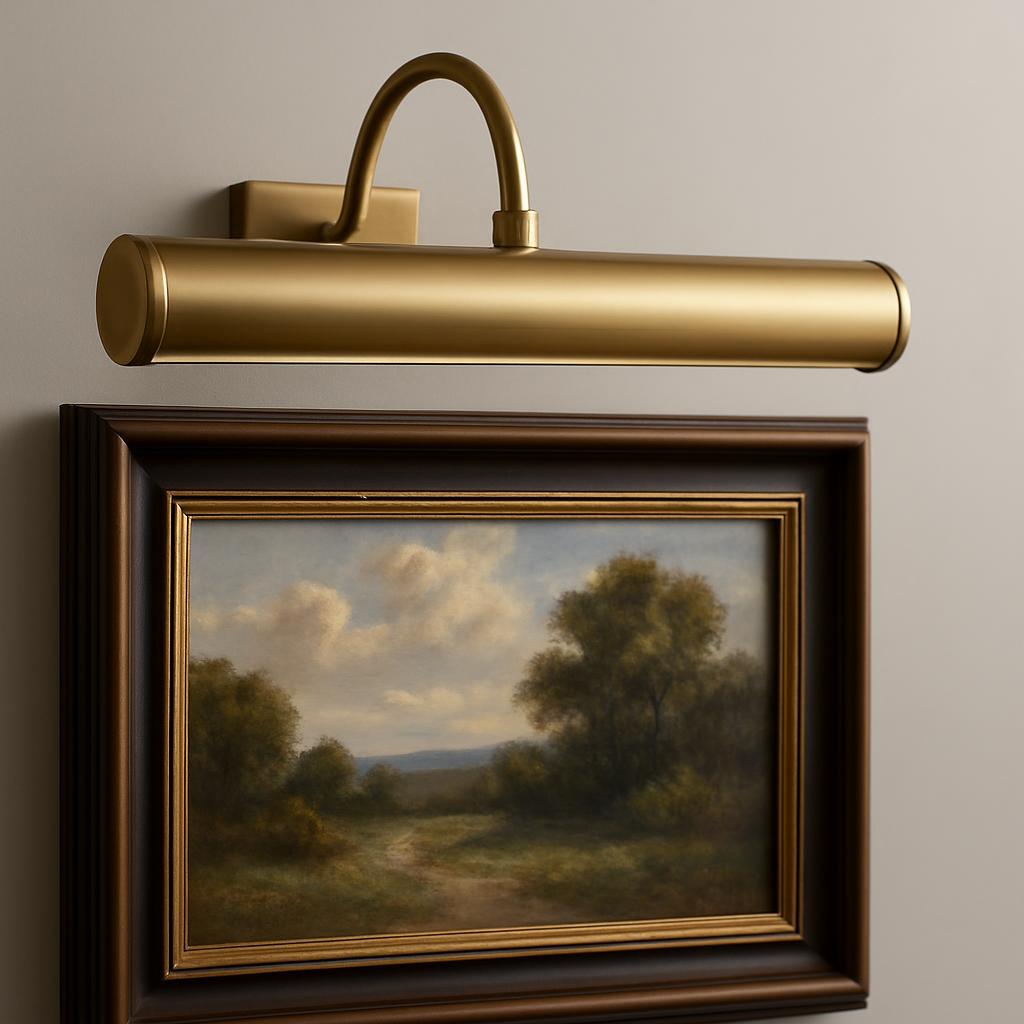
Cocoweb Brass Picture Light
$249
Solid brass body, museum-grade 3000K LED at 92+ CRI, hardwire or plug-in versions. Available in 13", 18", and 25" lengths. The standard every other fixture in this category gets measured against.
View on Amazon
Check Current PriceIf you're hanging real artwork worth more than $500, this is the picture light. The body is genuinely solid brass — heavy, real metal, the kind of thing that develops a patina rather than chipping. The LED is exactly 3000K, exactly 92+ CRI, with a long even spread that washes a painting cleanly without a hot spot.
You can hardwire it (junction box) or plug it in via the included cord. The plug-in cord is brown and threaded so it disappears against most walls; hardwire installs are obviously cleaner. There are also three diffuser options included to fine-tune the spread.
Why it wins: Nothing else feels like an actual museum fixture at this price. Cocoweb has been making these for galleries for 20 years and it shows.
The catch: $249 is a lot if your painting is a $40 print. Match the picture light to the value of the work.
Best Cordless / No-Drill: EZVALO 16" Rechargeable Magnetic Picture Light

EZVALO 16" Rechargeable Magnetic Picture Light
$24.99
16-inch cordless light bar with a 4800mAh rechargeable battery, magnetic mounting, and dimming from a wireless remote. No drill, no cord, no electrician.
View on Amazon
Check Current PriceFor renters, anyone who hates electrical work, or anyone who swaps art frequently, this is the cordless pick of the current crop. The mounting plate goes on the wall, the bar attaches magnetically, and the wireless remote handles on/off and dimming — so you can pull the light down to recharge or rotate artwork without touching hardware.
The honest caveat: EZVALO does not publish a CRI figure, which our own buying rules flag. At $25 the risk is low and returns are easy, but if you are lighting serious work where color accuracy is the whole point, spend up on the Cocoweb and wire it properly.
Why it wins for cordless: 16 inches of coverage — enough for art up to roughly 24" wide under the two-thirds rule — with a magnetic mount and remote dimming at a commodity price.
The catch: You have to remember to charge it, and the maker doesn't state CRI. A recurring calendar reminder every two weeks solves the first; the Cocoweb solves the second.
For a closer look at how picture lighting integrates with mounting and gallery walls, see our art framing masterclass.
Best for Large Works: Concept Lighting Museum-Grade LED
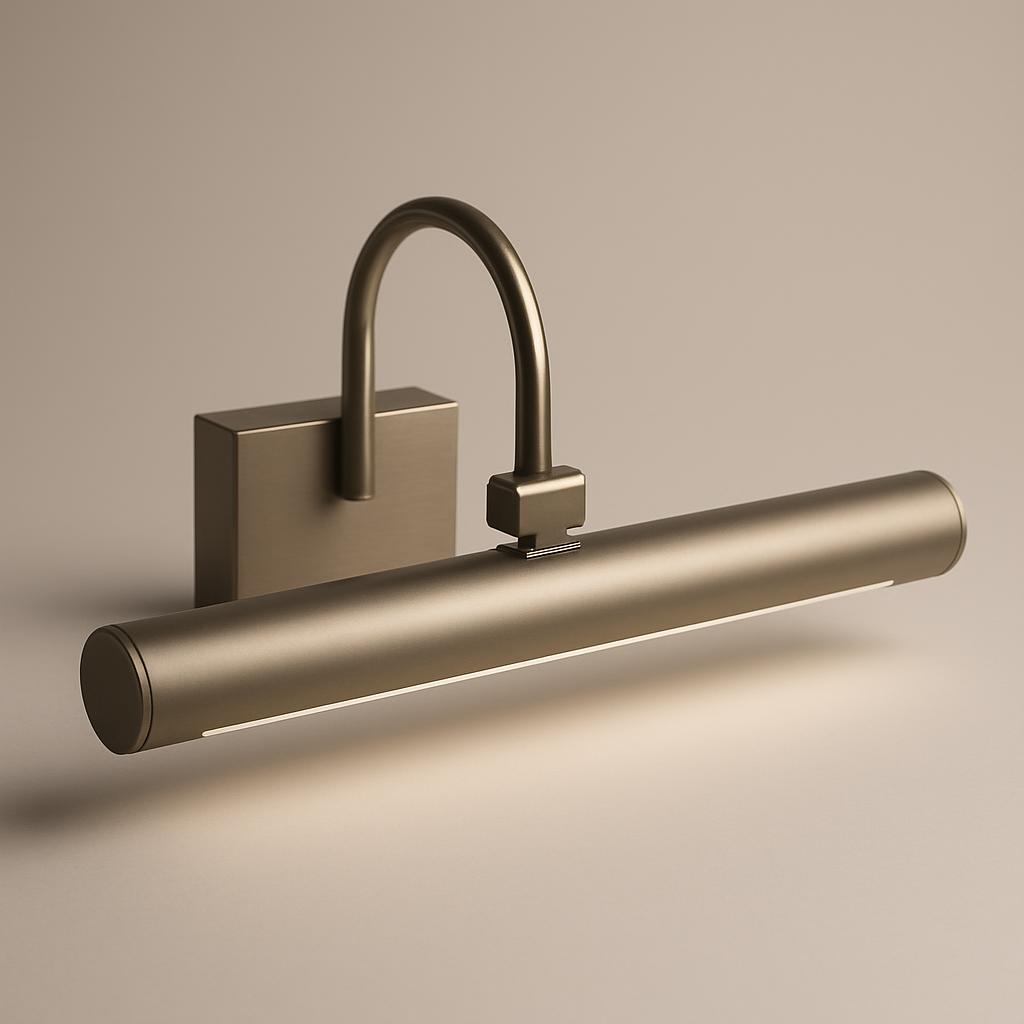
Concept Lighting Museum-Grade LED Picture Light
$295
Available in 18", 24", 30", and 36" lengths. 95+ CRI. Designed for museums and serious collectors. The fixture you find in real galleries.
Austin Art Insider
Free weekly guide to galleries, exhibitions & collecting in Austin.
View on Amazon
Check Current PriceIf your painting is wider than 24 inches, you need a longer light or you'll get dark corners. The Concept Lighting goes up to 36" and gives a perfectly even wash even at full length. The 95+ CRI is the highest manufacturer-stated rating in this group, and it is the spec that gets a painting closest to its on-easel state.
Why it wins for big works: Coverage and CRI. Nothing else hits both at this length.
The catch: Hardwire only — you'll need an electrician unless you're comfortable with a junction box.
Best Modern / WAC Lighting LED Picture Light
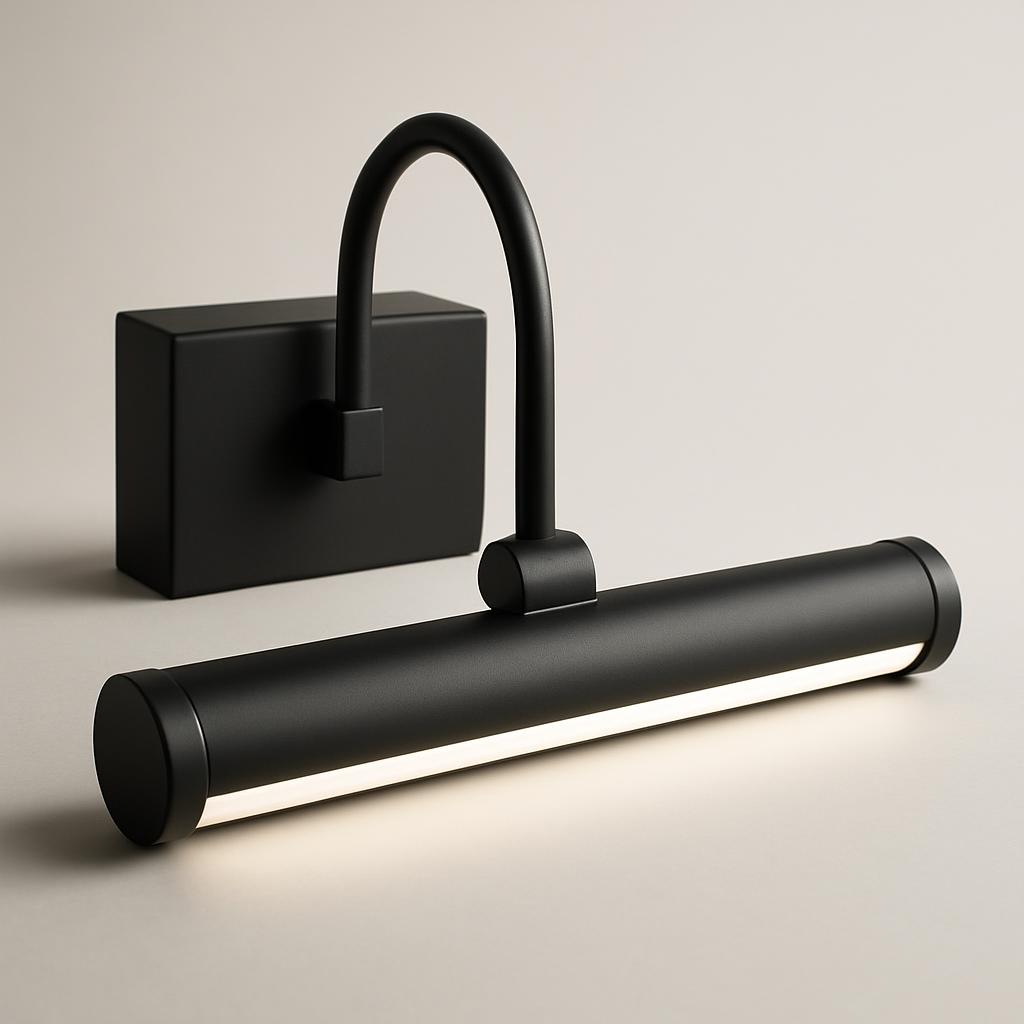
WAC Lighting LED Picture Light
$219
Modern matte-black or brushed-nickel finish. 92 CRI, 3000K. Slim profile that disappears into contemporary interiors better than traditional brass.
View on Amazon
Check Current PriceWAC's offering looks like architecture, not jewelry. If your room is mid-century modern, contemporary, or you just hate the "old library" look of traditional brass, this is the picture light. The matte black version disappears against dark walls beautifully; the brushed nickel reads cleanly against gallery white.
Best Traditional / House of Troy Slim Line
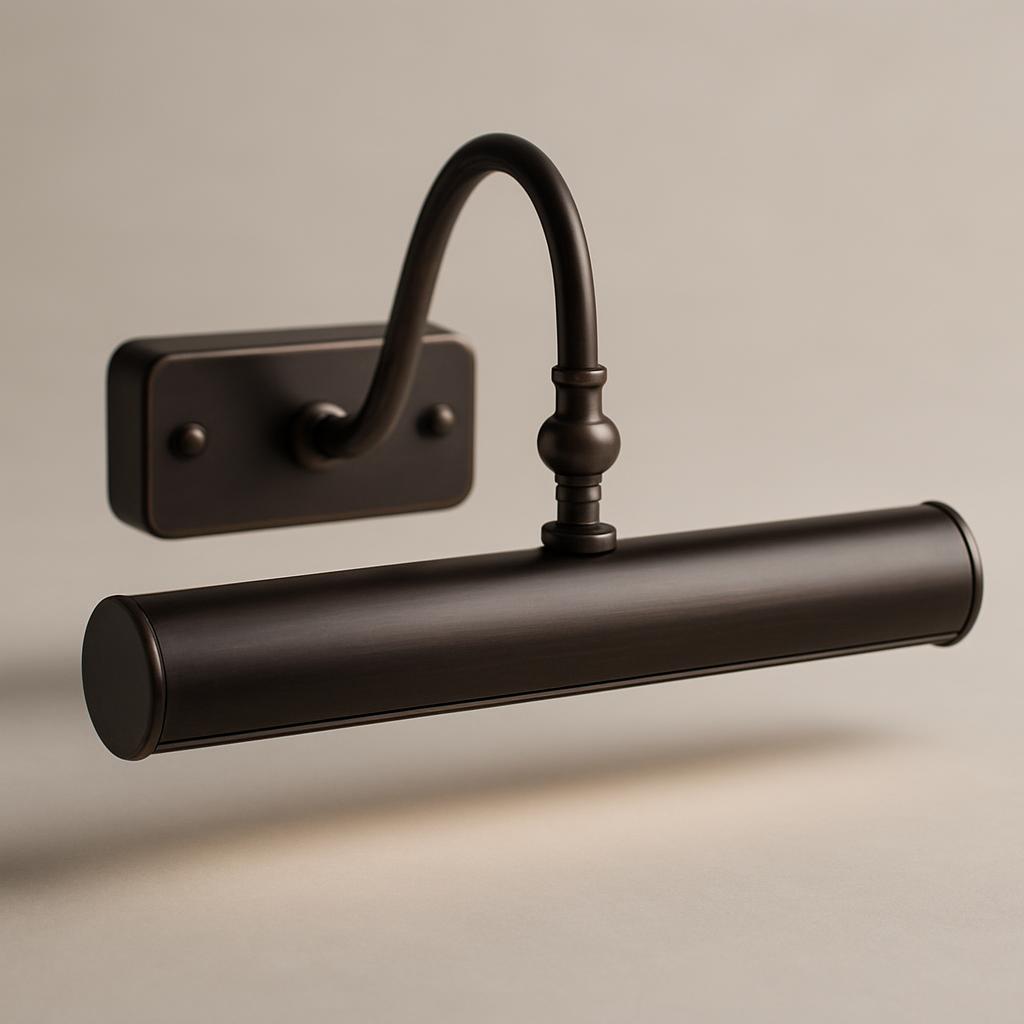
House of Troy Slim Line Picture Light
$159
Plug-in version of the gallery-classic profile. Three finish options. The picture light you'd see in a country club library.
View on Amazon
Check Current PriceFor traditional and transitional rooms, the House of Troy is the right shape. Slim, classic, and the plug-in version means no electrician. The CRI isn't as high as the Cocoweb, but at this price for the form factor, it's the right buy.
Best Budget: Pasoar 16-Inch Brass Plug-In

Pasoar 16-Inch Brass Picture Light Plug-In
$27
16-inch plug-in picture light in a brass/gold finish with an adjustable 4W LED head. The classic picture-light look at the lowest credible price on this list.
View on Amazon
Check Current PriceThe Pasoar takes the budget slot on look and length. Sixteen inches of bar in a traditional brass finish, a plug-in cord, and an adjustable head that lets you angle the light down the canvas properly — for $27. That combination used to cost $45-60 in this category.
Like most lights at this price, the maker does not publish a CRI number, so treat it as room-and-print lighting rather than conservation-grade display. For a $40 poster, a family photo wall, or a first framed print, it is exactly right; for a painting you paid four figures for, buy the Cocoweb.
Why it wins on budget: The traditional brass look and a full 16" of coverage at a price where mistakes don't hurt.
The catch: No published CRI — good enough for prints and decor, not what we'd put over serious work.
More Cordless Options: Tassuowell 12" Brass + LYTARA
Two more battery picks round out the cordless field. The Tassuowell 12" ($36) is the one to buy if you want the traditional brass look without drilling — a rechargeable bar with a remote, sized for works up to about 18" wide. The LYTARA ($33) is the utility pick: cordless, dimmable, and driven by a dedicated controller with a built-in timer, so it can switch itself on for the evening and off at midnight without a smart plug. Neither maker publishes a CRI figure, so the same caveat applies as with every budget cordless light: ideal for prints and decor, not conservation display.
Tassuowell 12" Brass Rechargeable Picture Light → LYTARA Cordless Picture Light with Timer →
Cordless vs Plug-in vs Hardwire: Which Should You Pick?
- Hardwire is the cleanest installation if you're willing to call an electrician (or you're confident with a junction box). No visible cord. The picture light becomes part of the wall.
- Plug-in is the standard residential install. The cord is visible but most picture light cords are brown/threaded and disappear against most walls. Many include a cord channel cover.
- Cordless / battery is the right answer for renters, frequent art-rotators, and anyone who hates wall holes. You'll trade some output and have to recharge every 1-2 weeks.
Our default recommendation: Plug-in for permanent collections, hardwire for serious gallery walls, cordless for renters and rotators.
Common Mistakes We See in Home Art Lighting
We light art in the gallery every day and see the same handful of mistakes on nearly every house call:
- Lighting the piece before hanging it right. The fixture mounts relative to the frame, so if the painting needs to move, the light moves with it, and now you have four holes instead of two. Get placement and wall spacing final first.
- Buying by looks instead of specs. A beautiful brass fixture at 80 CRI will make a painting look worse than no light at all. Color temperature and CRI are the product. The housing is packaging.
- A light bar that is too short. Dark corners read as a mistake from across the room. Two thirds the artwork width is the floor, not the ideal.
- Aiming a ceiling can at the art and calling it done. A downlight three feet from the wall rakes across the frame and throws a shadow band over the top third of the piece. If you want ceiling based lighting done properly, that is track lighting for art, aimed at 30 degrees.
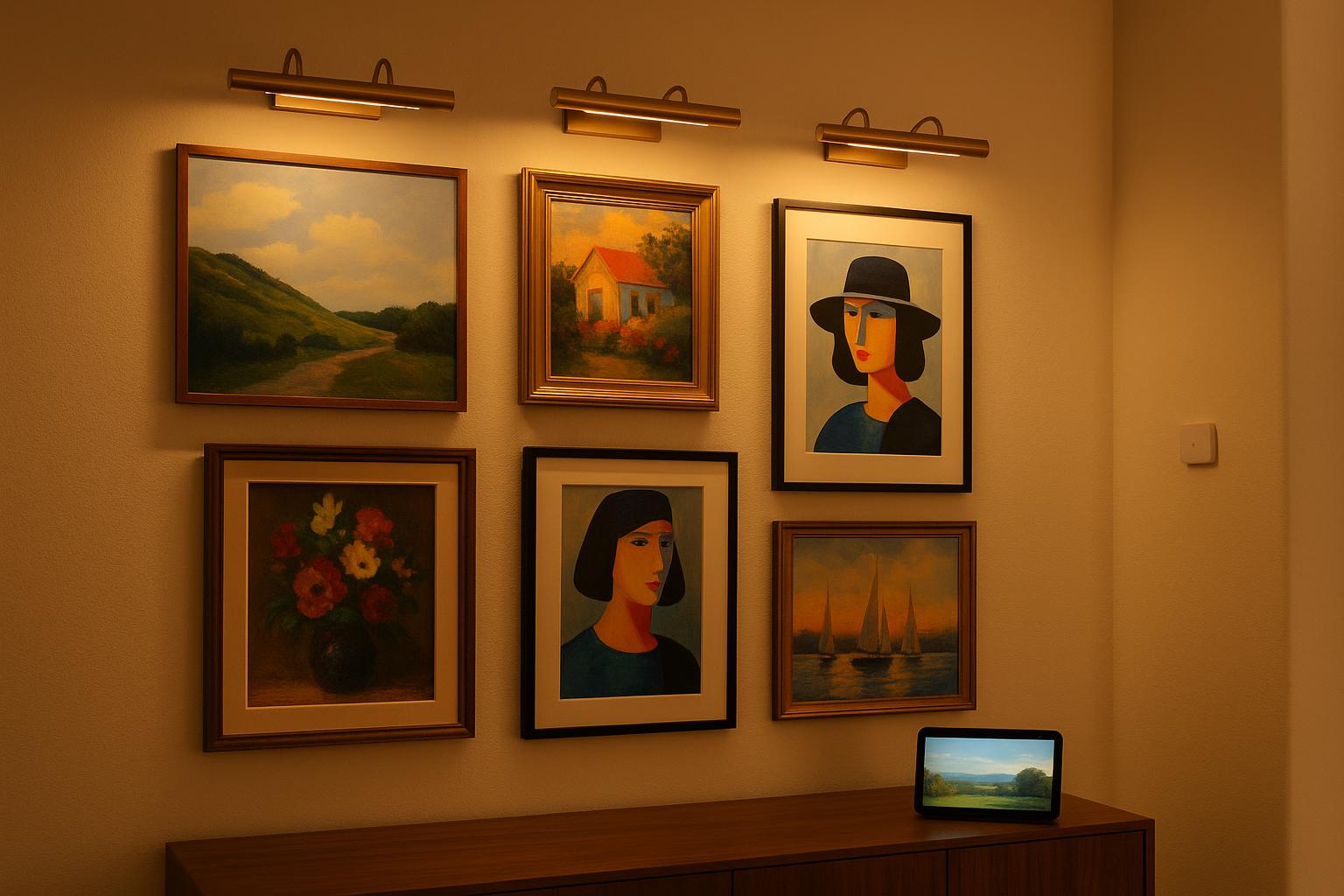
- Ignoring the rest of the room. A picture light in a bright room does nothing. The effect comes from contrast: the art sits a couple of stops above the ambient level. Dim the room, not just the art. Our art lighting masterclass covers layering ambient, accent, and picture light levels.
When to Call a Professional
Most picture lights on this page install with a screwdriver. Call in help for three situations:
- Any hardwire install where there is no junction box behind the wall. An electrician runs the box and switch loop cleanly in under two hours. Fishing romex yourself through a finished wall to save $200 is a bad trade.
- Museum grade collections. If the work is genuinely valuable, a lighting designer will spec fixtures, beam spreads, and lux limits for conservation. Watercolors and works on paper should live under 50 lux, which is dimmer than most people expect, and a pro will set that correctly.
- Stairwells and double height walls. Anything on a ladder above the first landing is an installer's job, both for the light and for the hanging hardware under it.
For everything else, the plug in and battery picks above are honest one person, twenty minute jobs.
Frequently Asked Questions
What is the best way to light artwork?
The best way to light artwork at home is a dedicated picture light mounted above the frame: 3000K color temperature, 90+ CRI, and a light bar about two thirds the width of the piece. It puts even, accurate light exactly where the art is and nowhere else. The alternatives each give something up: track lighting works well but requires ceiling wiring and careful 30 degree aiming, ceiling downlights rake shadows across the frame, and ordinary lamps and sconces are too warm and too inaccurate for art. For the whole room approach, see our guide to how to light artwork at home.
Are battery picture lights any good?
Yes, the good ones are genuinely usable now, which was not true five years ago. A quality battery picture light gives you 3000K and 90 CRI with zero wiring and zero holes beyond a small mounting plate, which makes them the default answer for renters. The trade offs are real but manageable: output is lower than wired fixtures, runtime is 6 to 8 hours per charge so you recharge every week or two, and nothing battery powered lights a painting wider than about 20 inches evenly. For a permanent collection in a home you own, wired is still better.
A quality battery picture light gives you 3000K and 90 CRI with zero wiring and zero holes beyond a small mounting plate, which makes them the default answer for renters.
Will a picture light damage my artwork over time?
Old incandescent picture lights produced UV and significant heat that could fade and crack pigments over decades. Modern LED picture lights produce no UV and very little heat — they're safe for both oils and watercolors with no special protection.
What color temperature is best for paintings?
3000K is the museum standard and works for the broadest range of work. Watercolors and lighter palettes can look slightly better at 2700K (warmer); contemporary work and photography often look better at 3500K (slightly cooler). Avoid 4000K+ — it makes warm tones look clinical.
Do I need a different picture light for oils vs watercolors?
No, the same fixture works. The variables that matter are color temperature, CRI, and even distribution — not the medium of the work. A 3000K, 92+ CRI light flatters all media equally well.
Can I use a regular wall sconce instead?
Most wall sconces are 80-85 CRI and 2700K — too warm and not color-accurate enough. They'll make a painting look muddy. The picture light category exists precisely because general residential lighting is wrong for art.
How high above the painting should the light mount?
Standard guidance: the light should be about half the depth of the frame above the top of the frame. So for a 2" deep frame, mount the picture light 1" above the top edge. For a 4" frame, 2" above. This gives you the proper angle of light without casting a shadow from the frame itself.
Should I dim my picture lights?
Yes if the fixture supports it. Most picture lights look best at 60-80% brightness — full brightness can be too hot and 100% can introduce flicker on cheaper LEDs. Cocoweb, Concept, and WAC all support dimming via a wall dimmer.
Are smart bulbs (Hue, LIFX) good for picture lights?
Most don't fit picture light fixtures (which often use integrated LEDs, not standard bulbs). For fixtures that DO take bulbs, smart options are okay but watch the CRI — most smart bulbs are 80-85 CRI. If you want smart-controlled gallery lighting, see our smart home for art collectors guide and the LED bulb guide for picture lights.
For fixtures that DO take bulbs, smart options are okay but watch the CRI — most smart bulbs are 80-85 CRI.
How to Mount a Picture Light (Quick Guide)
- Center the light over the painting. The light bar should be centered on the frame's horizontal midpoint.
- Mount above the top of the frame at the height described in the FAQ above (~half the frame depth).
- For plug-in: Run the cord down behind the painting if possible, or use a cord channel cover painted to match the wall.
- For battery: Mount the magnetic plate level — most battery lights have a small spirit-level on the back. Charge before installing.
- For hardwire: Use a UL-rated junction box. Most picture lights are 12V or 24V transformer-driven, so you won't be running 120V to the fixture itself — the transformer mounts in the box.
For mounting any heavy framed work first, see our picture hangers for heavy frames guide and tools for hanging art like a pro.
The Bottom Line
If you're lighting one or two pieces and want them to look as good as they do under gallery lights, get the Cocoweb Brass. If you're a renter or rotate artwork frequently, the EZVALO 16" Rechargeable is the cordless option we'd buy today. If you have a 30"+ painting, the Concept Lighting Museum-Grade is what museums actually use.
For the bulb side of the equation — picture lights that take standard E26 bulbs — see our companion guide to the best LED bulbs for museum-grade art display.


