Austin Gallery

Printing & Reproduction

Best Photo Scanners 2026: Digitize Family Photos Fast

The boxes in the closet are the only copy. These are the machines that fix that: batch feeders for the shoeboxes, flatbeds for the fragile ones, film scanners for the slides, ranked by how fast they get a family archive actually finished.

By Justin ParkJuly 18, 202614 min readHow we research

The best photo scanner for most families in 2026 is the Epson FastFoto FF-680W ($629.99): it feeds whole stacks of prints at roughly a photo per second, captures the handwriting on the backs, and restores faded color as it goes. That one capability, batch feeding, is the difference between a digitized family archive and a project that dies in a closet. Around it, the right choice depends on what your collection actually is: loose prints want a feeder, albums and fragile photos want a flatbed, and slides and negatives want a film scanner. Many families, honestly, need one of each of two.

One important distinction before we start: this guide is about digitizing photographs, the prints, slides, and negatives in the family boxes. If you are scanning artwork, paintings, drawings, pieces you want to reproduce and sell as prints, that is a different job with different specs (Dmax, color targets, large beds), and it has its own dedicated guide: the best scanners for art. Everything below is chosen for the family-archive job. Every link goes to Amazon with our affiliate tag; we earn a small commission, at no cost to you, when you buy through us. Every product, price, and image on this page was verified live on Amazon this week.

Which Photo Scanner Should You Buy? The 60-Second Decision

Find your collection in the left column and the right machine follows. Every pick is reviewed in full below.

Your collectionBuy thisPrice
Shoeboxes of loose prints (500+)Epson FastFoto FF-680W$629.99
Photos plus a house full of paperworkScanSnap iX2500 Photo Edition$415.99
A few hundred prints, moderate budgetPlustek ePhoto Z300$197.10
Albums, fragile prints, small collectionsEpson Perfection V19 II$89.00
Carousels of slides, simplest workflowKodak Slide N Scan$189.99
Big slide collections, older eyesKodak Slide N Scan Max$209.99
Mixed film formats incl. Super 8 framesMagnasonic FS71$129.98
Negatives that deserve real qualityPlustek OpticFilm 8300i SE$429.00

In a Hurry?

The 3 picks that cover most readers. Tap to read the full review or buy direct.

Best Overall

Epson FastFoto FF-680W

Epson FastFoto FF-680W

$629.99

A photo per second, both sides, color restored. The archive finisher.

Best Budget Flatbed

Epson Perfection V19 II

Epson Perfection V19 II

$89.00

The gentle flatbed for albums and fragile prints, one USB cable.

Best for Slides

Kodak Slide N Scan

Kodak Slide N Scan

$189.99

Feed slides, watch them appear on screen, save to SD. No computer.

Best OverallOur Pick

Type

Sheet-fed batch photo scanner

Speed

About 1 photo per second (at 300 dpi)

Sides

Two-sided in one pass (captions on the back)

Connectivity

Wireless + USB

Pros

  • Feeds and scans whole stacks of prints hands-free
  • Captures handwritten notes on photo backs automatically
  • Auto color restoration rescues faded prints as it scans
  • Wireless scanning straight to computer or cloud
  • Doubles as a fast household document scanner

Cons

  • Loose prints only, nothing in albums or frames
  • Overkill for small collections
  • Feed-through quality trails a flatbed on any single photo

Here is the math that sells the FastFoto: a flatbed scans a photo in about 30 seconds, and a family collection runs 2,000 photos. That is seventeen hours of standing at a scanner lifting the lid, and that estimate is generous, because nobody scans 2,000 photos in one heroic session. Most flatbed digitization projects die a quiet death in month two. The FastFoto exists to prevent that death: load up to a stack of prints in the feeder, press one button, and it pulls them through at roughly a photo per second.

~1/secphotos per second through the FastFoto's feeder at 300 dpi. A 2,000-photo archive becomes a weekend project instead of a lost year

The details show that Epson understands what a family archive actually is. It scans both sides of every print in the same pass, which means the names, dates, and "Lake Travis, summer 1974" notes written on the backs survive into the digital copy as paired files. The software auto-crops, straightens, and applies color restoration to faded prints, and the restored versions save alongside untouched originals, so nothing is destructive. Wireless means it can live near the photo boxes instead of near the computer.

Know its one boundary: the FastFoto is for loose prints in decent condition. Photos glued in albums, mounted on board, or fragile enough to crack need a flatbed like the V19 II below (or a careful smartphone copy). Most collections are 90 percent loose prints and 10 percent delicate exceptions, and the winning setup is this machine for the 90 plus a cheap flatbed for the rest.

Our Pick

The machine that turns a shoebox project into an afternoon. Load a stack of prints, press start, and the FastFoto feeds them through at roughly a photo per second, capturing both sides, auto-cropping, and restoring faded color as it goes. For a real family collection, hundreds or thousands of prints, nothing else here is close.

Buy this if your collection is measured in shoeboxes, not stacks. The feeder handles batches of prints in one pass, it scans the back of each photo in the same pass (so Grandma's handwritten captions survive), and it sends everything wirelessly to your computer or cloud folder. It also doubles as a genuinely fast document scanner for the rest of the house.

What we don't like

It only takes loose prints: nothing in albums, nothing mounted, nothing fragile enough that a roller-feed pass worries you. And at $629.99 it costs more than paying a service to scan a few hundred photos, so it makes sense at volume, not for a single envelope of prints.

Best Feeder AlternativeAlso Great

Type

Sheet-fed scanner with photo mode

Screen

5-inch touchscreen

Feeder

100-page auto document feeder

Connectivity

Wireless + USB

Pros

  • Excellent feeder pedigree from the document world
  • Large touchscreen, works without a computer open
  • Handles photos and household paperwork equally
  • About $214 less than the FastFoto

Cons

  • Photo features are lighter than the Epson's
  • No paired back-of-print caption workflow
  • Photo batches want more attention

ScanSnap owns the desks of accountants and paperless-office obsessives, and the iX2500 Photo Edition is that machine turned toward the family archive. The core hardware is the appeal: a fast, reliable duplex feeder, a 100-page document tray, wireless everything, and a 5-inch touchscreen that lets you scan straight to a phone, folder, or cloud service with nobody's laptop involved. The Photo Edition packages that with photo-oriented software and handling accessories for prints.

The honest comparison with the FastFoto: Epson built a photo scanner that also does documents, and ScanSnap built a document scanner that also does photos. If your photo collection is a few hundred prints and your real life includes years of receipts, statements, and school papers, the ScanSnap is the better total-household purchase and saves you real money. If the photo archive is the mission, thousands of prints, captions on the backs, deep restoration, the FastFoto justifies its premium. Either way you end up with the same win: the boxes leave the closet.

Also Great

The strongest challenger to the FastFoto, from the other great name in feed scanning. The iX2500 Photo Edition pairs ScanSnap's superb feeder and 5-inch touchscreen with photo-focused software, and it costs about $214 less. If your project is photos plus a house full of paperwork, it is arguably the smarter buy.

Buy this if you want one machine for the family photo project and everything else: receipts, tax records, kids' artwork, the whole paper life. ScanSnap's software ecosystem is the best in document scanning, the big touchscreen makes it usable without a computer open, and the Photo Edition adds photo handling to a scanner that was already a household workhorse.

What we don't like

It is a document scanner that learned photos, not a photo-first machine: it lacks the FastFoto's photo-specific tricks like paired back-of-print caption capture, and photo batches want more babysitting. Photo purists with huge collections should pay up for the Epson.

Best Midprice Photo FeederAlso Great

Type

Hand-fed single-photo scanner

Speed

About 2 seconds per 4x6 print

Sensor

CCD

Max size

Up to 8x10 prints

Pros

  • Dramatically faster than any flatbed
  • One-at-a-time feeding is gentle on prints
  • CCD sensor gives solid color for the price
  • Auto crop and deskew as photos pass through

Cons

  • No stack feeder, you feed every print by hand
  • Single-sided, captions need a second pass
  • Utilitarian software

There is a big gap between a $117 flatbed and a $630 batch feeder, and the ePhoto Z300 is what lives in it. The workflow is manual but quick: you slip one print into the slot, the scanner grabs it and pulls it through in about two seconds for a 4x6 (a bit longer for an 8x10), then you feed the next. No lid to lift, no preview to click, no waiting for a lamp. In practice a shoebox of 300 prints is one relaxed evening.

Two things earn it the midprice slot. First, the CCD sensor, the same sensor family better flatbeds use, produces noticeably better color and sharpness than the cheapest feed scanners. Second, the hand-feeding that costs you speed at volume buys you control: each photo gets a human glance before it enters the machine, which is exactly what you want when a fragile 1962 print surfaces in the pile. If your collection is in the hundreds, this is the sensible buy; if it is in the thousands, the FastFoto's stack feeder is worth every extra dollar.

Also Great

Feed-through photo scanning at a third of the FastFoto's price. The ePhoto Z300 takes photos one at a time rather than in stacks, about 2 seconds for a 4x6, with a CCD sensor and automatic crop and rotate. The right middle ground for collections in the hundreds.

Buy this if a flatbed is too slow but $630 is too much scanner. You hand-feed each print, which sounds tedious until you feel the rhythm: slide a photo in, it pulls through in a couple of seconds, slide the next. A few hundred photos is an easy evening in front of the TV, and the one-at-a-time handling is actually gentler on prints you care about.

What we don't like

No stack feeding means your hands are involved for every single print, so thousand-photo archives get old. It is also single-sided, so handwritten captions on photo backs need a second pass, and the software is more utilitarian than Epson's.

The Classic (Know Before You Buy)Also Great

Type

Flatbed with film scanning

Resolution

6400 dpi optical

Film

35mm and medium-format holders

Status

Scarce, priced well above historical list

Pros

  • The legendary do-everything photo flatbed
  • 6400 dpi with real film and slide holders
  • Hardware-assisted dust and scratch removal on film
  • Immense track record and software support

Cons

  • Scarce stock now trades around triple its old price
  • A flatbed plus film scanner bought separately costs less
  • Slow per photo, like every flatbed

Ask any photography forum from the last fifteen years to name a photo scanner and you will get one answer: the V600. It earned that status honestly. One reasonably priced flatbed that scanned prints beautifully at 6400 dpi, handled 35mm and medium-format film with proper holders, and cleaned dust and scratches in hardware. Millions of family archives passed through its glass.

Here is what the forums have not updated: the V600 era is ending, and remaining units now sell at scarcity prices, $1,109.19 at our last check, roughly triple what this scanner cost for most of its life. Nothing about the hardware got better; the supply got worse. So do the 2026 arithmetic before you pay it: an Epson V19 II flatbed ($89) for prints plus a Plustek OpticFilm 8300i SE ($429) for negatives gives you meaningfully better film scans and change from $550. The V600 remains a wonderful machine, and if you find one at a sane price it is still an easy recommendation. At today's price, it is a monument you can buy, and we would rather you build the archive than the shrine.

Also Great

The most famous photo scanner ever made, with a big asterisk in 2026: it is scarce, and remaining stock trades at collector prices, $1,109 as we write this. The 6400 dpi flatbed with film holders is still superb. The price is not. Read our take before you click.

Buy this only if you specifically need what made the V600 legendary, one flatbed that does beautiful print scans AND 35mm and medium-format film with hardware dust removal, and you want it now at any price. For everyone else: the V19 II below covers prints for $89, and a dedicated film scanner covers negatives for less than this now costs.

What we don't like

The price. The V600 spent a decade as the roughly $250 default recommendation of every photography forum, and today's four-figure listings reflect scarcity, not a better scanner. We include it because everyone searches for it, and because you deserve the honest arithmetic before paying 2019's cult following as a surcharge.

Best Budget FlatbedBudget Pick

Type

Flatbed

Resolution

4800 dpi optical

Power

Single USB cable

Lid

High-rise, removable (albums and books)

Pros

  • Gentlest possible handling for fragile photos
  • Removable high-rise lid manages albums and thick books
  • 4800 dpi is more than old prints can use
  • One USB cable, no power brick, light enough to shelve

Cons

  • Slow for any real volume
  • No film or slide scanning
  • Manual everything

Every family archive has a fragile minority that must never see a feed roller, and this is the $89 machine for exactly those photos. The V19 II is Epson's entry flatbed done properly: 4800 dpi optical resolution, a single USB cable for both data and power, and, the feature that matters most for this job, a high-rise lid that lifts and removes so you can lay a whole album page or a thick family Bible face-down without cracking the spine or peeling the photo from its black-paper page.

Resolution anxiety is not required. A typical 4x6 print from a consumer lab holds detail equivalent to roughly 300 to 600 dpi; scanning at 600 dpi captures everything that is actually there, and 1200 dpi future-proofs small prints you may want to enlarge. The V19 II's 4800 dpi ceiling is, frankly, more scanner than any print needs, which is the correct kind of overkill at this price. Pair it with a FastFoto or Z300 for the loose-print bulk and you have the complete two-machine archive setup for the price of one nice dinner over the feeder alone. Planning to reprint the best rescues for the wall? Our home printers for art guide covers the machines that do old photos justice.

Budget Pick

The $89 answer for careful, one-at-a-time scanning: 4800 dpi, powered by a single USB cable, with a removable high-rise lid that accommodates albums and books. The right tool for the fragile 10 percent of every collection, and a fine only-scanner for small ones.

Buy this if your collection is small, or as the gentle companion to a feed scanner. Anything that should never ride a roller, album pages, cracked prints, cabinet cards from the 1900s, lies flat on glass under a lid that lifts off entirely. At 4800 dpi it captures more detail than any old print actually holds, and USB power means one cable and no brick.

What we don't like

It is slow the way all flatbeds are slow, a half minute per photo once you count handling, and there is no film or slide capability at this price. Volume is the enemy: fine for 100 photos, grim for 1,000.

Austin Art Insider

Free weekly guide to galleries, exhibitions & collecting in Austin.

Best for Slides and NegativesAlso Great

Formats

35mm, 126, 110 slides and negatives

Output

22MP JPEG to SD card

Screen

5-inch LCD

Computer

Not required

Pros

  • Instant on-screen preview of every frame
  • Quick-feed tray makes carousels go fast
  • Works entirely without a computer
  • Handles 35mm, 126, and 110 formats

Cons

  • Interpolated 22MP, not true film-scanner resolution
  • JPEG only, no RAW or TIFF workflow
  • No automatic dust removal

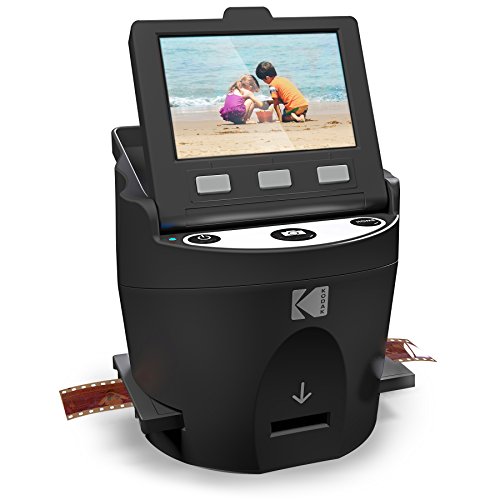
Slides are the cruelest format in the family archive: hundreds of Kodachrome frames of the 1960s and 70s, and no projector on earth still working to show them. The Slide N Scan is the pragmatic rescue. It is a small lightbox-and-camera unit with a 5-inch screen: slide the adapter tray through, and each frame appears instantly, corrected and bright, ready to save as a 22-megapixel JPEG to an SD card. A carousel of 140 slides takes well under an hour once you find the rhythm.

Purists will note, correctly, that this is digitizing rather than drum-grade scanning: the 22MP figure is interpolated, fine detail trails a real film scanner, and output is JPEG. For the actual job, making Grandpa's slides viewable, shareable, and printable at normal sizes before another decade fades them, none of that matters. What matters is that the whole workflow lives in the device, no computer required, which is why this thing has digitized more attic carousels than every pro film scanner combined. Frame the best rescues properly; our frame size guide covers the odd sizes old prints come in.

Also Great

The friendly answer to the carousel of slides in the attic. Feed 35mm, 126, or 110 slides and negatives through the quick-feed tray, watch each one appear on the 5-inch screen, and save 22MP JPEGs to an SD card. No computer, no learning curve, no service fees.

Buy this if your inheritance includes slide carousels and negative strips and you want them visible again this weekend. The screen-and-SD-card workflow means zero software setup: push film through the tray, see the image instantly, press save. It is the machine you can hand to a retired parent and expect finished results.

What we don't like

It is a digitizer, not a precision film scanner: 22MP interpolated JPEGs are wonderful for sharing and prints up to 8x10, but serious photographers wanting maximum detail from negatives should look at the Plustek 8300i below. Dust control is manual, so blow off each slide before it goes in.

Best Slide Scanner UpgradeAlso Great

Formats

35mm, 126, 110 slides and negatives

Screen

7-inch tiltable LCD with gallery mode

Feed

Quick-feed tray

Computer

Not required

Pros

  • Big tilting screen makes long sessions comfortable
  • Gallery mode for reviewing finds on the device
  • Same fast tray-feed workflow
  • Still works entirely without a computer

Cons

  • Same interpolated output as the standard model
  • $20 premium is wasted on tiny collections

The Max is Kodak admitting what slide digitizing actually is: hours of squinting at a small screen deciding whether that is Uncle Ray or motion blur. The 7-inch display, nearly double the standard model's viewing area, tilts up toward you like a little easel, and after an hour of feeding strips the ergonomic difference stops being trivial. Gallery mode adds the pleasure the project deserves: flip through the evening's recoveries right on the device, with the family crowded around, before the card ever reaches a computer.

Underneath it is the same machine, the same formats (35mm, 126, 110), the same tray feed, the same computer-free SD workflow, and the same honest ceiling on ultimate quality. Our rule of thumb: one carousel, buy the standard model; a closet shelf of carousels, buy the Max and thank the bigger screen by carousel three. Either way, the point is the same, those frames come back to life. Display the best of them properly; a digital art frame that cycles through the restored archive is the single best gift this project produces.

Also Great

The same beloved workflow with a tiltable 7-inch screen and a gallery mode, for $20 more. The bigger display sounds like a luxury until you are judging focus and color on frame 400 of the evening; then it is the reason you finish the project.

Buy this over the standard Slide N Scan if you are digitizing a large slide collection or doing it with (or for) older eyes. The 7-inch tilting screen turns the device into a tiny viewing station, the gallery mode lets the family review the evening's finds together, and the quick-feed tray keeps long runs moving.

What we don't like

Same honest limits as its smaller sibling: interpolated resolution, JPEG output, manual dust duty. And if your collection is a single carousel, save the $20.

Best Budget Film ScannerBudget Pick

Formats

35mm, 126, 110 film and slides + Super 8 frames

Output

24MP JPEG, 128MB built-in memory + SD

Screen

5-inch LCD with HDMI out

Computer

Not required

Pros

  • Reads more formats than anything near its price
  • HDMI out turns digitizing into a family event
  • Built-in memory works even without an SD card
  • Simple enough for any generation to run

Cons

  • Super 8 is frame-by-frame stills, not video conversion
  • Budget-tier detail and dynamic range
  • Manual dust duty, like all budget digitizers

Real attic boxes are not curated: a strip of 35mm here, a 110 cartridge from a 1978 Instamatic there, a short reel of Super 8 nobody can play. The FS71's pitch is one $130 device that accepts all of it. Adapters handle each format, a 5-inch screen previews every frame, and files land on internal memory or an SD card at 24MP. It is the least intimidating film digitizer we have found, and the one we recommend when the project belongs to a parent or grandparent working alone.

The feature that makes it a Sunday tradition rather than a chore: HDMI out. Connect it to the living room TV and every frame appears at 55 inches as it is scanned, which converts a solitary task into two hours of "wait, is that the old house?" Set expectations correctly, the optics are budget class, Super 8 comes across as individual still frames rather than motion, and dust you do not blow off gets immortalized, and this is the best $130 this project can spend.

Budget Pick

The widest format coverage per dollar in the guide: 35mm, 126, and 110 film and slides plus Super 8 movie film frames, with a 5-inch screen, HDMI out to the living room TV, and built-in memory, for $130. The family-night digitizer.

Buy this if the attic box is a mixed bag, some 35mm strips, some ancient 110 cartridges film, a reel of Super 8, and you want one affordable device that reads them all. The HDMI output is the sleeper feature: plug it into the TV and the whole family watches each frame surface in real time.

What we don't like

Super 8 support means scanning individual movie frames as stills, not converting whole reels to video, a common misreading of the listing. Image quality is honest budget tier: great for sharing, not for gallery prints.

Best for Serious Film QualityUpgrade Pick

Format

35mm film and slides only

Resolution

7200 dpi optical

Dust removal

Hardware infrared channel

Software

SilverFast SE Plus 9 + QuickScan bundled

Pros

  • Real film-scanner optics, not interpolation
  • Infrared dust and scratch removal that actually works
  • Pulls print-grade detail from good negatives
  • Serious bundled software with room to grow

Cons

  • 35mm only, frame by frame
  • Slow at full quality
  • SilverFast has a learning curve

Somewhere in most family archives are a few dozen frames that were shot well, a father who read the Kodachrome instructions, an aunt with a good eye, and those frames deserve a real scanner. The difference is not subtle. A budget digitizer photographs the frame through modest optics and calls it 22 megapixels; the 8300i draws a 7200 dpi sensor across the film and resolves the actual grain. Faces in the background become faces. The lake becomes a specific lake.

The infrared channel is the other half of the argument. Fifty-year-old film carries fifty years of dust and micro-scratches, and retouching them by hand is the task that kills archive projects. The 8300i scans an infrared pass that sees defects separately from the image and removes them from the data, cleanly, automatically, frame after frame. Our honest workflow advice: run the whole collection through a Kodak or Magnasonic digitizer first to triage, then bring the fifty frames that matter to this machine and SilverFast. That two-pass approach gets the archive done AND done justice, and it is exactly how we would spend the money. For what those fifty frames become on paper, see our large-format printer guide.

Upgrade Pick

When the negatives deserve better than a digitizer: 7200 dpi dedicated 35mm optics, infrared dust and scratch removal, and the bundled SilverFast SE Plus 9 software. This is the machine that finds the detail Kodachrome has been holding for fifty years.

Buy this if the family shot slide film worth taking seriously, or you shoot film yourself. A well-exposed 35mm frame holds far more detail than any budget digitizer extracts; the 8300i's real 7200 dpi optics recover enough of it for large prints, and its infrared channel removes dust and scratches from the scan data itself rather than smearing pixels.

What we don't like

It is 35mm only, one frame at a time, and genuinely slow at maximum quality, minutes per frame, not seconds. SilverFast is powerful and famously dense; budget an evening to learn it. This is a craft tool, not a shoebox emptier.

Head-to-Head

How the top picks compare

The two matchups that decide most photo-scanner purchases: the battle of the feeders, and the two ways to rescue a slide collection.

Epson FastFoto vs ScanSnap iX2500 Photo Edition: Which Feeder?

The photo-first machine against the document king that learned photos.

Epson FastFoto FF-680W

Epson

Winner

Epson FastFoto FF-680W

Photo-first: stack feeding, back captions, restoration

$629.99
Check Price →
ScanSnap iX2500 Photo Edition

ScanSnap

ScanSnap iX2500 Photo Edition

Best-in-class feeder, touchscreen, $214 less

$415.99
Check Price →

Our verdict

Winner: Epson Epson FastFoto FF-680W. For the family-archive mission, the FastFoto wins on the photo-specific details: it was designed around stacks of prints, it pairs each photo with the handwriting on its back in a single pass, and its restoration pipeline is tuned for faded consumer prints rather than faded invoices. Those are exactly the features you use on photo number 1,400, and they are why the photo-first machine earns its premium at real volume. The ScanSnap's case is total-household value: its feeder pedigree is arguably the best in the business, the 5-inch touchscreen makes it the easiest scanner in this guide to operate, and it will still be earning its keep on tax documents years after the photo project ends, all for $214 less. Our line: collections in the thousands, or archives where the back-of-print captions matter, buy the Epson; collections in the hundreds attached to a household that also drowns in paper, buy the ScanSnap and put the savings toward a film digitizer for the slides.

Buy the Epson

the photo archive is the mission: thousands of prints, captions on backs, deep restoration.

Buy the ScanSnap

you want one machine for photos and the whole household's paperwork, and $214 back.

Kodak Slide N Scan vs Plustek 8300i SE: Easy or Excellent?

The screen-and-SD digitizer against the real film scanner.

Kodak Slide N Scan

Kodak

Winner

Kodak Slide N Scan

Instant, computer-free, a carousel per hour

$189.99
Check Price →
Plustek OpticFilm 8300i SE

Plustek

Plustek OpticFilm 8300i SE

7200 dpi optics, infrared dust removal

$429.00
Check Price →

Our verdict

Winner: Kodak Kodak Slide N Scan. The Kodak wins for most families because the real enemy of a slide collection is not resolution, it is another decade in the attic. At $189.99 with a screen, a fast feed tray, and zero software, it converts carousels into shareable images at a pace that gets the whole collection actually done, and for viewing, sharing, and prints up to 8x10 its output is genuinely satisfying. The Plustek is the better scanner by every optical measure, real 7200 dpi resolution that recovers what the film actually holds, infrared cleaning that erases fifty years of dust from the data, but it is 35mm only, frame-by-frame, minutes per scan, and it asks you to learn SilverFast. It rescues the fifty best frames magnificently and would take a year to rescue three thousand. The workflow we actually recommend: Kodak first for the entire collection, then the Plustek for the frames that turn out to deserve it. If you must own only one, own the one that finishes: the Kodak.

Buy the Kodak

you want the whole slide collection digitized and viewable this month.

Buy the Plustek

you are extracting maximum quality from a curated set of well-shot frames.

How we
chose

We judged photo scanners the way a family archive project actually unfolds, from the first box to the finished backup:

  • Time to a finished archive. The dominant spec. We favored machines whose workflow survives contact with 2,000 photos: batch feeders for loose prints, tray-feed digitizers for slides, and honest warnings about flatbed-only plans.
  • Handling safety. What each machine can accept without risk: roller-feed limits, album and fragile-print accommodations, and one-at-a-time control where it matters.
  • Real-world image quality. Judged against the medium: old prints need faithful color and 600 dpi, not marketing dpi; film rewards true optics and infrared dust removal, and we said which machines deliver it.
  • Workflow independence. Machines that work without a computer (screen and SD card) scored points for the many archives digitized by the generation that owns them.
  • Live verification. Every ASIN, price, and product image on this page was pulled live from Amazon's catalog this week. Where a price is distorted by scarcity, as with the Epson V600, we say so plainly instead of pretending it is normal.

Share this guide

Share

Common Questions

Frequently Asked Questions

Have art
to sell?

Austin Gallery specializes in selling inherited art, estate collections, and fine art with zero upfront fees. Get a free evaluation today.