The Austin World School Guide: How Texas Families Take Homeschool On The Road
Texas families have a structural advantage when it comes to worldschooling: Leeper protections, no registration, $0 state income tax, and the strongest mail-forwarding ecosystem in the country. This is the logistics-first guide to taking your homeschool on the road — curriculum, internet, insurance, banking, and the 90-day plan from withdrawal letter to wheels-up.
By Austin Gallery
Most worldschooling guides sell you the dream. This one tells you what to do this week — write the withdrawal letter, set up the Texas mail-forwarding box, pick the curriculum, buy the Starlink — so that ninety days from now you're on the road and your kids are still legally in school.
We wrote it because the bar for the genre is low. The top-ranking pages for "worldschooling guide" in 2026 are mostly families journaling their own adventures — beautiful, but not very useful when you're trying to figure out whether you can keep your driver's license, what insurance covers your eight-year-old in Bali, or which curriculum works without internet on a Croatian ferry. The mechanics matter. They're the difference between a year you remember forever and a year you cut short three months in because you forgot to file something with the State of Texas.
If you're based in Austin or anywhere else in Texas, you have a structural advantage most American families don't. The state already treats your homeschool as a private school under Leeper v. Arlington ISD — no registration, no testing, no portfolio reviews — and the same rules that let you teach from your kitchen table let you teach from a beach in Sintra. The infrastructure for full-time travelers (Escapees domicile in Livingston, the Texas Education Freedom Account, no state income tax) was built for this. Most families don't realize how good they have it.
If you're based in Austin or anywhere else in Texas, you have a structural advantage most American families don't.
This guide contains affiliate links. If you click through and buy a product or sign up for a service, Austin Gallery may earn a small commission at no extra cost to you. We only link to things we'd use ourselves — and many of the picks here are tools our own founder is researching for his family's transition.
4.5MTraveling families currently living the digital nomad life (MBO Partners, 2026)
$2,000/yrTEFA Education Savings Account per Texas student
0Registrations, tests, or government approvals required by Texas
6Boundless Life worldschool campuses across Europe, Asia, and the Americas
What You'll Find in This Guide
Texas law in 5 minutes — the same Leeper protections that work at home work abroad. No registration, no testing, no permission needed.
Establish a Texas home base in a weekend — Escapees mail forwarding, voter registration, banking that works in any country.
Pick your travel mode honestly — RV vs. Airbnb hops vs. worldschool hubs vs. hybrid. With real monthly budgets, not Instagram fantasies.
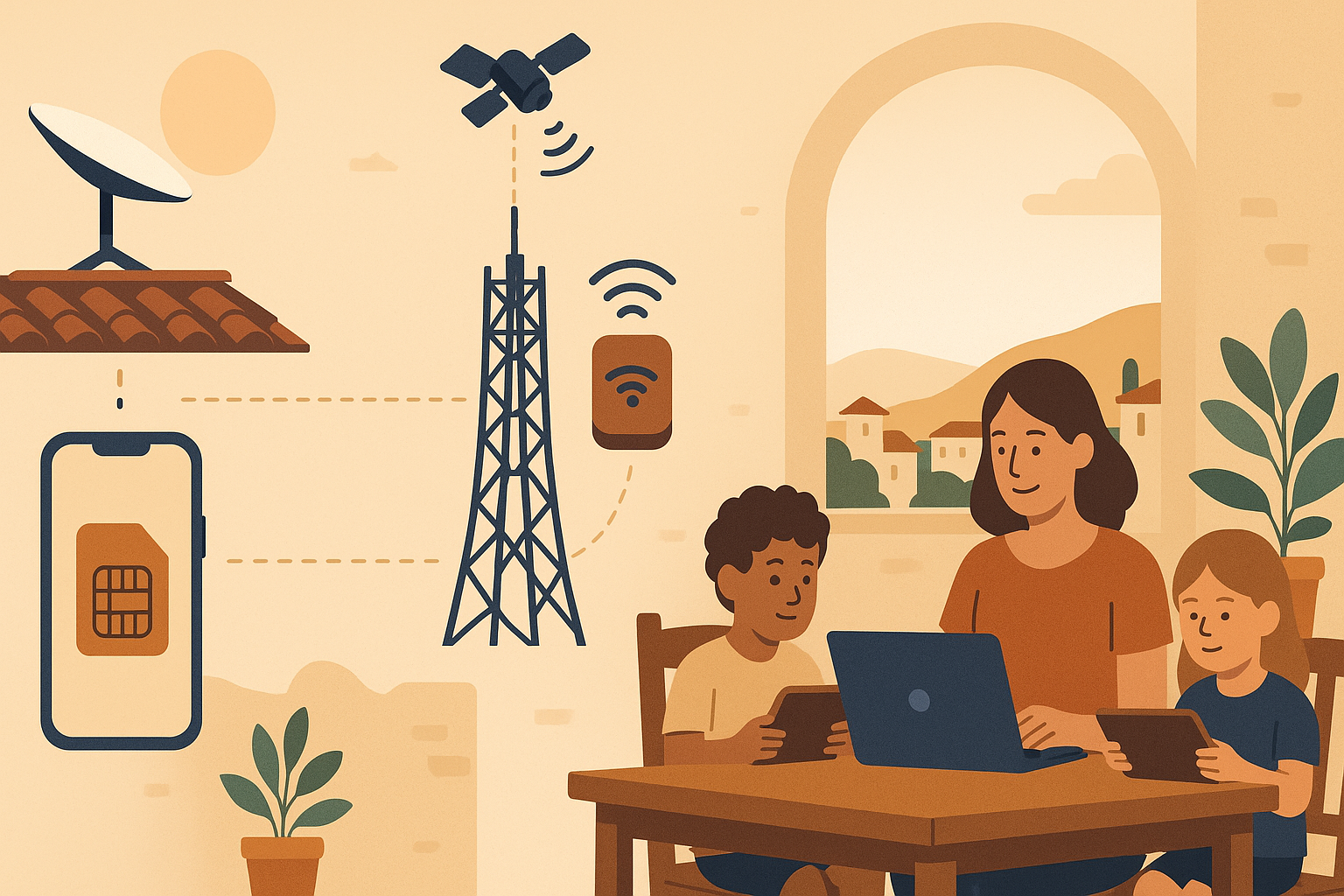
The internet stack that actually works — Starlink Mini + cellular hotspot + local eSIM. Three layers, ≈$200/mo, 99% uptime.
Curriculum that travels — Time4Learning, Outschool, KiwiCo, BookShark, and the offline backbones that work without Wi-Fi.
Insurance, banking, and money mechanics — SafetyWing, Schwab, Wise, the cards with no foreign transaction fees.
The First 90 Days plan — week-by-week from withdrawal letter to wheels-up.
The Texas Advantage: What You Keep When You Leave
Worldschooling is a special case of homeschooling — it's homeschooling that intentionally uses travel and place as part of the curriculum. The legal substrate is identical. If you can homeschool from Austin, you can homeschool from anywhere on Earth, because the Texas legal framework follows the family, not the address.
The Five Requirements (still apply when you're abroad)
In Texas, homeschools are treated as private schools under state law. The Texas Supreme Court established this in Leeper v. Arlington ISD (1994), and the ruling has never been successfully challenged. Your homeschool — wherever in the world it's currently operating — must meet five requirements:
The instruction must be bona fide — you're genuinely teaching, not just keeping the kids home. Good-faith standard, not bureaucratic.
You must cover five subjects: reading, spelling, grammar, mathematics, and good citizenship. Beyond those five, total curricular freedom.
The curriculum must be in visual form — books, workbooks, online courses, videos, worksheets. Virtually every modern curriculum qualifies.
You do not need to register with the state, your school district, or any government agency. There is no homeschool registry in Texas — and there is certainly none for travelers.
No required standardized tests, no annual portfolio reviews, no attendance tracking.
Notice what's missing: any reference to a physical address, a residency requirement, or a domicile check. Texas does not care whether your "school" is operating in Westlake or Wellington. That's the structural advantage.
How to Withdraw From Public School (do this first)
If your kids are currently enrolled in a Texas public school, send a written withdrawal letter to the school district. You do not need their permission — the letter is a notification, not a request. State that:
The effective date of withdrawal
That you intend to homeschool under Texas private school law
That your curriculum will cover the five required subjects in a bona fide manner
Send it certified mail and keep a copy. THSC has a free withdrawal letter template you can copy verbatim. After the letter is delivered, your kids are no longer truants — they're legally enrolled in a private school you're operating, and the school district has no further claim on them.
Travel Note
Once you've withdrawn, you don't need to "re-withdraw" if you move states. Your homeschool exists under Leeper regardless of where the family physically sleeps. If you eventually settle in another state, you'll re-comply with that state's rules — but mid-trip, while you're domiciled in Texas, Texas law travels with you.
TEFA: $2,000 Per Year, Per Student (and yes, you can spend it from abroad)
The Texas Education Freedom Act (2025) deposits $2,000 per year per student into a state-managed Education Savings Account that pays for curriculum, tutoring, therapy, and accredited extracurriculars. Applications for the 2026-2027 school year run through March 31, 2026, via the TEA portal.
The funds are eligible for use against approved providers — and most online curriculum providers (Time4Learning, BookShark, Outschool, KiwiCo) have either applied to be on the approved list or are seeking it. The location where your kid uses the curriculum is not in the eligibility test. We've seen no TEA guidance suggesting a Texas-domiciled student forfeits their account by traveling abroad — but the policy is new and the wording is being clarified through 2026. Keep your domicile clearly Texas (see Section 2), keep receipts, and confirm with TEA before you commit large 2026-2027 spend abroad. Don't let the $2,000 go uncollected because you're traveling — collect it, use it on something approved, document it.
State Income Tax: $0 (and you keep it abroad)
Texas has no state income tax, no taxes on vehicle transfers, and a court-tested mail-forwarding-as-residency posture that Florida and South Dakota only partially match. If you're a US citizen working remotely while traveling, your federal tax obligation is what it is — but your state obligation stays at zero as long as your domicile remains Texas. Don't accidentally domicile yourself somewhere else by moving your driver's license to a Colorado mailbox.
If You're Not in Texas
Your home state's homeschool laws still travel with you while domiciled there. The states most worldschooling families re-domicile to before leaving the country are Texas, Florida, and South Dakota — all three are nomad-friendly with no state income tax and accept PMB addresses for residency. If your current state is California, New York, Pennsylvania, or Massachusetts, the registration/notification burden is meaningful, and worldschoolers from those states often establish a TX/FL/SD domicile before departing. We cover this in Section 10.
Establishing a Texas Home Base on the Road
Domicile is the legal concept that matters here. It's not where you sleep tonight — it's where you intend to maintain a permanent connection. Your domicile drives your driver's license, vehicle registration, voter registration, jury duty, state tax, and (for our purposes) which homeschool law applies. While you're traveling, you need a Texas address that mail can be sent to and that legal documents will recognize.
Mail Forwarding: Comparison Table
Three mail-forwarding services dominate among Texas-domiciled nomads. The differences come down to whether they're recognized for domicile (not all PMB services are), how fast they scan inbound mail, and what they do with packages.
If domicile is the priority, Escapees in Livingston is the canonical choice. They run their own campground in Livingston, and the county officials there have processed thousands of nomadic Texans through driver's license renewals, voter registration, and vehicle inspection. That is a real advantage when you eventually need to renew your license while you happen to be in Bali.
Driver's License + Vehicle Registration
Texas DPS offices accept the Escapees Livingston address for license renewal. If you're already a Texas resident, you don't need to do anything special before leaving — your existing license will renew on its normal schedule, and you can renew online once for one cycle before needing to present in-person again. Vehicle inspection (where required) and registration also work through the Livingston office — Escapees handles forwarding the sticker to wherever you currently are.
Voter Registration + Absentee Ballots
Once your domicile address is set in Polk County (Livingston is the seat), register to vote using that address. Texas accepts ballot-by-mail for voters who'll be absent on Election Day, including overseas — request a ballot in each election cycle and Escapees forwards it to your current address. Easier than it sounds.
Banking That Works Abroad (Critical)
Most US banks treat international ATM withdrawals as a tax. Two accounts solve this:
Charles Schwab High-Yield Investor Checking — refunds ALL ATM fees worldwide. No foreign transaction fee. No minimum balance. Free wire to international accounts. The only nomad-banking hack everyone agrees on.
Wise Multi-Currency (formerly TransferWise) — hold balances in 40+ currencies, get local account numbers in USD/GBP/EUR/AUD, and convert at near-mid-market rates. Pair this with Schwab and you're set for any country.
Fidelity Cash Management — backup account, also reimburses ATM fees globally, with brokerage attached.
Most US credit unions and regional banks will fight you on PMB addresses — they read the Patriot Act narrowly. If your bank does, switch to one of the above before you leave. Don't try to argue with a bank from a hostel in Lisbon.
Storage in Austin
If you're keeping a base load of belongings in Austin while you travel — books, art, kid stuff you'll grow back into — three storage operators dominate:
For a family of 4 doing a 6–12 month worldschool with seasonal wardrobe + a dozen boxes of books and kids' art, a 10x10 climate-controlled unit ($150–200/mo) handles it. Don't oversize. The mental cost of "I have a 10x20 full of stuff I haven't seen in 8 months" weighs more than the rent saved by going smaller.
There is no single "worldschool" lifestyle. There are four distinct modes, and the mode you choose determines almost everything downstream — budget, internet stack, curriculum density, kid socialization. Pick deliberately.
Mode 1: RV / Trailer Life (US-only, full kitchen, pets included)
Best for: Families with elementary-and-younger kids, a dog, a strong desire for a full kitchen, and a US-focus for the first 6–12 months. Lower passport-bureaucracy overhead. National parks become the curriculum.
Realistic monthly budget for a family of 4:
Line Item
Monthly
RV/trailer payment + insurance
$400–900
Diesel/gas (1,500 mi/mo)
$400–550
Campground / RV park
$400–900
Groceries (cook 90% of meals)
$900–1,200
Internet (Starlink + cellular)
$200–230
Curriculum + activities
$150–300
Health insurance
$400–800
Misc / repairs / kids' clothes
$300–500
Total
$3,150–5,380
The hidden cost is repairs. RVs are houses on wheels that get earthquake-tested every day. Set aside an extra $200/mo as a repair buffer, even on a 2024-model rig.
$200
Set aside an extra /mo as a repair buffer, even on a 2024-model rig
Best for: Families ready to leave the US. Kids 0–10 are easy to slot into any neighborhood. Houses come furnished. You're spending 30–60 days per location, which is the magic length for kids to stop asking "when can we go home" and start saying "when can we go to Marco's house."
Realistic monthly budget, mid-cost European cities (Lisbon, Krakow, Athens), family of 4:
Line Item
Monthly
Apartment (Vrbo or Airbnb, 30+ day stays for monthly discount)
$1,500–3,000
Groceries + dining out 30%
$1,000–1,400
Local transport (transit + occasional Uber)
$200–350
eSIM + Wi-Fi backup
$40–80
Curriculum + activities
$200–400
Health insurance
$300–500
Flights (averaging 2 hops/quarter)
$300–600
Total
$3,540–6,330
Booking.com wins for short stays under a week. For 30-day rates, Vrbo and Airbnb both honor monthly discounts of 20–40%. Always negotiate directly with the host if you're staying more than a month — many will discount further for a guaranteed booking.
A second small purchase that pays off across every Mode-2 stay: a set of compression packing cubes. When you're moving every 30-60 days, the difference between "live out of the suitcase" and "actually unpack" is whether your kids' clothes are in three labeled cubes or one chaotic pile. Worth the $35 the first stay.
Mode 3: Worldschool Hubs (turnkey, community built-in)
Best for: Families who don't want to plan housing or schooling. You arrive, your apartment is ready, your kids' classroom is across the courtyard, and there are 40 other traveling families in the village.
Operators in 2026:
Boundless Life — six campuses (Sintra Portugal, Syros Greece, Tuscany Italy, Sanur Bali, Kotor Montenegro, Estepona Spain). 1–6 month residencies. Apartment + kids' education center + co-working included. Premium price ($4–6K/mo per family) but every logistical pain disappears.
Worldschool Pop-Up Hub — week-long gatherings rotating through 12+ countries. Less expensive than Boundless because you BYO housing; the value is the community and field-trip programming.
Galileo XP — accredited project-based microschool, partners with Boundless and runs independent locations.
Mode 4: Hybrid (6 Austin / 6 on the road)
Best for: Families with a real Austin home, in-laws nearby, kids in local sports leagues they don't want to leave. The hybrid year is school-year-on / summer-and-fall-off, or vice versa. You keep the Austin lease (or own outright) and travel half the year.
Hidden advantage: the hybrid is also the easiest to TELL relatives about. "We're going on a long trip, then we'll be home for the holidays." Saves you 100 conversations. The flip side is you pay for housing twice during the away half.
Internet Setup for Roadschool (the #1 Thing Families Get Wrong)
If your remote-work paycheck depends on Zoom, the single most important investment you make is internet redundancy. We've watched families fly to Bali, find their Airbnb has 3 Mbps shared with 12 villas, and book a flight home a week later. Don't be that family.
The working setup is three layers:
Primary: satellite
Backup: cellular hotspot
In-country: local eSIM
If any one layer fails, the other two carry you. Total cost: ≈$200/mo plus hardware.
Austin Art Insider
Free weekly guide to galleries, exhibitions & collecting in Austin.
Layer 1: Starlink Roam (Mini or Standard)
Starlink is the only satellite option that actually works for roadschoolers in 2026. Two relevant SKUs:
Starlink Mini ($249 hardware + $50/mo for 100GB Roam, or $165/mo for unlimited). Suitcase-sized, sets up in 5 minutes, works internationally with the Roam Global plan.
Starlink Standard ($349 hardware + same monthly tiers). Larger antenna, better in marginal sky.
Starlink Mini is the right pick for international travel and slow Airbnb hops. Starlink Standard is the right pick for full-time RVers who'll mount it permanently.
Layer 2: Cellular Hotspot
In the US, T-Mobile 5G AWAY ($110/mo for 200GB, $160/mo unlimited, no equipment fee) is the cleanest hotspot option for highway corridors and urban areas. Verizon's hotspot plans are similar; pick whichever has the best coverage along your planned route.
For RV-mounted setups, a router that takes a cellular SIM and external antenna outperforms a phone hotspot. Two picks at very different price points:
Peplink Balance 20X — $499 — the small-business-grade router RV nomads run. Failover across SIM + Starlink + Wi-Fi automatically. See on Amazon →
GL.iNet GL-MT3000 (Beryl AX) — $99 — pocket-sized travel router for Airbnb hops. Shares any hotel Wi-Fi as your private network, accepts a cellular SIM. See on Amazon →
Both ship internationally if you order in advance. Pair whichever router you pick with a travel surge protector with USB — Airbnb wiring in older European apartments is a real risk to a $499 router, and a good surge strip protects the laptops too. If you're leaving the US, add a universal international plug adapter — the all-in-one block beats carrying four country-specific adapters and is the cheapest piece of gear that prevents real Day-1 problems.
Layer 3: International eSIM
When you land abroad, your US carrier's roaming fees will eat your budget. The fix is an eSIM in your phone that uses local networks at local prices. Three players to know:
Airalo — country and regional plans starting at ≈$5 for a few GB. Most cosmopolitan: works in 200+ countries.
Saily — built by NordVPN's parent company, includes a built-in adblock/ad-tracking blocker. Pricier than Airalo on small plans, sometimes cheaper on regional.
Holafly — unlimited data plans, no GB cap. More expensive per day but worth it if your job demands HD video.
A typical month of intra-Europe travel: Airalo regional plan, $35 covers 30 days / 5 GB across 33 countries. For unlimited Bali video calls, Holafly's $50/30-day plan is the simpler answer.
≈1.6 GBPer day per family of 4 (Zoom + streaming + work)
$200–230/moCombined Starlink + cellular for full redundancy
99%Uptime achievable with the 3-layer stack
$5–50Airalo regional eSIM, depending on data + countries
Curriculum That Travels With You
The curriculum question is the one most families overthink. Here's the honest answer: pick a backbone, layer two or three supplements, and use the world as the rest. The backbone provides structure on travel days when you can't be original; supplements fill the gaps the backbone is weak on; and field trips, languages, and real-world experiences fill the rest.
Best for families who want physical books and Charlotte Mason / classical lean
Time4Learning is the practical default. It's secular, K–12, $24.95/mo for the first child, and the lessons run cleanly offline once cached on a tablet. BookShark is the choice if you want physical books — they ship internationally and the weekly schedule is plug-and-play. Power Homeschool and Acellus both offer accredited transcripts, useful if you'll re-enter a brick-and-mortar high school later or apply to selective colleges.
Live-Class Supplements
Backbone curricula are asynchronous. Kids need at least some live-instructor or peer time per week, and that's where the live-class platforms shine:
Outschool — à la carte live + recorded classes from $10–50 each. Topics range from creative writing to chess to Minecraft engineering. Take one or two per week; pick by your kid's current obsession.
Prisma — small synchronous classes, K–12, project-based. Premium price (≈$650/mo) but you get a real classroom experience plus actual classmates your kid sees daily.
Galileo XP — accredited project-based microschool. Available standalone or paired with Boundless Life campuses.
Subscription Boxes That Find You Anywhere
The genius of KiwiCo for traveling families: each crate is one self-contained STEAM project (paint set, fossil dig, paper-airplane physics) and KiwiCo ships to your forwarding address — Escapees forwards to wherever you currently are. Nine different age-targeted lines (Tadpole 0–3 to Eureka 14+); pick the line that matches your kid's age and let it auto-deliver monthly.
Beast Academy is the math program serious traveling families add on top — it's by the people behind the Art of Problem Solving and produces kids who actually understand math, not just compute it. Online or physical workbooks; ships internationally.
Free + Cheap Tools Every Worldschooler Uses
These are universal — no affiliate program, just real recommendations.
Khan Academy (free, K–college) — backbone for math review and SAT prep
CommonLit (free) — reading + comprehension practice with thousands of texts
Newsela (free + paid) — current events at five reading levels
MIT OpenCourseWare (free) — for high schoolers ready for college-level material
Duolingo (free) — local language for whatever country you're in
Mystery Science — short K–6 video science lessons
The Classics (paper + pencil, no internet required)
Travel-day backup curriculum. When the Wi-Fi dies and the Starlink isn't aligned and the kids still need to do school, you reach for paper. Buy these once and they last the whole trip.
Saxon Math Homeschool Kit — $90–110 per grade level — the K-12 spine traveling families default to. 120 incremental paper lessons per book, zero screens required. Find on Amazon →
Singapore Math Primary Mathematics — $25–40 per textbook — visual + concept-first math, lighter packs than Saxon. The choice if your kid hates repetition. Find on Amazon →
Story of the World by Susan Wise Bauer — $15–35 per volume + audio — four-volume narrative-history sequence with audiobook. Plays in the car, the train, the tuk-tuk. The single best curriculum-in-a-backpack purchase. Find on Amazon →
Brave Writer: The Writer's Jungle — $45 — writing curriculum that fits in a backpack and works at any age. Pair with a $4 composition notebook per kid. Find on Amazon →
The Health & Insurance Stack
Your US health insurance generally vanishes at 30,000 feet. Even Marketplace plans cap "out-of-network" coverage at the US border. You need an explicit travel/expat policy, and the right pick depends on how long you'll be abroad and how old your kids are.
Kids under 10: included free, up to two children per adult policy
Format: rolling 28-day subscription, auto-renews, cancel anytime
Coverage: worldwide except your home country (with brief incidental coverage when home)
Buy after departure: unique to SafetyWing — you can buy while already abroad, not just before departure
The kids-under-10-free policy is what tips this for families. A family of 2 adults + 2 kids under 10 is ≈$112/4-week period — ≈$1,460/year. That is preposterously cheap for the coverage.
Allianz — For Long Stays in One Country
If you're settling in one country for 6+ months, Allianz Global Health is the more comprehensive (and more expensive) policy. Better for families with a kid managing a chronic condition (T1 diabetes, asthma, ADHD with ongoing prescriptions). Annual policies, broader specialist network, real expat-grade coverage.
IMG Global — Medical Powerhouse, Higher Cost
IMG Global plans run more expensive but offer the highest medical coverage limits ($1M+) and are the answer if you're going somewhere with limited healthcare infrastructure (rural Latin America, Southeast Asia outside major cities) where medical evacuation may be a real concern.
World Nomads — Trip-Based, Activity-Friendly
World Nomads is per-trip rather than rolling-monthly; better fit for families taking discrete 1–3 month trips rather than year-long open-ended ones. Their differentiator is broad activity coverage (snorkeling, hiking, mountain biking) that other policies exclude.
Telehealth: Don't Skip This
Subscribe to a US telehealth service before you leave. Teladoc is the largest; many US health insurance plans include access for free or low cost. From any country with internet, your family can talk to a US-licensed pediatrician for routine ear infections, rashes, or "is this normal" calls. Saves a lot of unnecessary clinic visits abroad.
The Travel Medical Kit
Build a kit before you leave. Pharmacy quality varies wildly abroad — packing this from a US Target or Amazon order is faster than scavenging in a Bali pharmacy at midnight when your kid spikes a fever. The full kit fits in a one-quart Ziploc.
Children's Tylenol + Motrin liquid — $8 each — alternate every 4 hours for a fever; bring both. Buy on Amazon →
Children's Benadryl + Zyrtec — $10 each — one for acute reactions, one for daily allergies. Different countries' pollen will surprise you. Buy on Amazon →
Imodium + Pepto chewables — $15 combo — traveler's stomach is the #1 trip-killer. Don't leave without this. Buy on Amazon →
Liquid IV hydration packets — $24 / 16-pack — rehydrates a sick kid faster than water. Single-serve so they pack flat. Buy on Amazon →
Compact travel first-aid kit — $20 — bandages, gauze, hydrocortisone, antibiotic ointment in one tin. Pre-built saves 30 min of curating. Buy on Amazon →
Forehead no-touch thermometer — $30 — the iHealth or Femometer model. Two seconds, no waking the kid. Buy on Amazon →
30-day buffer of prescription medications — pack with the doctor's note in case customs asks. No affiliate link — talk to your pharmacist a month before departure.
The "Go Home for the Dentist" Hack
US-priced cleanings abroad in tourist-heavy destinations are not actually that cheap. A flight to Austin, two cleanings, and a flight back can be cheaper than equivalent quality care in some destinations. Plan dental visits around US trips for the kids, not around your travel cycle abroad. Same logic for vision exams.
The banking section above (Schwab + Wise + Fidelity) covers your transactional needs. Here's the credit-card and tax layer.
Cards With No Foreign Transaction Fees
The three to know:
Chase Sapphire Preferred — $95/yr, no FTF, strong travel insurance built in (lost luggage, trip cancellation), and 3x points on travel + dining. Best general-purpose nomad card.
Capital One Venture — $95/yr (or $395 Venture X), 2x miles on everything, no FTF.
Bilt Mastercard — $0 annual fee, points on rent, dining, travel. Underrated for nomads with US rent or storage payments.
Carry two cards from different networks (one Visa or Mastercard + one Amex). Some countries (and most rural ATMs) reject Amex.
Tax Mechanics for Nomads (the Short Version)
You still owe US federal taxes as a US citizen, regardless of where you sleep. The US is one of two countries that tax based on citizenship.
Foreign Earned Income Exclusion (FEIE) lets you exclude up to ≈$130,000 of earned income (2026 figure) if you spend 330+ days in foreign countries during a 12-month period. File IRS Form 2555.
State taxes: if your domicile is Texas, you owe $0 state. Don't accidentally domicile yourself elsewhere.
Get a CPA who knows expat tax. It's not that expensive ($800–1,500/year) and they pay for themselves through FEIE alone.
Texas Registered Agent (if you have an LLC)
If you run a Texas LLC and you're traveling, you need a registered agent at a Texas address. Use a service ($100–150/year — Northwest Registered Agent, ZenBusiness, Harbor Compliance) so the state can serve your LLC documents to a real US address. This is separate from your mail forwarding.
Cash Strategy by Region
Always carry $200–300 USD in small bills as emergency cash. Convert at airports only when you have to (terrible rates). Use Schwab's fee-refund ATM access in the destination — best rate, smallest hassle. In countries that are still cash-heavy (Italy, Japan rural areas, parts of Latin America), pull a week's cash on arrival and pay locals in their currency, not yours.
Income Strategies That Travel With You
This isn't a guide on how to start a business — there are 10,000 of those. But you can't worldschool without an income story, and these are the patterns that actually work for families.
Remote W-2
The cleanest path. Confirm with your employer, in writing, that international work is allowed. Many US employers have policies that quietly forbid it (for tax-nexus reasons; if you work in France for 6 months, your employer may now owe French employer taxes). The conversation worth having: "I want to work from outside the US. How long is OK? Which countries are off-limits? Do I VPN through a US IP?" The answer informs your route.
Freelance / Consulting
Marketplace platforms (Upwork, Toptal, Contra) work fine from anywhere with internet. The challenge is time zones. East Coast clients + Asian destinations means you're working at midnight. Plan your route around your client mix.
Building Digital Products / Content
The aspirational path that 90% of family travel blogs sell. The reality: it takes years to monetize. If you're going to try, the realistic path is to start before you leave — build the audience while you still have a steady income, not after.
Stripe + Lemon Squeezy + ConvertKit is a sufficient stack to sell digital products from a beach. The discipline is treating it as a business, not a hobby.
Family-Collaborative
The kids ARE the worldschool curriculum, and the worldschool itself can BE the deliverable. A blog or YouTube channel run by the family — kids editing, writing, researching — is itself a learning project. It also means the mortgage on your business comes from your year of curriculum, not in addition to it.
The 18M digital-nomad data point (per MBO Partners, 2026) is real; the 4.5M of those traveling with families is the meaningful subset. You're not a unicorn for trying this. You're joining a real market.
The Worldschool Community
The single biggest predictor of "did this family enjoy the year" is whether the kids found friends. Adults adapt; kids need peers. Plug into the community deliberately.
Even without a paid hub, every major worldschool destination has a Facebook group, a WhatsApp group, and an after-school meetup at the playground around 4 pm. Search for "[city name] worldschoolers" or "[city name] expat families" on Facebook before you arrive. Show up with kids; the rest takes care of itself.
The most-active "unhubbed" cities for traveling families in 2026: Lisbon, Bali (Ubud + Canggu), Mexico City, Medellín, Chiang Mai, Tbilisi, Da Nang, Antigua Guatemala. Pick destinations where other families already are.
Very high friction. Re-domiciling commonly worth it.
Pennsylvania
Annual evaluation + standardized testing
Moderately high friction. Worth considering.
Massachusetts
District approval required + annual evaluation
High friction. Re-domiciling often worth it.
Re-domiciling, In Plain English
"Re-domiciling" means switching your legal home state — driver's license, voter registration, vehicle registration, mail address — from a high-friction state to a nomad-friendly one. Escapees and a few similar services exist explicitly to facilitate this. The transition typically takes 30–60 days and a single in-person visit to the new state. Worth it if your home state is in the high-friction column above. Talk to a tax attorney before you flip — getting the paperwork wrong on the front end can trigger residency audits years later.
The First-90-Days Plan
The best worldschoolers don't leave on a Tuesday. They leave at the end of a 90-day plan. Here's the timeline that works.
Days 0–7: Decide + Withdraw
Day 1: Family meeting. Decide the where, when, for-how-long. Pick a travel mode (Section 3).
Day 21: First KiwiCo subscription delivery to Escapees.
Day 25: Renew passports if any are within 1 year of expiring.
Days 31–60: Pack + Cleanup
Day 35: Furniture into Public Storage. Sell what you don't need.
Day 45: Talk to your CPA about FEIE eligibility and the 330-day rule.
Day 50: Apply for TEFA for the upcoming school year if you haven't.
Day 55: Set up Texas registered agent for your LLC, if applicable.
Day 60: Last weekend at home. Don't pack yet.
Days 61–90: Launch
Day 62: Pack. One bag per person, plus the curriculum kit, plus the Starlink. Don't overpack.
Day 65: Wheels up.
Day 75: First Sunday on the road. Family check-in: what's working, what isn't.
Day 90: First proper review. Adjust.
Real Family Sample Schedules
Here's a four-day "school week" (one full day for travel/exploring), time-zone-aware. This works whether you're in Austin or Athens.
Time (local)
Activity
Notes
7:30–8:30
Wake / breakfast / morning walk
Same routine every day, anywhere
9:00–11:00
Core academics (Time4Learning + Beast Academy)
Quiet hours for parent work
11:00–12:30
Real-world: museum, language class, hike
The "world" in worldschool
12:30–13:30
Lunch / kid downtime
Often eat out at this hour locally
13:30–16:00
Parent work block / kid project time
Outschool live class slots in here once a week
16:00–17:30
Park / playground / community
Kid-friend time is non-negotiable
17:30–19:00
Family dinner + reading aloud
Story of the World audio works great here
19:00–20:30
Wind-down / family movie / journal
One hour of sacred slow time
Friday is the field-trip day. Monday and Tuesday are the academic-heavy days. Thursday is the "catch up on what didn't get done" day. Wednesday is your best parent-work day because the kids have rhythm and you've banked four good days.
Chasing too many countries. Six countries in three months is a panic attack disguised as a year. Slow down. 30–60 days per stop is the working pattern.
No internet redundancy. One layer fails, the trip ends. Do the three-layer stack from Section 4.
Cancelling US health insurance entirely. Even if you have SafetyWing, keep a US Marketplace plan if you can. You'll come back.
No socialization plan for the kids. Solo-family travel for more than 4 weeks gets bleak. Plug into hubs, parks, FB groups, sports leagues — wherever you go.
Over-packing. One carry-on per person + one shared check-in is the working budget. You're not preparing for a year; you're preparing for the next 30 days. The next 30 days you'll buy what you need.
Ignoring kids' rhythm. Some kids do great with novelty; some need a known bedroom. You'll figure out which one yours is in week three. Adjust the pace accordingly.
No rest days. Schedule one "do nothing" day per week. Treat it as a non-negotiable. The novelty exhaustion is real.
No community plug-in. Go to the playground at 4pm. Show up at the worldschool hub. Ask the Airbnb host for kids' classes nearby. The community is there if you reach for it.
Is worldschooling legal under Texas law?
Yes. Texas treats your homeschool as a private school under Leeper v. Arlington ISD (1994). The legal framework follows the family, not the address. You can teach your kids from Austin or Athens with the same legal status.
Do I have to tell the school district I'm leaving the country?
No. Once you've withdrawn from public school via a written withdrawal letter, you're operating a private school. You owe them nothing — no relocation notice, no annual report, no return-from-abroad notification.
Can I still get TEFA money while traveling?
Most likely yes, as long as your domicile remains Texas and you spend on approved providers. The policy is new (2025), wording is being clarified, and we encourage families to confirm with TEA directly before committing the full year's spend abroad.
What about my kids' passports?
Apply at least 12 weeks before departure. Both parents must be present (or have notarized consent from the absent parent) to apply for a child's passport. Cost: $135/child for the book + $35 acceptance fee. The processing time fluctuates — 6–8 weeks is normal in 2026, longer near peak summer.
Will my US driver's license work abroad?
For short stays, usually yes. For driving in many EU countries longer than ≈3 months, you need an International Driving Permit (IDP) — get one from AAA before you leave for $20. It's a translation document, not a license; you carry both. In some Asian countries (Vietnam, Indonesia), the IDP is not officially recognized — research before driving.
What about voting?
Texas accepts ballot-by-mail for absent voters. Once your domicile is in Polk County (Livingston) via Escapees, request your ballot from the county before each election. You vote in your home precinct's races, regardless of where you currently are.
What's the right age to start worldschooling?
Anywhere from 4 to 14 is the sweet spot — kids are old enough to remember and young enough that academic continuity isn't critical. Starting at 15+ is harder because high-school transcripts and SAT prep timing matter; you're better off doing a single-summer pilot first.
How do my kids re-enter regular school later?
They will, and it's fine. Your kid's transcript shows worldschool credits. Most US public schools accept and place by interview/test for grades 6+ (some by parent-issued transcripts). For high schoolers, accreditation matters more — that's where Power Homeschool, Acellus, or Galileo XP earn their cost.
Will my kids fall behind academically?
Depends what "behind" means. If they're following Time4Learning's grade-level sequence + supplementing with real experiences, they're on track. Most families find their worldschooled kids are ahead in geography, history, languages, and social skills — and at par or slightly behind in spelling and grammar (which catch up fast on return).
What about socialization?
Real talk: this is the question every grandparent asks, and it's the least of your worries. Worldschoolers spend more time with adults, kids of multiple ages, and strangers in real social situations than schooled peers. The "what if my kid doesn't have friends" fear is real for a week — and then the kids find each other. Get them to the hub or the park.
Is it actually safe?
Statistically, family travel in most worldschool destinations is safer than US suburban driving. The fears are real but mostly about the unfamiliar, not the actual risk. Standard safety hygiene — don't keep cash + passport in the same place, register with the State Department's STEP program, keep copies of documents in cloud storage — handles 95% of risk.
Do you need to speak the local language?
For 30-day stops, no. Hello, please, thank you, sorry — that's the floor. Google Translate handles the rest. For 6+ month stops, learning the local language is part of the curriculum — your kids will pick it up faster than you do.
What about pets?
Possible, but RV mode is far easier than international hops. Bringing a dog to Europe means EU Pet Passport ($300–600), rabies title test ($100–200), microchip + vaccine timing requirements that take 90+ days. If you're going international, consider boarding the dog with family for the duration. If RV, the dog comes with.
How do you handle homesickness?
It happens, usually around month 2 or 3. The fix is a planned visit home — schedule a 7–10 day trip back to Austin around month 4 of a 12-month trip. Reset, see grandparents, then back out. Knowing the visit is on the calendar makes month 2 easier.
Can a single parent worldschool?
Yes — many do. Single parents tend to choose hub-based mode because the built-in community matters more. Worldschool Pop-Up Hub and Boundless Life both have meaningful single-parent representation in their cohorts.
What's the absolute minimum we need to start?
Withdrawal letter. Texas mail-forwarding address. SafetyWing policy. Time4Learning subscription. Starlink Mini. Two months of expenses in cash. First 30-day rental booked. That's it. Everything else can be figured out from the road.
This guide is updated regularly as programs and pricing change. Last updated April 2026. Internet pricing and curriculum costs in particular shift every 3–6 months — always verify before purchasing.