Key Takeaways
- Nancy Basket transforms invasive kudzu vine into stunning fiber art, merging Cherokee tradition with environmental activism
- Her work has been exhibited nationally and is held in important collections of Native American contemporary art
- Basket's process — harvesting, processing, and weaving kudzu — can take weeks for a single piece
In the rolling foothills of the Blue Ridge Mountains, nestled in the small town of Walhalla, South Carolina, lives one of America's most remarkable living folk artists. Nancy Basket, a Cherokee descendant who took her grandmother's name to honor her heritage, has spent over four decades mastering the ancient art of fiber basketry—while simultaneously revolutionizing it with an unlikely material: kudzu.
From Washington State to the Heart of Cherokee Country
Nancy Basket was born in Yakima, Washington, a descendant of Cherokee woman Margaret Basket who lived in Virginia in the mid-1800s. At age 29, her life took a transformative turn when she met Vi Phillips, a master basket weaver in her 60s who would change the trajectory of Nancy's artistic journey forever.
"We wanted to learn more: the different kinds of materials like horsehair, pine needle, and corn husks," Nancy recalls of those early days. "I've learned to make baskets of all kinds. I make miniature baskets (1 foot = 1 inch), and have mastered them as small as my fingernail. Now, looking back, I've been making baskets for almost 40 wonderful years."
I make miniature baskets (1 foot = 1 inch), and have mastered them as small as my fingernail.
Together with Vi and five other aspiring weavers, Nancy helped establish the Vi Phillips Northwest Basketweavers Guild around 1979—the first modern basketry guild in the United States. She served as its first president, laying the groundwork for what would become a lifetime of cultural preservation and artistic innovation.
The Move to South Carolina
Seeking to be closer to her Cherokee roots and the native long-leaf pine trees essential to traditional basket-making, Nancy eventually relocated to South Carolina. The Upstate region, with its abundant natural materials and proximity to Cherokee elders, provided the perfect setting for her artistic evolution.
Today, her home in Walhalla doubles as Kudzu Kabin Designs, an art gallery where every inch showcases the breadth of her creative vision—from delicate pine needle baskets and ceremonial masks to free-form kudzu sculptures and handmade paper art.
Detail of the intricate weaving technique in "Kudzu Spirit" - showcasing Basket's mastery of three-dimensional fiber construction
Embracing the "Pervasive" Vine
Perhaps no aspect of Nancy Basket's work is more distinctive—or more controversial—than her embrace of kudzu, the fast-growing vine that has become synonymous with invasive species in the American South. But Nancy refuses to use that word.
"Words have power," she explains. "Nothing on earth is invasive, but no one likes kudzu but me and a few other people I've met through the years." She prefers to call it "pervasive"—a subtle but meaningful distinction that reflects her philosophy of seeing opportunity where others see only nuisance.
Kudzu, a member of the pea family, grows an astonishing 12 inches per day before frost. Introduced from Japan in the late 1800s for erosion control, it now covers an estimated 7 million acres across the Southeast. Most view it as an unstoppable green menace. Nancy sees it as a gift.
"It grows 12 inches per day just looking for someone to love it," she says with characteristic warmth. "That's me!"
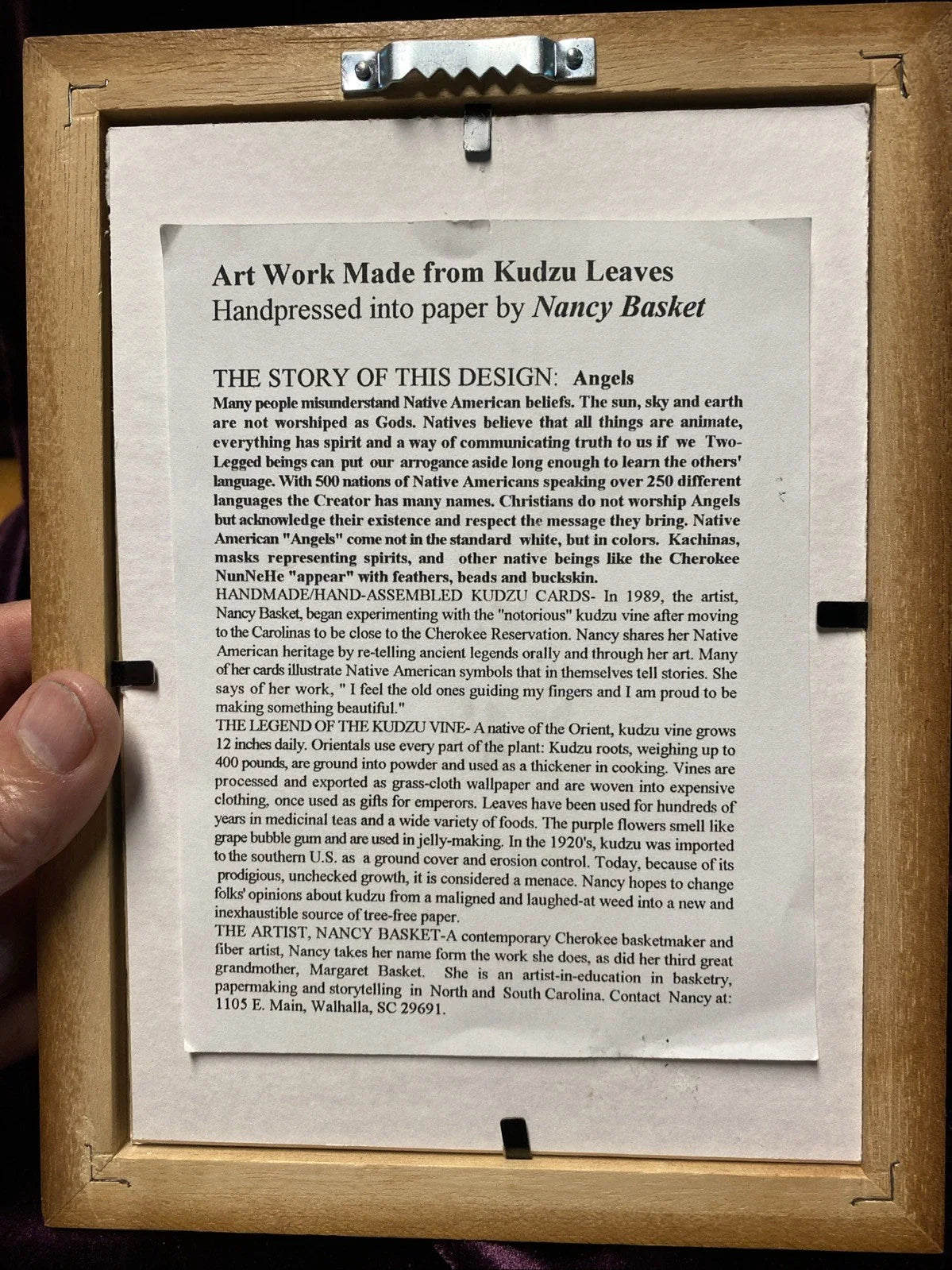 The organic, flowing form of "Kudzu Spirit" demonstrates how Nancy transforms raw kudzu vines into elegant sculptural art
Learning the Ancient Japanese Art of Kudzu Cloth
Nancy's commitment to mastering kudzu led her to Japan, where the vine has been used for centuries in traditional crafts. There, she learned from a Japanese couple who had been making fabric from kudzu for over 70 years, absorbing techniques that stretch back generations.
This cross-cultural exchange exemplifies Nancy's approach to her art: honoring tradition while embracing innovation, connecting Cherokee heritage with broader human experiences of working with natural materials.
The Art of Kudzu Paper
Insider Tip
Nancy Basket's work is best experienced in person. The texture and dimensionality of kudzu fiber art cannot be captured in photographs.
At the heart of Nancy's creative process is her handmade kudzu paper—a labor-intensive craft that transforms the maligned vine into something beautiful and functional.
The process begins with harvesting kudzu leaves, which she grinds using a whiskey barrel, galvanized tub, and blender. The resulting pulp ferments for two weeks—"They smell really bad during this part," she admits with a laugh—before being transformed through a painstaking drying process.
Using a needlepoint screen and felt, she drains the fibrous mixture, then hangs the sheets on a clothesline to dry. The result is one-of-a-kind paper: smooth on one side, textured on the other, and completely scent-free. She often adds coffee to the batch for color, creating warm, earthy tones that complement her Cherokee-inspired designs.
Her gallery offers over 300 different designs of folk art on kudzu paper, each piece handmade and unique. "Find a way to use everything," she counsels, noting that even the dripping water from her paper-making process goes to nourish her plants.
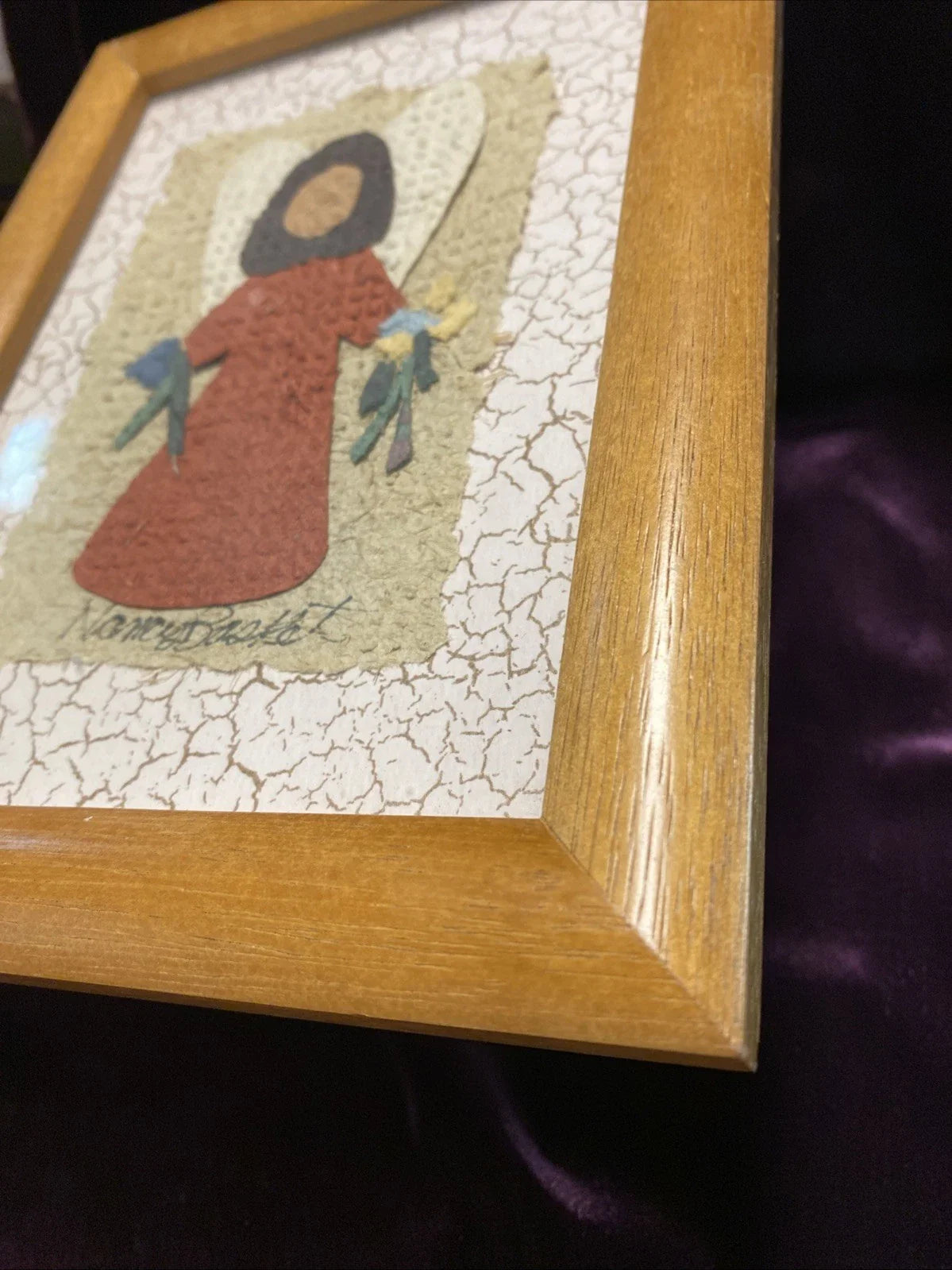 Close-up revealing the rich texture and organic quality of Basket's fiber art technique
Monumental Sculptures and Cherokee Legends
While Nancy's smaller pieces make her work accessible to collectors of all budgets, her large-scale sculptures demonstrate the full scope of her artistic vision. Her gallery features works that bring Cherokee legends to vivid life:
- Uktena, a crystal-studded Cherokee serpent, hangs overhead—a mythical creature from Cherokee tradition believed to possess a powerful crystal in its forehead
- Thunder Bird, a kudzu and driftwood masterpiece, stands as testament to both her artistry and her spiritual connection to her materials
The story of Thunder Bird's creation reveals Nancy's deep relationship with the natural world: "I dreamed where to get Thunder Bird's leg in the Chattooga River," she recalls. "The next morning, there it was on the banks. And I said, 'Hey Creator, thanks! Where's the other leg?' I ended up having to have a friend make it with a chainsaw."
Her miniature work is equally impressive. Nancy has mastered baskets "as small as my fingernail," while her large-scale architectural pieces can reach up to 8 feet by 8 feet.
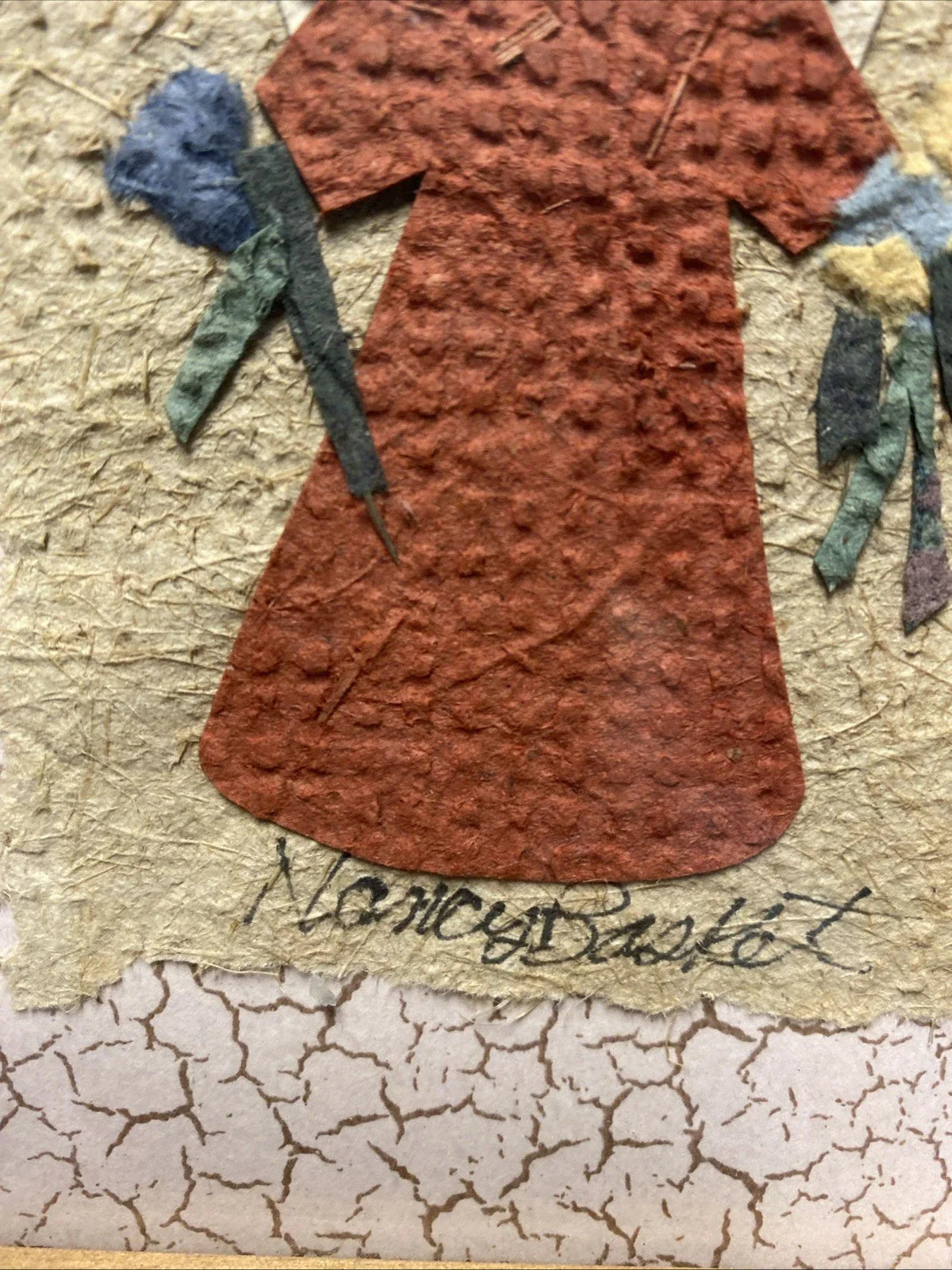 Side perspective of "Kudzu Spirit" showing the three-dimensional depth and layered construction
Hollywood and Beyond
Nancy Basket's reputation for authenticity has caught the attention of major film productions. Her mastery of prehistoric fiber arts led to commissions as a set dresser and prop maker for notable movies, including:
- "The Last of the Mohicans" (1992) - the acclaimed historical drama starring Daniel Day-Lewis
- "Young Indiana Jones" - the adventure television series
For these productions, she created authentic mats, masks, and baskets from traditional materials like cattail leaves, bark, and corn husks—bringing historical accuracy to Hollywood's depictions of Native American life.
The Pittsburgh Zoo Commission
One of Nancy's most remarkable commissions came from the Pittsburgh Zoo, which hired her to create nine five-foot-wide kudzu chandeliers designed to mimic the nests of African weaver birds. These massive, organic light fixtures demonstrate the architectural potential of kudzu fiber art and highlight Nancy's ability to work at monumental scale.
Her architectural fiber art has also found homes in Las Vegas restaurants and galleries from Bishopville to Asheville, Walterboro to Walhalla.
Preserving Cherokee Traditions
At its core, Nancy Basket's work is about cultural preservation. The craft the Cherokee people are most frequently known for throughout the world is basket weaving—an ancient tradition passed down for generations that has become a unique and recognized Native American art form.
Traditional Cherokee baskets are made from locally harvested materials including:
- River cane - which has a beautiful, rich yellow hue in its natural color
- White oak - prized for its strength and flexibility
- Honeysuckle - offering delicate, pliable fibers
For darker colors, baskets were traditionally boiled with black walnut or bloodroot, and dyed naturally with yellowroot or butternut. Nancy honors these traditions while also innovating with materials like kudzu and long-leaf pine needles.
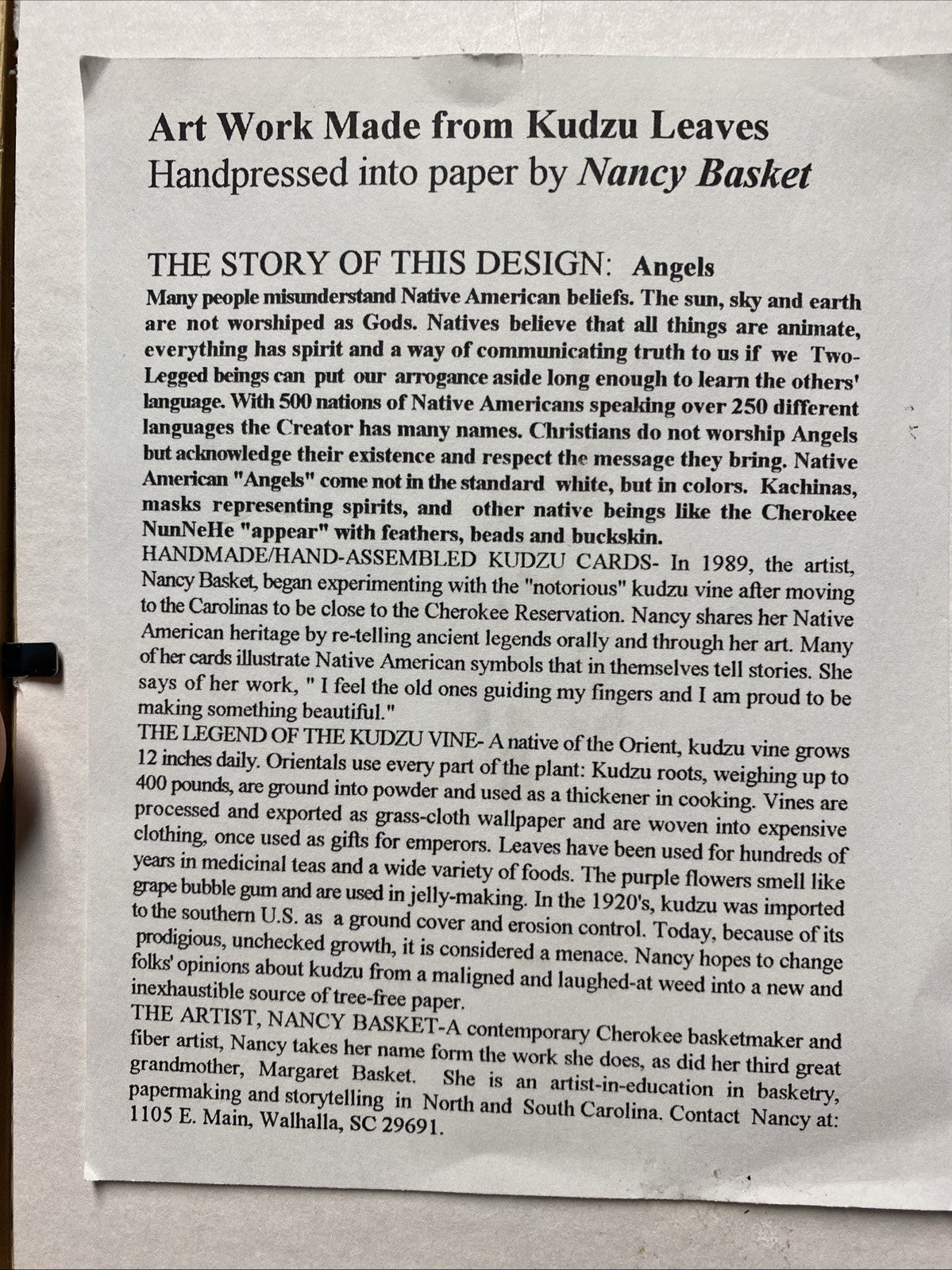 Full view of "Kudzu Spirit: Three-Dimensional Fiber Art" - available at Austin Gallery
The Jean Laney Harris Folk Heritage Award
In 2005, Nancy Basket received South Carolina's highest honor for traditional artists: the Jean Laney Harris Folk Heritage Award. This lifetime achievement recognition celebrated her decades of work preserving Cherokee basketry and sharing it with new generations.
Her work has earned the attention and respect of numerous organizations, including:
- The National Indian Education Association
- Multiple museums throughout the Southeast
- Several colleges and universities
- The National Forest Service
- State departments of education across the country
- Public television productions
- A Smithsonian Institution festival nominating committee
- The McKissick Museum at the University of South Carolina
Teaching the Next Generation
Perhaps Nancy's most lasting legacy will be her work as an educator. Since 1989, she has served as an artist-in-education for South Carolina public schools, teaching Lowcountry youth to connect with nature through basketry.
"I've used what grows in my backyard to make my art," she explains. "A lot of things in your backyard can be turned into all kinds of baskets. These techniques I have learned throughout the years are history that I hold. That's why I love my work so much. My connection with people and plants."
She currently works with a Catawba apprentice on a river cane restoration project—reviving a 2.5-acre plot of this traditional basket-making material. "Back in the day, it was so thick a horse couldn't push its way through," she explains. "But recently, it all bloomed and then died off, which happens every 50 years or so. No one had ever seen this. So this is now our work together."
VAWAA: Vacation With An Artist
For those wanting to learn directly from Nancy, she offers mini-apprenticeships through VAWAA (Vacation With An Artist), a unique program that allows guests to immerse themselves in her world of fiber arts.
Participants learn:
- Papermaking from kudzu and other "pervasive" plants
- Freeform weaving techniques
- Traditional Cherokee storytelling
- The cultural significance behind each craft
Set against the backdrop of quintessential Southern charm and the rich heritage of Walhalla, these experiences connect visitors not just to techniques but to the deeper meaning behind traditional arts.
Owning a Piece of Living History
For collectors seeking authentic contemporary folk art with deep cultural roots, Nancy Basket's work represents an extraordinary opportunity. Each piece carries within it:
- Over 40 years of mastery in fiber arts
- Cherokee traditions stretching back millennia
- Cross-cultural techniques learned from Japanese kudzu masters
- A philosophy of environmental stewardship and material innovation
- The personal touch of a nationally recognized folk artist
The piece currently available at Austin Gallery—"Kudzu Spirit: Three-Dimensional Fiber Art"—exemplifies everything that makes Nancy Basket's work extraordinary. This compelling three-dimensional fiber sculpture showcases her deep connection to traditional materials and storytelling, transforming the often-maligned kudzu vine into a medium of profound cultural expression.
The intricate weaving and sculptural form evoke a sense of organic vitality, hinting at hidden narratives and ancestral wisdom. For collectors of contemporary folk art and Native American artistry, it represents an opportunity to own a piece of living cultural heritage.
The Kudzu Kabin: A Living Gallery
Nancy's studio—a 100-year-old barn on the back of her property—has been transformed into what she calls her "playhouse." Originally home to cows, the structure now houses stained-glass windows, a wood-burning stove, and cozy cane furniture. Drying lines, blenders, and bales of split kudzu vines await her creative surges.
Perhaps most remarkably, the barn itself is fortified with kudzu bales—walls made of compressed kudzu plastered with masonry sand and lime. It's a testament to Nancy's commitment to finding beauty and utility in what others discard.
A Message for Collectors
Nancy Basket approaches her art with a democratic spirit. "I love the basket-making, but the paper items sell so much quicker and faster," she explains. "I can put days into baskets, but only people who are really wealthy can buy those, and I'm not going to be an elite artist. That's why I enjoy making the smaller pieces."
This philosophy makes her work accessible while maintaining the quality and authenticity that have earned her national recognition. Whether you're acquiring a major sculpture or a piece of her handmade kudzu paper art, you're connecting with a tradition that spans continents and centuries.
Conclusion: Living Art, Living Legacy
Nancy Basket stands at the intersection of ancient tradition and contemporary innovation. Her work reminds us that the materials for art surround us—in our backyards, along our roadsides, in the "pervasive" plants we've learned to dismiss.
Her work reminds us that the materials for art surround us—in our backyards, along our roadsides, in the "pervasive" plants we've learned to dismiss.
Through four decades of dedicated practice, she has:
- Preserved Cherokee fiber art traditions
- Learned from Japanese masters
- Taught thousands of students
- Created works for major museums and Hollywood films
- Earned South Carolina's highest folk heritage honor
- And transformed a "pest" plant into objects of genuine beauty
Her story is one of cultural pride, artistic innovation, and environmental philosophy—a reminder that mastery takes time, that tradition and innovation can coexist, and that beauty often hides in plain sight.
Sources
- VAWAA - Vacation With An Artist: Nancy Basket's Artist Profile
- TOWN Carolina: "Dream Weaver" - Nancy Basket Profile, 2022
- Visit Oconee SC: Kudzu Kabin Designs
- South Carolina Arts Commission: Jean Laney Harris Folk Heritage Award Recipients
- KnowItAll.org: South Carolina Folk Heritage Award Documentation
- Smithsonian Institution: Festival Nominating Committee Records
- Cherokee Nation Cultural Resources: Traditional Basket Weaving Documentation
"Kudzu Spirit: Three-Dimensional Fiber Art" by Nancy Basket is currently available at Austin Gallery. This authentic Cherokee fiber art piece represents an opportunity to own a work by one of America's most celebrated living folk artists.
Fiber Art
Art made from natural or synthetic fibers using techniques like weaving, knitting, felting, or braiding. Fiber art bridges craft and fine art traditions.


