Key Takeaways
- Trinity College's Long Room library is one of the world's most beautiful — and houses the 9th-century Book of Kells
- Merrion Square's Georgian architecture and Oscar Wilde statue make it a cultural landmark
- Timed tickets for the Book of Kells sell out weeks ahead in peak season
There are places in the world where history doesn't simply exist—it breathes. Trinity College Dublin is one such place. Founded in 1592 by Queen Elizabeth I, this ancient university has shaped the intellectual and artistic fabric of Ireland for over four centuries. Combined with the nearby Merrion Square and its tribute to Oscar Wilde, these neighboring landmarks offer visitors an unparalleled journey through Ireland's literary and cultural heritage.
During our recent visit to Dublin, we had the privilege of exploring these extraordinary sites firsthand. What follows is our comprehensive account of the experience—a guide for art lovers, history enthusiasts, and anyone drawn to the places where great minds have walked.
The Historic Heart of Dublin: Trinity College
The iconic Campanile stands as the symbolic heart of Trinity College, framed by the historic Parliament Square. Photo: Austin Gallery
Walking through the cobblestone entrance of Trinity College is like stepping back in time. The university occupies 47 acres in the very center of Dublin, an oasis of Georgian architecture and manicured lawns surrounded by the bustling modern city. According to Trinity's official records, the college has produced some of Ireland's most celebrated minds, including Samuel Beckett, Oscar Wilde, Bram Stoker, and Jonathan Swift (Trinity College Dublin Archives, 2023).
The university occupies 47 acres in the very center of Dublin, an oasis of Georgian architecture and manicured lawns surrounded by the bustling modern city.
The Campanile, rising 30 meters above Parliament Square, was designed by Sir Charles Lanyon and completed in 1853. Legend holds that any student who walks beneath it while the bell tolls will fail their exams—a superstition that sends Trinity students scurrying around its base during examination periods.
The Old Library and Book of Kells
The crown jewel of Trinity College is undoubtedly the Old Library, home to the legendary Book of Kells. This illuminated manuscript, created by Celtic monks around 800 AD, is considered one of the finest examples of medieval art in existence. The book contains the four Gospels in Latin, adorned with intricate illustrations that continue to astonish scholars and visitors alike.
Bernard Meehan, former Keeper of Manuscripts at Trinity, described the Book of Kells as "the work of angels" in his definitive study of the manuscript (Meehan, The Book of Kells, Thames & Hudson, 2012). The level of detail achieved by monks working by candlelight, using quills and pigments made from natural materials, defies modern comprehension.
The Long Room: A Cathedral of Knowledge
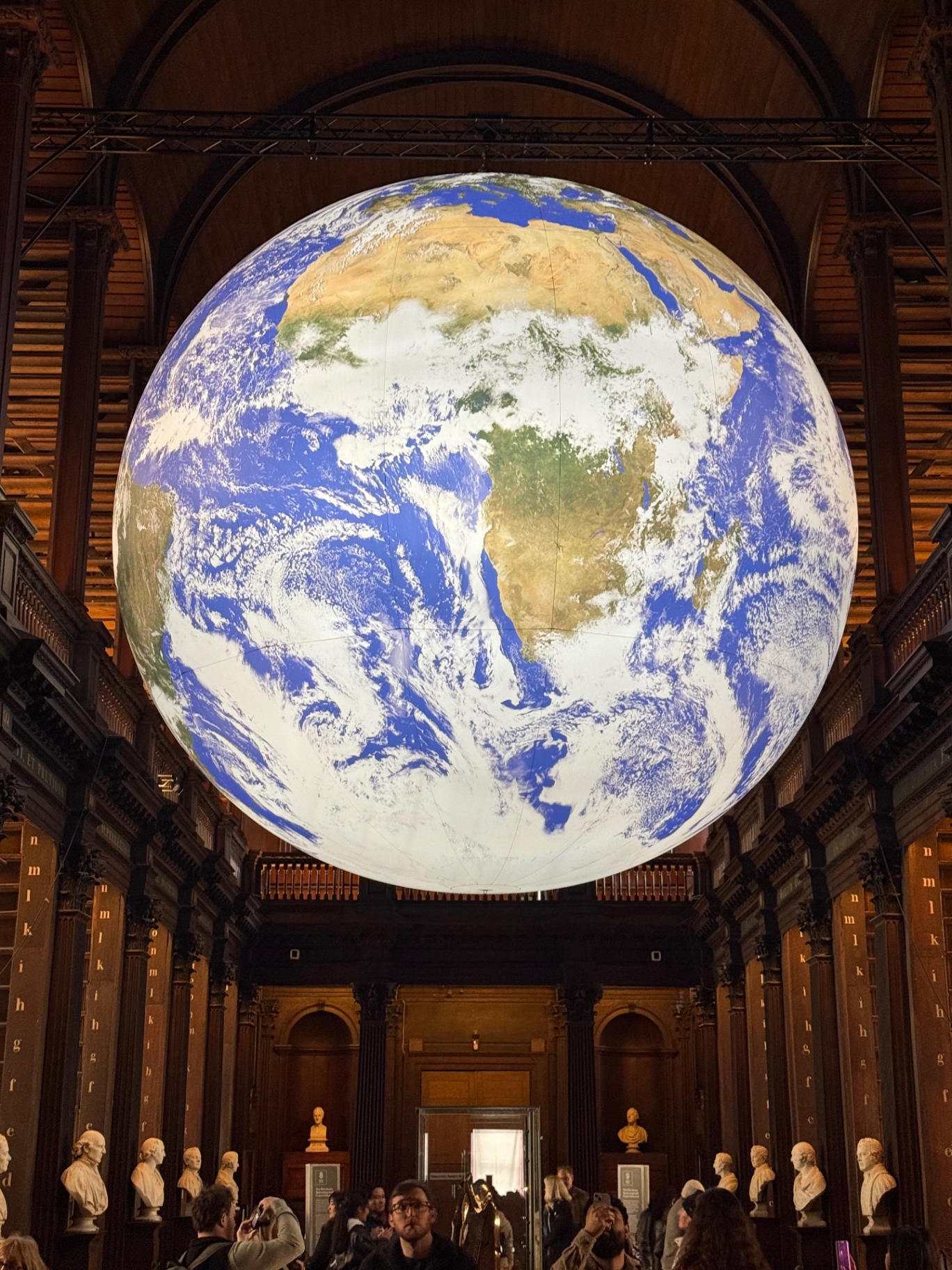 Luke Jerram's "Gaia" installation floats majestically above the Long Room's marble busts. Photo: Austin Gallery
Nothing quite prepares you for the Long Room. At 65 meters in length, it is one of the world's most beautiful libraries—a soaring barrel-vaulted chamber lined with 200,000 of Trinity's oldest books. The room was constructed between 1712 and 1732, and its original flat ceiling was raised in 1860 to accommodate the growing collection.
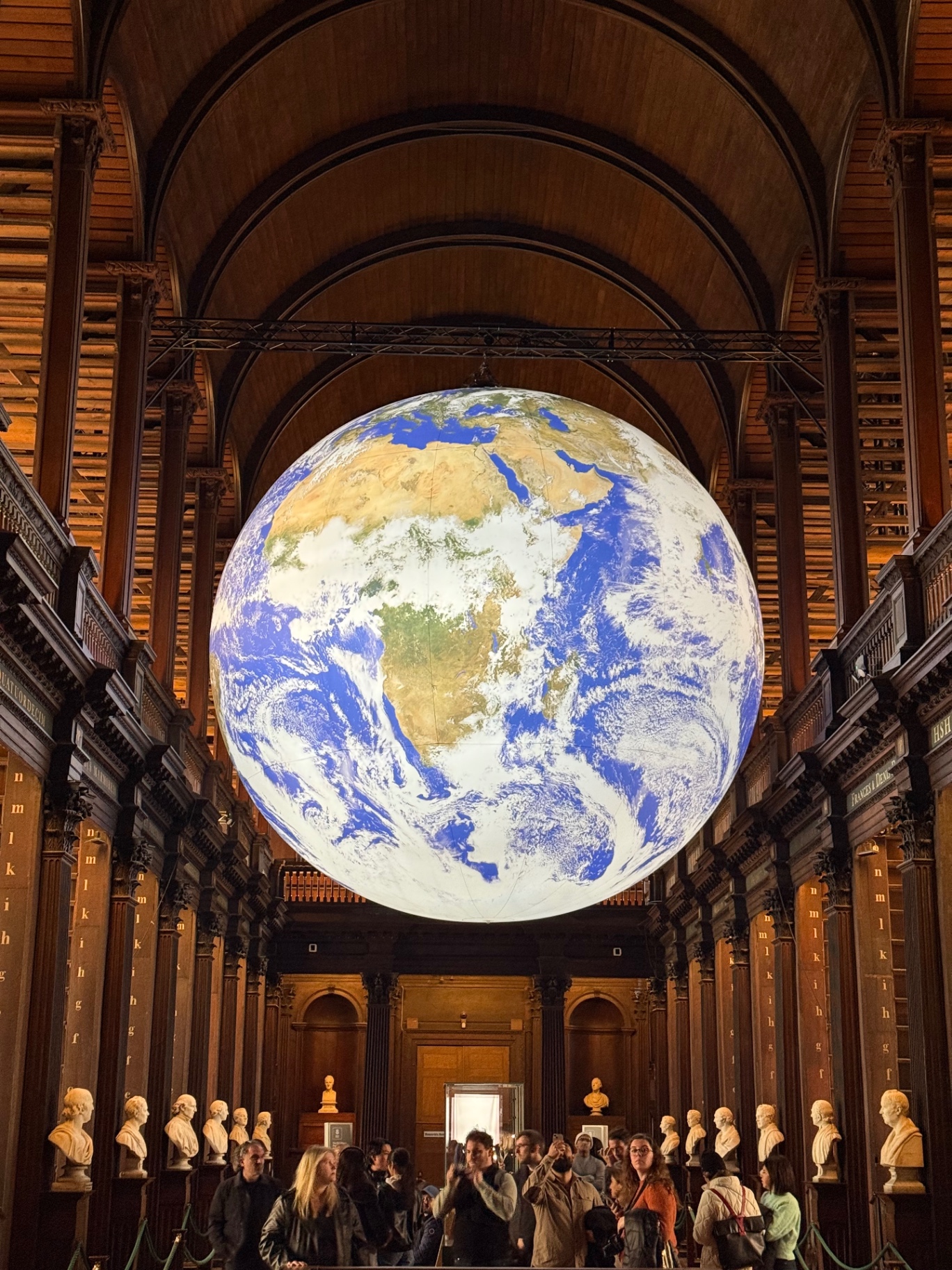 The Long Room's barrel-vaulted ceiling stretches into infinity, flanked by two stories of ancient texts and marble busts of great thinkers. Photo: Austin Gallery
During our visit, we were fortunate to experience Luke Jerram's extraordinary "Gaia" installation—a seven-meter illuminated replica of Earth suspended from the Long Room's ceiling. Created using NASA satellite imagery, Gaia has toured the world since 2018, inviting viewers to experience the "Overview Effect" that astronauts describe when seeing our planet from space (Jerram Studio, 2023). Seeing it floating above centuries of accumulated human knowledge created a profound meditation on our place in the universe.
The Marble Busts: Guardians of Knowledge
Forty-eight marble busts line the Long Room, depicting philosophers, writers, and great thinkers of Western civilization. These sculptures were installed beginning in 1743 and include representations of Socrates, Plato, Aristotle, Shakespeare, Swift, and Newton, among others.
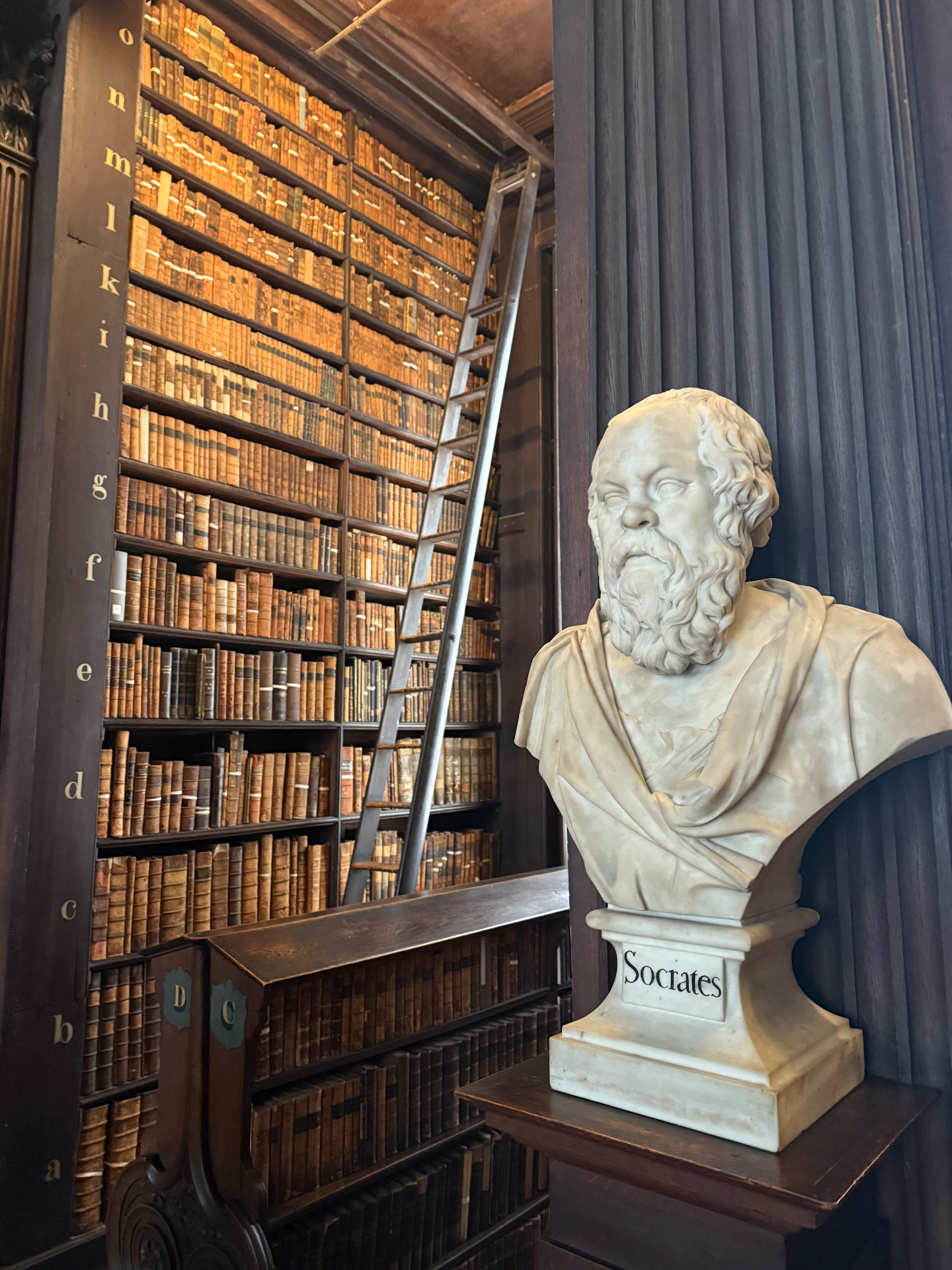 The bust of Socrates surveys the ancient texts of the Long Room, a fitting tribute to the father of Western philosophy. Photo: Austin Gallery
Each bust was commissioned from leading sculptors of the 18th and 19th centuries, including Peter Scheemakers and Louis François Roubiliac. The Irish-born sculptor John Foley contributed several busts, including that of Edmund Burke—the Irish statesman and philosopher who remains one of Trinity's most celebrated alumni.
The Brian Boru Harp: Ireland's National Symbol
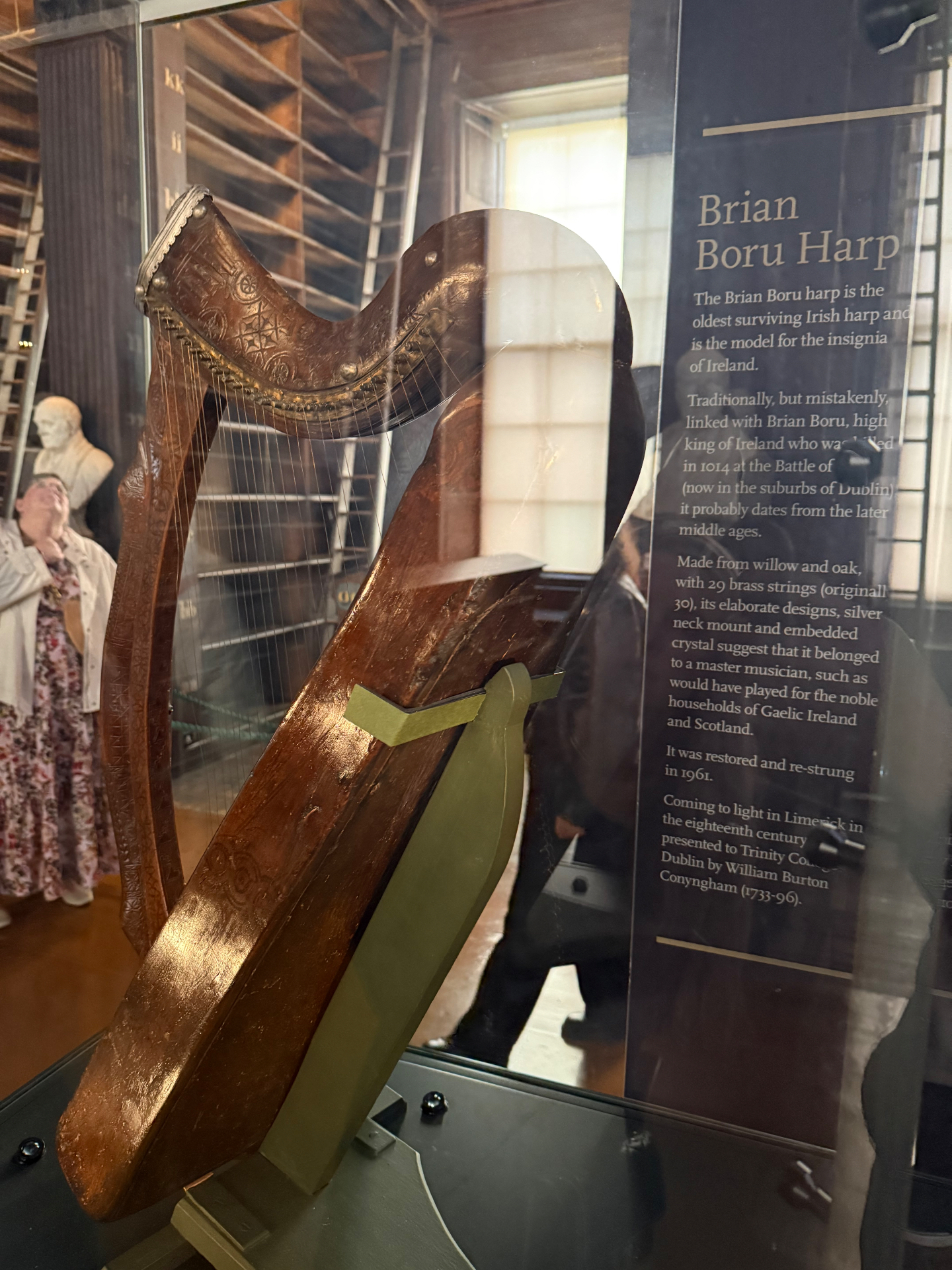 The Brian Boru Harp, oldest surviving Irish harp and the model for Ireland's national symbol. Photo: Austin Gallery
Among the Long Room's most precious treasures is the Brian Boru Harp, the oldest surviving Irish harp and the model for the emblem of Ireland. Contrary to popular belief, the harp did not belong to the famous High King Brian Boru, who died at the Battle of Clontarf in 1014. Dendrochronological analysis suggests the instrument dates from the 14th or 15th century (Rimmer, The Irish Harp, Mercier Press, 1969).
The harp is constructed from willow and oak, with 29 brass strings (originally 30). Its elaborate designs, silver neck mount, and embedded crystal suggest it belonged to a master musician who would have performed for the noble households of Gaelic Ireland and Scotland. The instrument came to light in Limerick in the 18th century and was presented to Trinity College by William Burton Conyngham in the 1780s.
This humble instrument achieved immortality when it was adopted as the symbol of Ireland, appearing on everything from passports to euro coins. Guinness famously reversed the harp's orientation for their trademark, distinguishing it from the state emblem.
Historical Documents: The 1916 Proclamation
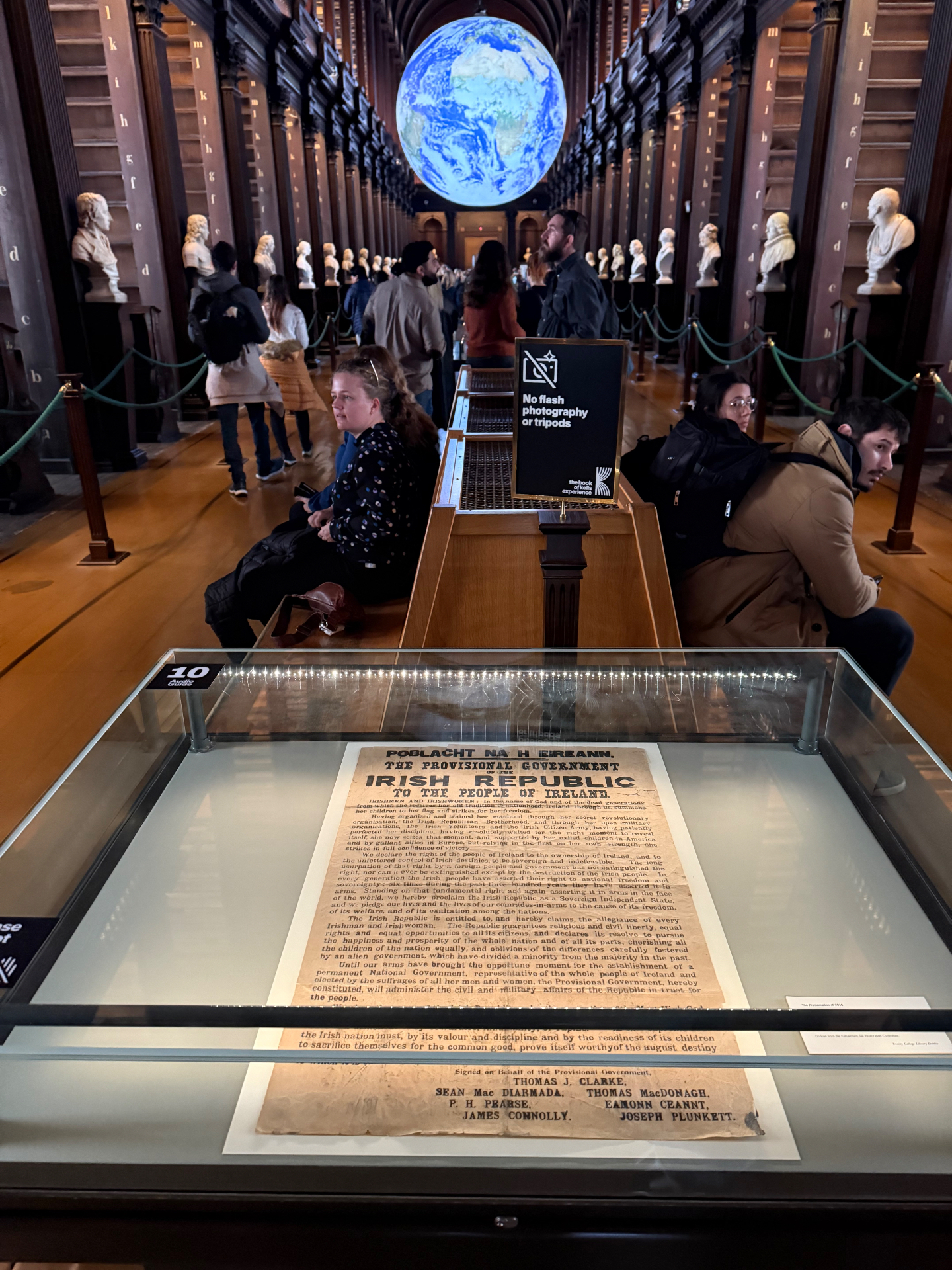 The 1916 Proclamation of the Irish Republic, displayed in the Long Room with Gaia floating above. Photo: Austin Gallery
The Long Room houses a copy of the 1916 Proclamation of the Irish Republic, the document read by Patrick Pearse on the steps of the General Post Office at the start of the Easter Rising. This single sheet of paper changed the course of Irish history, leading ultimately to independence from British rule.
The Proclamation begins with the famous words: "IRISHMEN AND IRISHWOMEN: In the name of God and of the dead generations from which she receives her old tradition of nationhood, Ireland, through us, summons her children to her flag and strikes for her freedom."
Signed by the seven members of the Provisional Government—Thomas J. Clarke, Seán Mac Diarmada, Thomas MacDonagh, P.H. Pearse, Éamonn Ceannt, James Connolly, and Joseph Plunkett—all of whom were subsequently executed by the British, the document represents the foundational text of modern Irish identity.
Viewing the Manuscripts
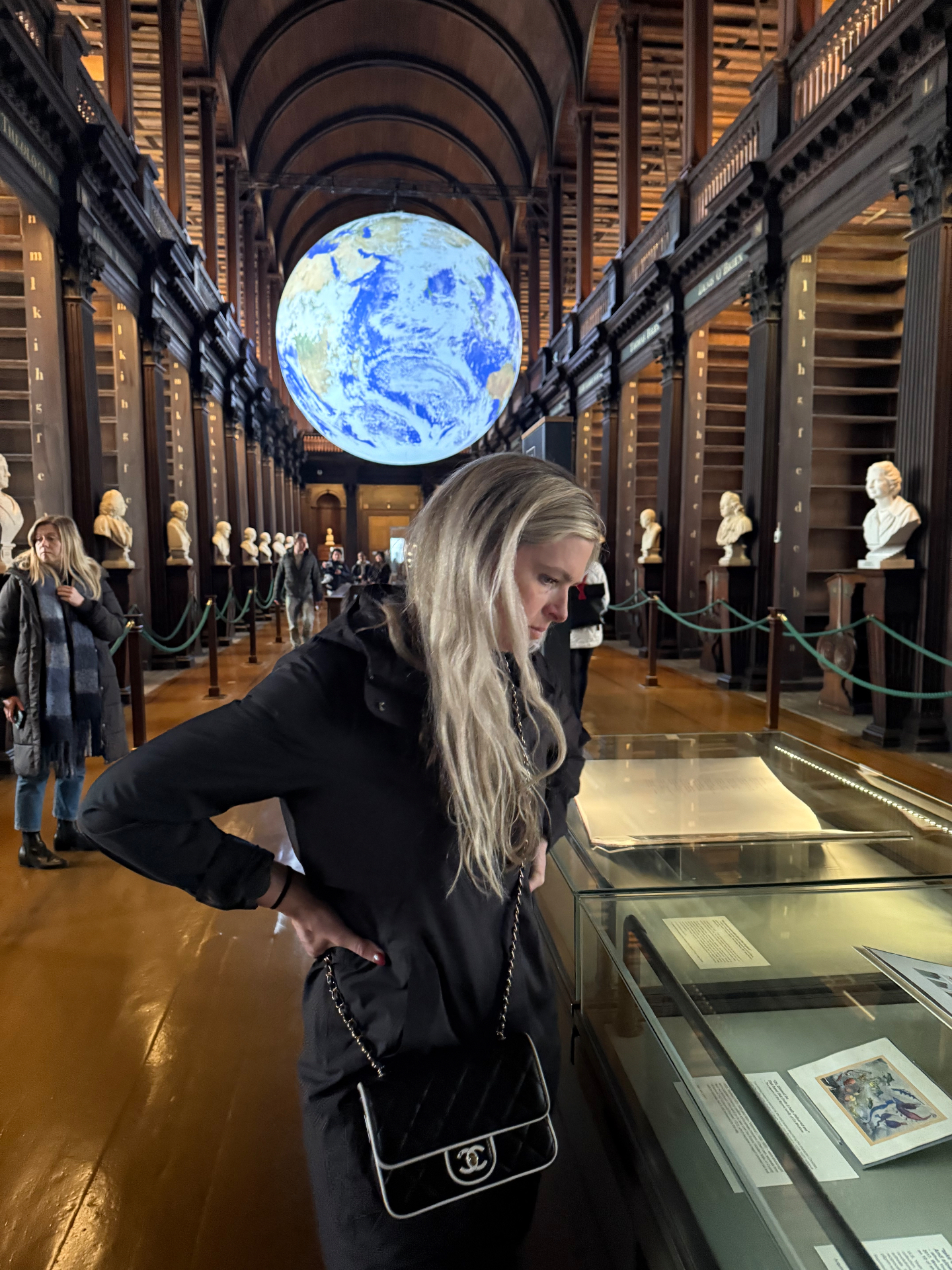 Visitors study illuminated manuscripts in the Long Room, with Gaia casting its ethereal glow from above. Photo: Austin Gallery
Beyond the Book of Kells and the Proclamation, the Long Room displays rotating selections from Trinity's vast manuscript collection. During our visit, we observed beautifully illuminated pages, ancient maps, and historical documents that span centuries of Irish and European history. The experience of viewing these treasures in their historic setting—rather than behind glass in a sterile modern museum—creates an intimate connection with the past that few other institutions can match.
Merrion Square: Dublin's Georgian Jewel
A short walk from Trinity College brings visitors to Merrion Square, one of Dublin's finest Georgian squares and home to a memorial that perfectly captures the wit and tragedy of Oscar Wilde. The square was laid out in 1762 and quickly became the most prestigious address in Dublin, its elegant townhouses home to politicians, professionals, and the Irish aristocracy.
Number 1 Merrion Square was the childhood home of Oscar Wilde, where he lived from 1855 to 1876 with his parents—Sir William Wilde, a renowned eye surgeon, and Lady Jane Wilde, a poet and Irish nationalist who wrote under the pen name "Speranza."
The Oscar Wilde Memorial: Art Meets Wit
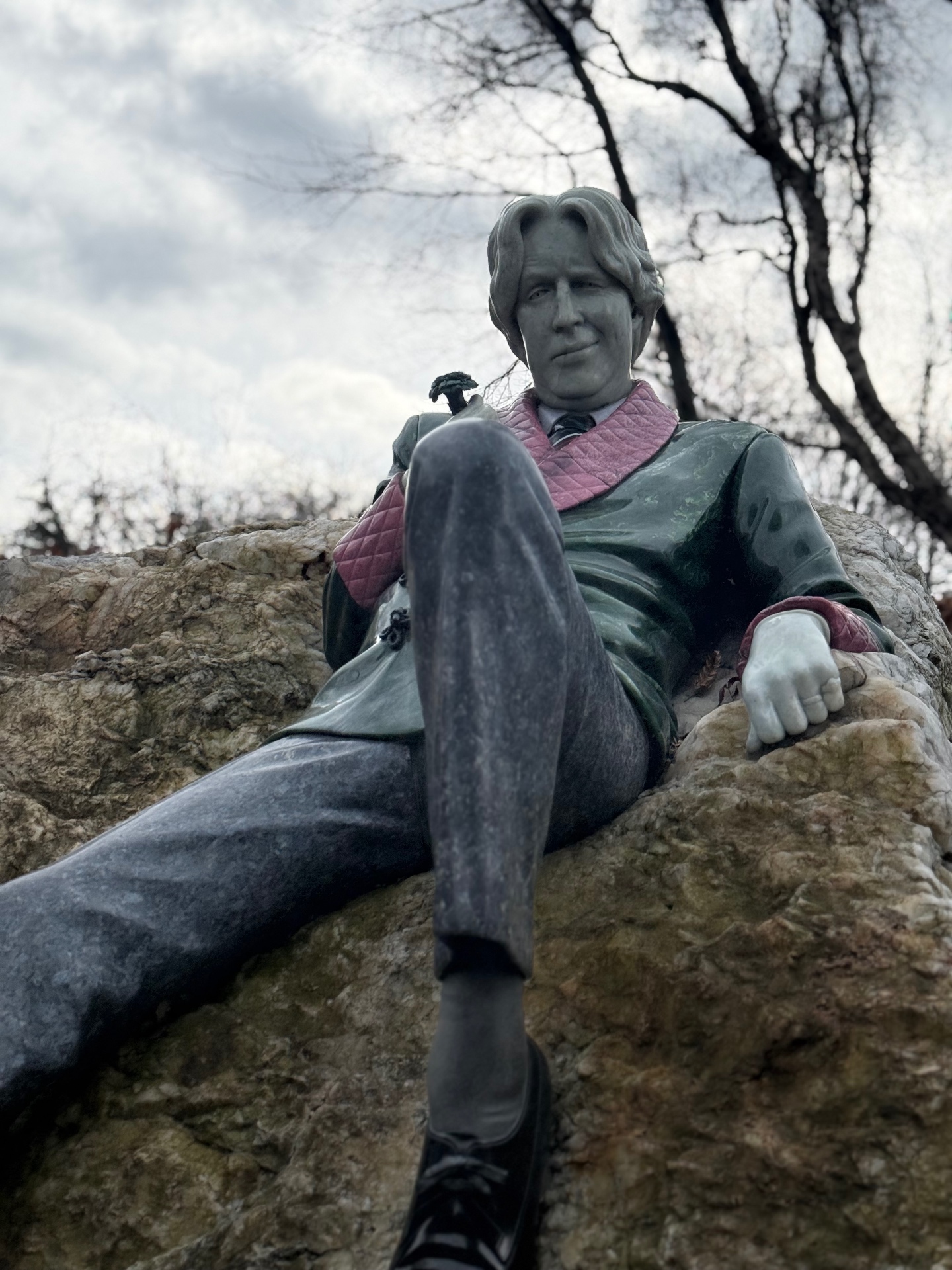 Danny Osborne's striking statue of Oscar Wilde reclines on a quartz boulder in Merrion Square. Photo: Austin Gallery
In the northwest corner of Merrion Square's park, directly across from his childhood home, sits one of Dublin's most beloved and photographed monuments: Danny Osborne's memorial to Oscar Wilde. Unveiled in 1997, the sculpture captures Wilde in characteristically languid pose, reclining on a large quartz boulder sourced from the Wicklow Mountains.
The statue is remarkable for its multi-colored construction. Wilde's jacket is green nephrite jade, his collar is thulite (a pink stone from Norway), and his face, hands, and feet are porcelain—a deliberate choice by Osborne to evoke Wilde's famous wit and theatrical personality. The figure wears a knowing smile, seemingly amused by the steady stream of visitors who come to pay homage.
Osborne spent three years creating the memorial, conducting extensive research into Wilde's appearance, mannerisms, and clothing. "I wanted to capture his spirit," Osborne explained in interviews, "not just his likeness, but the essence of who he was—witty, elegant, defiant" (Irish Times, October 1997).
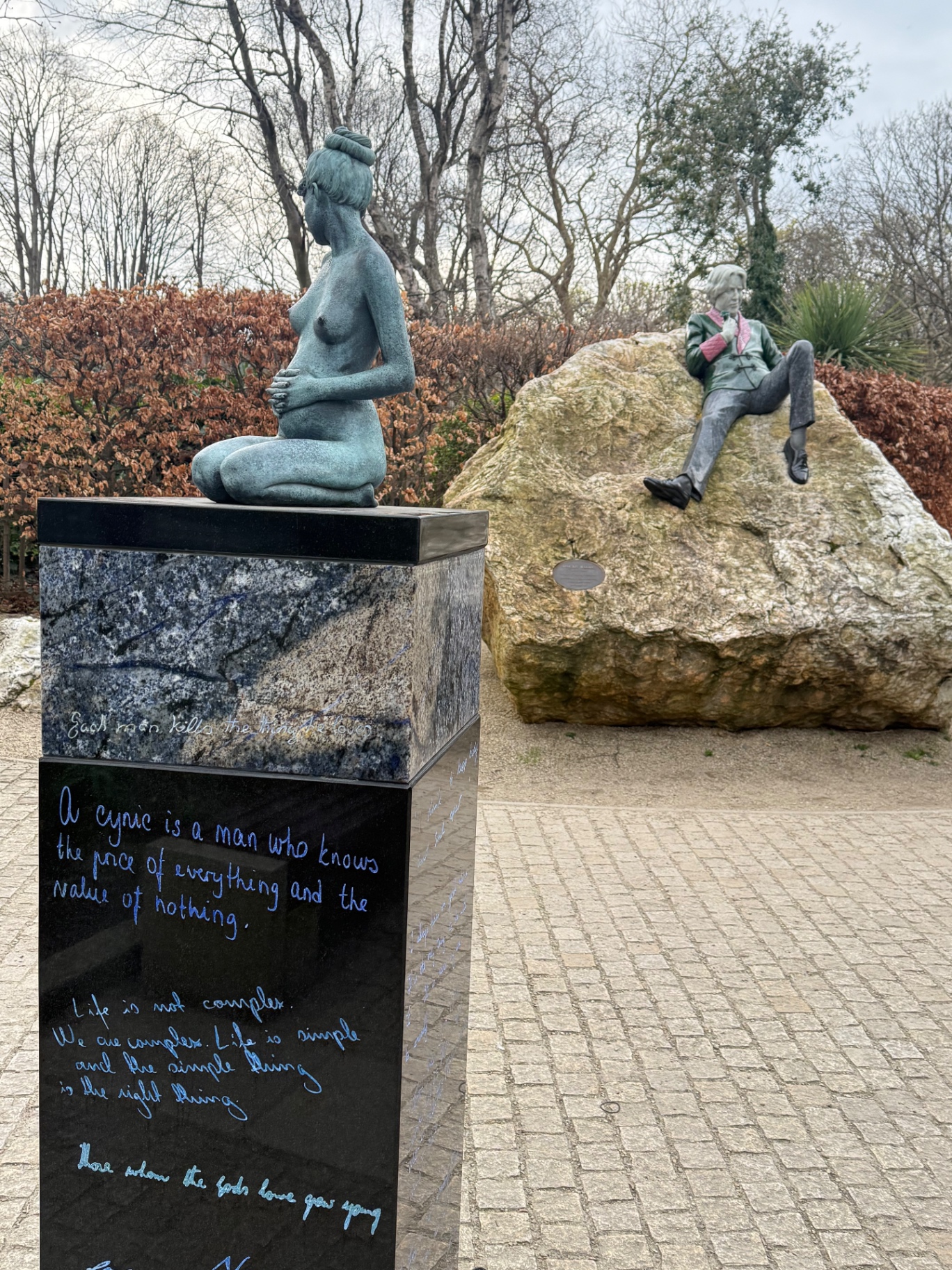 The complete Wilde memorial includes a pregnant female figure and columns inscribed with the writer's famous aphorisms. Photo: Austin Gallery
The memorial is not limited to the central statue. On the opposite side of the walkway stands a bronze female figure, pregnant and contemplative, representing Constance Lloyd—Wilde's wife, who bore him two sons before their marriage was destroyed by his imprisonment. The statue is a poignant addition, acknowledging the human cost of Wilde's downfall.
Two granite pillars flank the installation, inscribed with some of Wilde's most famous quotations:
- "A cynic is a man who knows the price of everything and the value of nothing."
- "Life is not complex. We are complex. Life is simple and the simple thing is the right thing."
- "Those whom the gods love grow young."
These aphorisms, drawn from Lady Windermere's Fan, various letters, and Wilde's philosophical writings, encapsulate the wisdom and wordplay that made him the most quoted writer in the English language after Shakespeare.
Oscar Wilde: A Brief Biography
Oscar Fingal O'Flahertie Wills Wilde was born on October 16, 1854, just steps from where his memorial now stands. A brilliant student, he won the Berkeley Gold Medal at Trinity College before earning a scholarship to Magdalen College, Oxford, where he achieved a double first in Classics.
Wilde rose to become the most celebrated wit in Victorian society, his plays—including The Importance of Being Earnest, An Ideal Husband, and Lady Windermere's Fan—drawing packed houses in London's West End. His novel The Picture of Dorian Gray remains a cornerstone of Gothic literature.
In 1895, at the height of his fame, Wilde was convicted of "gross indecency" for his relationship with Lord Alfred Douglas and sentenced to two years' hard labor. The experience destroyed his health and reputation. Upon release, he fled to France, where he died in poverty on November 30, 1900, at the age of 46.
His final words, according to legend, were: "Either that wallpaper goes, or I do."
Planning Your Visit
Trinity College and the Book of Kells
- Address: College Green, Dublin 2
- Hours: 9:30 AM - 5:00 PM (extended hours in summer)
- Admission: Adults €18; students €16; children under 12 free
- Tip: Book timed tickets online in advance, especially during peak season
- Website: Trinity College Library
The Book of Kells exhibition includes both the Treasury (where the manuscript is displayed) and the Long Room. Allow at least 90 minutes to fully appreciate both spaces.
Merrion Square
- Address: Merrion Square, Dublin 2
- Hours: Park open daily, dawn to dusk
- Admission: Free
- Tip: Visit on a Sunday to experience the outdoor art market
The Oscar Wilde memorial is located in the northwest corner of the park, easily visible from the entrance gates.
Why Art Collectors Should Visit
For those of us at Austin Gallery who spend our days surrounded by art, visiting Trinity College and Merrion Square offers essential context for understanding Irish artistic heritage. The Book of Kells represents the apex of medieval illumination—a reminder that the human drive to create beauty is timeless. The Long Room demonstrates how architecture itself can become art, creating spaces that inspire and elevate.
The Oscar Wilde memorial, meanwhile, represents the best of contemporary public sculpture—a work that captures personality, provokes thought, and creates dialogue between past and present. Danny Osborne's choice of materials, pose, and setting demonstrates the power of thoughtful artistic decision-making.
Whether you're a serious collector, an art student, or simply someone who appreciates beauty and history, these Dublin landmarks deserve a place on your itinerary.
Sources and Further Reading
- Meehan, Bernard. The Book of Kells: An Illustrated Introduction to the Manuscript in Trinity College Dublin. Thames & Hudson, 2012.
- Rimmer, Joan. The Irish Harp. Mercier Press, 1969.
- Trinity College Dublin Library. "The Long Room." Accessed 2024. tcd.ie/library
- Jerram, Luke. "Gaia." Jerram Studio, 2023. my-earth.org
- Kiberd, Declan. Irish Classics. Harvard University Press, 2001.
- Ellmann, Richard. Oscar Wilde. Vintage Books, 1988.
All photographs in this article were taken during Austin Gallery's visit to Dublin and remain the property of Austin Gallery. For inquiries about our Irish art collection, please contact us at t@austingallery.org.
Pro Tip
Book your Book of Kells ticket for the first slot of the day (8:30am). The Long Room is nearly empty and the light is magical.
Book your Book of Kells ticket for the first slot of the day (8:30am).


