Reference · Updated August 2026
Paper Weight Conversion Chart: lb to gsm
Every conversion below is a figure a manufacturer publishes for its own paper, not an arithmetic guess. The chart is split by paper type on purpose, because that is the only way an lb number means anything.
By the Austin Gallery editors · August 8, 2026
The quick answer
For watercolor paper: 90 lb is 185 to 190 gsm, 140 lb is 300 gsm, 200 lb is 425 gsm, and 300 lb is 638 to 640 gsm. Those are the numbers Arches, St Cuthberts Mill, Strathmore and Canson print themselves. But there is no universal lb-to-gsm conversion, because a pound rating is measured on each paper grade's own parent sheet. Strathmore publishes 90 lb watercolor at 190 gsm; Canson publishes 90 lb drawing paper at 147 gsm. Same number, roughly 29 percent different sheet. Find your paper type in the tables below, then convert.
Watercolor paper: lb to gsm
Watercolor is the grade most people are actually looking for, and it is the one where the mills agree most closely. Where two figures appear for the same pound rating, that is a real difference between manufacturers, not a rounding error on our side.
| Basis weight | Published gsm | Manufacturers that publish this pairing |
|---|---|---|
| 90 lb | 185 gsm | Arches Aquarelle; Canson XL Watercolor |
| 90 lb | 190 gsm | Saunders Waterford and Bockingford (St Cuthberts Mill); Strathmore 200 Series |
| 140 lb | 300 gsm | Arches; St Cuthberts Mill; Strathmore 300/400/500 Series; Canson XL; Winsor & Newton Professional |
| 156 lb | 356 gsm | Arches Aquarelle |
| 200 lb | 425 gsm | Saunders Waterford and Bockingford (St Cuthberts Mill) |
| 250 lb | 535 gsm | Bockingford (St Cuthberts Mill) |
| 300 lb | 638 gsm | Saunders Waterford (St Cuthberts Mill) |
| 300 lb | 640 gsm | Arches Aquarelle |
| 400 lb | 850 gsm | Arches Aquarelle |
Sources differ slightly at 90 lb (185 vs 190 gsm) and at 300 lb (638 vs 640 gsm). Both are mill rounding of the same nominal weight, and both are printed on real packaging.
Scroll the table sideways to see every column.
If you want the paper behind the numbers, our best watercolor paper guide ranks the sheets themselves, and the watercolor paint set guide covers what goes on top of them.

about $43 on Amazon
The 140 lb / 300 gsm reference sheet. Arches publishes both units for this weight, and the four-side-glued block is the format that holds the sheet flat while you work.
Why a pound rating is not a thickness
US basis weight is, as PrintWiki puts it, the weight in pounds of a ream of 500 sheets cut to the basic size for that particular grade of paper. Every grade has a different basic size. So the same 500-sheet weight describes a different amount of paper per square metre depending on what kind of paper it is. Neenah states the consequence directly: because the starting base size is not the same between paper types, the basis weights do not correspond directly, and 80 text is much lighter than 80 cover.
Strathmore alone prints four different basic sizes across its own catalogue. That is worth sitting with: within a single brand, a pound number means four different things.
| Paper grade | Basic (parent) sheet size | Published by |
|---|---|---|
| Watercolor | 22 × 30 in | Strathmore prints the basis size on its watercolor lines |
| Drawing | 24 × 36 in | Strathmore 200/300/400 Series Drawing |
| Sketch and charcoal | 25 × 38 in | Strathmore 400 Series Sketch, 500 Series Charcoal |
| Bristol (Strathmore art bristol) | 20 × 26 in | Strathmore 300 Series Bristol |
| Bristol (commercial vellum bristol) | 22.5 × 28.5 in | Domtar, Neenah |
| Cover / card | 20 × 26 in | Domtar, Neenah |
| Text / book | 25 × 38 in | Domtar, Neenah |
| Index | 25.5 × 30.5 in | Domtar, Neenah |
| Tag | 24 × 36 in | Domtar |
| Bond / writing | 17 × 22 in | Mohawk, Neenah |
Scroll the table sideways to see every column.
Note the split on bristol. Strathmore measures its art bristol on the 20 by 26 cover sheet, while the commercial paper trade (Domtar, Neenah) measures vellum bristol on 22.5 by 28.5. Both conventions are real and in current use, which is exactly why a single "bristol" conversion row would be wrong.
The arithmetic
Case Paper and Horizon Paper both publish the same formula:
gsm = basis weight (lb) × 1406.5 ÷ (basic size width × height, in inches)
Worked through: 140 lb watercolor is 140 × 1406.5 ÷ (22 × 30) = 298 gsm, which mills round and print as 300. 80 lb Strathmore drawing paper is 80 × 1406.5 ÷ (24 × 36) = 130 gsm, exactly what Strathmore prints. 100 lb cover is 100 × 1406.5 ÷ (20 × 26) = 270 gsm, exactly what Domtar prints. The formula checks out against the published tables across every grade we tested.
One honest footnote on the constant. 1406.5 is the number the paper industry publishes, and it is a rounding: worked from 453.592 grams per pound and 1550.0031 square inches per square metre, the exact constant is about 1406.1. The difference is under 0.03 percent, which is far inside mill tolerance, so use 1406.5 and do not treat it as exact.
Drawing, sketch and cartridge paper: lb to gsm
This is where the pound rating misleads most often, because drawing and sketch papers use two different basic sizes (24 by 36 and 25 by 38) and sit right next to each other in the same store. Where Strathmore publishes the basis size on the product page, we have reproduced it, since that is the part that makes the number checkable.
| Paper | Basis weight | Basis size (in) | Published gsm |
|---|---|---|---|
| Strathmore 300 Series Sketch | 50 lb | 25 × 38 | 74 gsm |
| Canson XL Sketch | 50 lb | not published | 74 gsm |
| Strathmore 400 Series Sketch | 60 lb | 25 × 38 | 89 gsm |
| Strathmore 400 Series Artagain | 60 lb | 20 × 26 | 160 gsm |
| Strathmore 200 Series Drawing | 64 lb | 24 × 36 | 104 gsm |
| Canson Artist Universal Sketch | 65 lb | not published | 96 gsm |
| Strathmore 300 Series Drawing | 70 lb | 24 × 36 | 114 gsm |
| Canson XL Drawing | 70 lb | not published | 114 gsm |
| Strathmore 400 Series Drawing | 80 lb | 24 × 36 | 130 gsm |
| Canson Artist White Drawing (pads) | 80 lb | not published | 130 gsm |
| Strathmore 400 Series Toned Sketch | 80 lb | 25 × 38 | 118 gsm |
| Canson Artist Cream Drawing | 90 lb | not published | 147 gsm |
| Canson XL Black Drawing | 92 lb | not published | 150 gsm |
| Canson Graduate Drawing | 98 lb | not published | 160 gsm |
| Strathmore 400 Series Heavyweight Drawing | 100 lb | 24 × 36 | 163 gsm |
| Strathmore 400 Series Colored Pencil | 100 lb | 24 × 36 | 163 gsm |
| Canson "C" à Grain | 111 lb | not published | 180 gsm |
| Canson Artist White Drawing (sheets) | 123 lb | not published | 200 gsm |
Canson publishes lb and gsm together but does not publish the basis size, so those cells are marked rather than filled in by inference.
Scroll the table sideways to see every column.
The clearest single illustration is inside Strathmore's own catalogue: 60 lb 400 Series Sketch is 89 gsm on the 25 by 38 sheet, while 60 lb 400 Series Artagain is 160 gsm on the 20 by 26 sheet. Identical pound number, nearly twice the paper.

about $13 on Amazon
Published by Strathmore as 60 lb (25 × 38 × 500 sheets) 89 gsm. Useful as the low end of the scale: a 60 lb sketch sheet is nothing like a 60 lb Artagain sheet at 160 gsm.
If you are shopping the books rather than the loose sheets, our sketchbook guide and the alcohol marker guide both live on the paper-weight question from the other direction: bleed-through is a weight-and-sizing problem before it is a pen problem.
Bristol: plies and pounds
Bristol is usually sold by ply rather than by weight. Strathmore defines it as drawing paper pasted together into multi-ply sheets, so a 2-ply bristol is two drawing sheets laminated. The mill notes that the resulting pound weights are approximate, because glue is involved in the pasting.
| Paper | Ply | Basis weight | Published gsm |
|---|---|---|---|
| Strathmore 300 Series Bristol | single ply | 100 lb | 270 gsm |
| Strathmore 400 Series Bristol | 2-ply | 100 lb | 270 gsm |
| Strathmore 400 Series Bristol | 3-ply | 150 lb | 405 gsm |
| Strathmore 400 Series Bristol | 4-ply | 200 lb | 540 gsm |
| Strathmore 500 Series Bristol | 2-ply | 152 lb | 250 gsm |
| Strathmore 500 Series Bristol | 3-ply | 228 lb | 375 gsm |
| Strathmore 500 Series Bristol | 4-ply | 304 lb | 500 gsm |
| Canson XL Bristol | not published | 100 lb | 260 gsm |
| Canson XL Recycled Bristol | not published | 96 lb | 260 gsm |
| Domtar Lettermark Vellum Bristol | not applicable | 57 lb | 125 gsm |
| Domtar Lettermark Vellum Bristol | not applicable | 67 lb | 147 gsm |
Strathmore's 500 Series figures are the ones printed on the product page and repeated in its FAQ. A Strathmore blog post gives different numbers for the same product (roughly 215/325/430 lb and 260/390/520 gsm). We have published the pair that two Strathmore pages agree on and are flagging the conflict rather than resolving it.
Scroll the table sideways to see every column.
Note the direction of travel in that table: Strathmore's premium 500 Series 2-ply carries a higher pound number (152 lb) but a lower gsm (250) than the 400 Series 2-ply (100 lb, 270 gsm). That is not a typo in our chart. It is what happens when pound ratings and grammage are computed off different assumptions.

about $11 on Amazon
Strathmore publishes this as 100 lb (20 × 26 × 500 sheets) 270 gsm, a single-ply sheet with the caliper of a 2-ply bristol.
Printmaking paper: usually gsm only
Here is a finding worth stating plainly, because it contradicts a lot of retail listings. The major printmaking mills and distributors publish grammage only. Legion Paper lists Rives BFK and Stonehenge in gsm with no pound figure. Canson lists Arches BFK Rives in gsm. St Cuthberts Mill lists Somerset in gsm. The pound numbers you see on retail listings for these papers are conversions added downstream, and some of them do not survive checking: the widely quoted "Rives BFK 90 lb" does not correspond to 250 gsm on any standard basic size we could find.
| Paper | Sheet size | Published weight | Basis weight |
|---|---|---|---|
| Rives BFK (Legion Paper) | 19.5 × 25.5 in | 180 gsm | no lb published |
| Rives BFK (Legion Paper) | 19.5 × 25.5 in | 250 gsm | no lb published |
| Rives BFK (Legion Paper) | 22 × 30 in | 280 gsm | no lb published |
| Rives BFK (Legion Paper) | 44 × 30 in | 300 gsm | no lb published |
| Arches BFK Rives (Canson US) | sheet sizes vary | 310 gsm | no lb published |
| Stonehenge (Legion Paper), colors | sheet sizes vary | 250 gsm | no lb published |
| Stonehenge White (Legion Paper) | sheet sizes vary | 320 gsm | no lb published |
| Somerset Book (St Cuthberts Mill) | sheet sizes vary | 115 and 175 gsm | no lb published |
| Somerset Satin (St Cuthberts Mill) | sheet sizes vary | 250, 300, 500 gsm | no lb published |
| Somerset Velvet (St Cuthberts Mill) | sheet sizes vary | 250, 280, 300, 330 gsm | no lb published |
Scroll the table sideways to see every column.

about $79 on Amazon
Sold in gsm, which is how Legion Paper publishes it. 180 gsm at this sheet size is one of the weights in Legion's own Rives BFK spec list.
Working in relief? The linocut and block printing kit guide covers the blocks, brayers and barens that go with these sheets.
Cover, card, text and index
The commercial grades are the best-documented of the lot, because printing paper mills publish caliper next to grammage. The figures below are from Domtar spec sheets. They also contain the cleanest proof of the whole page: 100 lb text is 148 gsm, 100 lb cover is 270 gsm, and they come off the same spec sheet.
| Grade | Basis size (in) | Basis weight | Published gsm | Caliper |
|---|---|---|---|---|
| Text / book | 25 × 38 | 50 lb | 74 gsm | not published |
| Text / book | 25 × 38 | 60 lb | 89 gsm | not published |
| Text / book | 25 × 38 | 70 lb | 104 gsm | not published |
| Text / book | 25 × 38 | 80 lb | 118 gsm | not published |
| Text / book | 25 × 38 | 100 lb | 148 gsm | 7.5 to 8.6 pt |
| Cover / card | 20 × 26 | 65 lb | 176 gsm | 8.8 pt |
| Cover / card | 20 × 26 | 80 lb | 216 gsm | 10.9 pt |
| Cover / card | 20 × 26 | 100 lb | 270 gsm | 13.9 pt |
| Cover / card | 20 × 26 | 110 lb | 297 gsm | 14.7 pt |
| Cover / card | 20 × 26 | 130 lb | 352 gsm | 17.6 pt |
| Cover / card | 20 × 26 | 160 lb | 433 gsm | 21.8 pt |
| Index | 25.5 × 30.5 | 90 lb | 163 gsm | 7.8 pt |
| Index | 25.5 × 30.5 | 110 lb | 199 gsm | 9.5 pt |
| Tag | 24 × 36 | 100 lb | 163 gsm | 7.8 pt |
| Tag | 24 × 36 | 125 lb | 203 gsm | 9.5 pt |
| Tag | 24 × 36 | 150 lb | 244 gsm | 11.6 pt |
Scroll the table sideways to see every column.
Caliper is thickness measured in thousandths of an inch, where one point equals 0.001 inch. It is not interchangeable with weight: as The Paper Mill Store notes, two papers can share a basis weight and differ in caliper, and Canon's own equivalency chart footnotes that caliper varies by manufacturer. Treat any caliper figure as a property of a specific stock, never of a pound rating.
What weight should you actually buy?
For watercolor, this is the table that answers it. St Cuthberts Mill publishes curl behaviour weight by weight, which is more useful than any general rule about stretching:
| Weight | What St Cuthberts Mill says it does |
|---|---|
| 190 gsm (90 lb) | Will always experience some curl, even with dry brush work |
| 300 gsm (140 lb) | With dry brush work will only have minimal curl |
| 425 gsm (200 lb) | A thick paper that shouldn't curl |
| 535 gsm (250 lb) | A heavy paper that should stay flat, even with large washes |
| 638 gsm (300 lb) | A heavy paper that should stay flat, even with large washes |
Scroll the table sideways to see every column.
The mill also states that heavy weight paper of 425 gsm (200 lb) and above will be stable, meaning no stretching. Legion Paper's guidance runs the same way: 90 lb is better for drawing techniques but not ideal for heavy watercolor, 140 lb is the most commonly used but may buckle without stretching, and 300 lb withstands more water and is better for a heavy wash or a soaked sheet. If you do stretch, St Cuthberts gives soak times of roughly 3 minutes for 190 gsm and roughly 8 minutes for 300 gsm.

about $51 on Amazon
The weight St Cuthberts Mill describes as staying flat even with large washes. This is the sheet you buy when you do not want to stretch paper.
The third option is a block. Winsor & Newton describes the gummed block as keeping the paper stretched as it dries, so the finished piece comes off free of buckling. That is why 140 lb blocks outsell 140 lb sheets among people who paint wet.
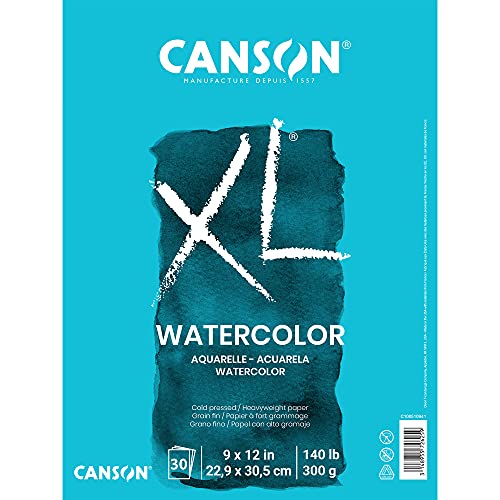
about $11 on Amazon
Canson publishes XL Watercolor as 90 lb / 185 gsm and 140 lb / 300 gsm. The 140 lb pad is the cheap way to feel what 300 gsm does under a wash.
Weight is not quality
One last caution, because weight charts encourage the wrong instinct. St Cuthberts Mill makes two watercolor papers at identical published weights, 190, 300 and 425 gsm: Saunders Waterford, which is 100 percent cotton and sized internally and externally with gelatine, and Bockingford, which the mill itself describes as high-grade alpha cellulose rather than cotton. Same numbers on the label, materially different papers under a brush. Fabriano's Studio line is a 200 gsm watercolor sheet that is 25 percent cotton and lignin-free cellulose pulp, sitting at the same grammage as premium rag sheets.
Fibre and sizing decide how a sheet behaves. Weight decides how much of it is there. Both matter, and only one of them is on the front of the pad.
Related references
This is one of three technical references we keep for painters. The lightfastness ratings reference translates between the ASTM, Blue Wool and manufacturer permanence systems, and the paint brush size chart publishes measured hair dimensions by size and shape across brands. For surfaces rather than paper, see standard canvas sizes, and for reproductions, the archival inkjet paper guide and print resolution and DPI chart.
Frequently asked questions
How many gsm is 140 lb paper?
For watercolor paper, 140 lb is 300 gsm. Arches, St Cuthberts Mill (Saunders Waterford and Bockingford), Strathmore, Canson and Winsor & Newton all publish 140 lb and 300 gsm as the same sheet. That equivalence only holds for watercolor paper, because 140 lb is a basis weight measured on the 22 by 30 inch watercolor parent sheet. A 140 lb rating on a different grade of paper, measured on a different parent sheet, is a different thickness.
Is 140 lb watercolor paper thick enough?
For most painting, yes, with one caveat about water. St Cuthberts Mill publishes that 300 gsm (140 lb) paper 'with dry brush work will only have minimal curl', and that heavy weight paper of 425 gsm (200 lb) and above 'will be stable' without stretching. Legion Paper puts it plainly: 140 lb 'is most commonly used, but may buckle without stretching'. So 140 lb is thick enough for normal work, and for heavy washes you either stretch it, tape it, or buy a block, which Winsor & Newton describes as keeping the paper stretched as it dries.
Is 90 lb watercolor paper the same as 90 lb drawing paper?
No. Strathmore publishes its 200 Series Watercolor as 90 lb (22 by 30 by 500 sheets) 190 gsm. Canson publishes its Artist Series Cream Drawing as 90 lb / 147 gsm. Same number on the label, roughly 29 percent more paper per square metre in the watercolor sheet. The reason is that US basis weight is the weight of 500 sheets at that grade's own parent size, and watercolor paper is measured on a smaller parent sheet (22 by 30) than drawing paper (24 by 36).
How do you convert lb to gsm?
gsm = basis weight in lb × 1406.5 ÷ (parent sheet width × height in inches). Case Paper and Horizon Paper both publish this formula. For 140 lb watercolor paper: 140 × 1406.5 ÷ (22 × 30) = 298 gsm, which mills round and print as 300. For 100 lb cover: 100 × 1406.5 ÷ (20 × 26) = 270 gsm, exactly what Domtar prints. You cannot do the conversion without knowing the parent sheet size, which is why there is no single lb-to-gsm number.
What is the difference between 80 lb text and 80 lb cover?
Roughly 100 gsm. Domtar's own spec sheet for Cougar lists 80 lb text at 118 gsm on the 25 by 38 text parent sheet, and 80 lb cover at 216 gsm on the 20 by 26 cover parent sheet. Neenah states the principle directly: because the starting base size is not the same between paper types, the basis weights do not correspond, and 80 text is much lighter than 80 cover.
Is 300 gsm the same as 140 lb?
In watercolor paper, yes, that is how the mills label it. Outside watercolor, no. 300 gsm is an absolute measurement, grams per square metre, and it means the same thing on every paper in the world. 140 lb is a relative measurement that only resolves to a thickness once you know the grade. This is why European mills like Fabriano, Hahnemühle and Legion Paper publish gsm only and skip the pound figure entirely.
Can a higher lb number be a thinner sheet?
Yes, and it happens often. Domtar publishes 110 lb index at 199 gsm and 9.5 pt caliper, and 100 lb cover at 270 gsm and 13.9 pt caliper, so the 110 is the thinner sheet. St Cuthberts Mill gives the art-paper version of the same trap: a 356 gsm sheet in one size is labelled 260 lb while a heavier 425 gsm sheet in a smaller size is labelled 200 lb, so the 260 lb sheet is the lighter paper.
Does paper weight tell you anything about quality?
Very little. St Cuthberts Mill makes two watercolor papers at identical 190, 300 and 425 gsm weights: Saunders Waterford, which is 100 percent cotton and sized internally and externally with gelatine, and Bockingford, which the mill describes as high-grade alpha cellulose rather than cotton. Same numbers, different papers. Fibre content and sizing decide how a sheet behaves under water. Weight only decides how much of it there is.
Sources
Every figure on this page comes from one of the following. Where two of them disagree, we have published both and said so rather than picking a winner.
- Arches, Aquarelle range (90/185, 140/300, 156/356, 300/640, 400/850)
- St Cuthberts Mill, Saunders Waterford spec sheet and Bockingford spec sheet
- St Cuthberts Mill, on imperial vs metric paper weights, on curl by weight, on stretching and soak times, and on Waterford vs Bockingford vs Millford
- Strathmore, "Paper weight: what does it mean?", plus the product pages for 200 Series Watercolor, 400 Series Watercolor, 400 Series Drawing, 400 Series Sketch, 300 Series Bristol, 400 Series Bristol and 500 Series Bristol
- Strathmore, on what bristol is and on plies vs pounds (the source that conflicts with the product page)
- Canson product pages for XL Watercolor, XL Drawing, Artist Series Cream Drawing, XL Bristol and Arches BFK Rives
- Winsor & Newton, Professional Watercolour Paper (300 gsm / 140 lb, and the description of what a glued block does)
- Legion Paper, Rives BFK, Stonehenge, and Choosing a Watercolor Paper
- St Cuthberts Mill, Somerset spec sheet
- Domtar, Cougar spec and stocking sheet (text and cover, gsm and caliper), plus the Index, Tag and Vellum Bristol sheets
- Neenah Paper, Basis Weights (basic sizes and the 80 text vs 80 cover statement)
- Case Paper, GSM calculator and Horizon Paper, grammage converter (the 1406.5 formula)
- PrintWiki, Basis Weight (the 500-sheet definition and the 1000-sheet caveat)
- Formax Printing, on caliper and The Paper Mill Store, on weight vs caliper
- Fabriano Artistico and Fabriano Watercolour Studio (grammage only, no pound figures published)
What we left out. We could not find a manufacturer-published caliper for any watercolor paper, so this page does not give one, and you should be suspicious of charts that do. We have not published pound figures for Fabriano, Hahnemühle, Legion Paper or Somerset papers, because those mills publish grammage only. Product links on this page are affiliate links. Prices are what we saw at publication and move constantly. See our affiliate disclosure.