Reference · Updated August 2026
Paint Brush Size Chart
Measured hair width and length by size and shape, taken from manufacturers' own published spec tables. This page exists because the number on the handle is not a measurement, and every chart that pretends otherwise is guessing.
By the Austin Gallery editors · August 8, 2026
Update, 8 August 2026. The da Vinci ladders in this page were added after first publication. The first version of this page carried no da Vinci figures at all, on the mistaken basis that da Vinci did not publish them. It does, per size, on individual product pages. That claim has been removed and corrected. A later research pass collected 343 published rows across 30 da Vinci series, and they are reproduced below with their provenance stated.
The quick answer
Brush sizes are not standardised, and the manufacturers say so themselves. A number 8 round is 4.40 mm wide at Escoda, 4.9 mm at Princeton, 5.2 mm in Rosemary & Co's Series 33 and 9.0 mm in their Ivory range. The number is an index into one maker's own ladder, not a spec. It also means different things across shapes: in Princeton's Umbria range a size 8 Round is 4.73 mm wide and a size 8 Bright is 15.54 mm. Read the millimetres, not the number.
It goes further than that. In da Vinci's Series 673 rigger, published on da Vinci's own site, the numbering runs backwards: size 0 is 6.5 mm across with 37 mm of hair, and size 6 is 2.9 mm with 28 mm of hair. The bigger number is the smaller brush.
A number 8 round, across brands
The single most useful table on this page. Every figure is published by the manufacturer named in the row. Nothing here is interpolated, converted from a different size, or estimated.
| Brand | Series | Hair width | Hair length |
|---|---|---|---|
| Escoda | Óptimo 1210 (kolinsky) | 4.40 mm | 22 mm |
| Escoda | Reserva 1212 (kolinsky-tajmyr) | 4.40 mm | 22 mm |
| Escoda | Perla 1430 (white toray) | 4.40 mm | 20 mm |
| Escoda | Versàtil 1540 (synthetic kolinsky) | 4.40 mm | 20 mm |
| Princeton | Umbria 6250 | 4.73 mm | 23 mm |
| Princeton | Neptune 4750 (synthetic squirrel) | 4.75 mm | 20 mm |
| Princeton | Aqua Elite 4850 | 4.85 mm | 23 mm |
| Princeton | Velvetouch 3950 | 4.9 mm | 22 mm |
| Princeton | Velvetouch 3950, Long Round | 5.06 mm | 25 mm |
| Rosemary & Co | Series 33 (pure kolinsky pointed round) | 5.2 mm | 24.2 mm |
| Rosemary & Co | Series 8 (pure kolinsky pointed round) | 5.7 mm | 26 mm |
| Rosemary & Co | Series 22 (kolinsky designer) | 6.0 mm | 27.6 mm |
| Rosemary & Co | Ivory (synthetic, for oils) | 9.0 mm | 32.5 mm |
| Rosemary & Co | Shiraz (synthetic, for acrylics) | 9.1 mm | 32.4 mm |
| da Vinci | Series 36 (red sable round) | 4.7 mm ◆ | 22.0 mm |
| da Vinci | Series 5598 CASANEO (round) | 5.1 mm ◆ | 25.0 mm |
| da Vinci | Series 5580 COSMOTOP-SPIN (round) | 5.3 mm ◆ | 25.0 mm |
| da Vinci | Series 35 MAESTRO (kolinsky, extra long) | 6.19 mm ◆ | 27.0 mm |
| da Vinci | Series 10 and Series 11 (MAESTRO kolinsky) | not published | 25.0 and 27.0 mm |
| Pro Arte | Prolene 101 | not published | 22 mm |
Roughly a 2x spread in width and a 1.6x spread in length, for one number. Note also that this is not simply a cheap-versus-expensive divide: Rosemary's synthetic ranges for oil and acrylic are the widest brushes in the table, because oil painters move more paint. ◆ da Vinci's figure is not the same measurement as the others: it publishes the hair-bundle diameter of the brush body, where Escoda, Princeton and Rosemary publish a hair width. On a round those describe the same part of the brush, but they are different fields and we have not silently merged them. Adding da Vinci did not move either end of the spread: the narrowest number 8 in this table is still Escoda at 4.40 mm and the widest is still Rosemary's Shiraz at 9.1 mm, with all five da Vinci rounds landing inside that band.
Scroll the table sideways to see every column.

about $51 on Amazon
Every brush in this set appears by name in the Velvetouch table above, so you can read the exact published width and hair length of each one before you buy. That is unusual, and it is the reason Velvetouch is the series this page leans on hardest.
The makers say it themselves
It would be easy to assume this is an oversight nobody admits to. It is not. Five manufacturers state it on their own sites:
- Princeton: brush sizes vary by manufacturer and may be labeled based on the width of the hair, such as a quarter inch angle, or a general size, such as a number 6 round.
- Winsor & Newton: each number does not necessarily equate to the same size brush in different ranges, and this is particularly noticeable between English, French and Japanese sizes.
- Rosemary & Co: there is no universal brush size; their brush sizes are different to every other brush company, and are not comparable across their own ranges either.
- Pro Arte: most paintbrush sizes are only given a number, which, unfortunately, is not standard across manufacturers.
- da Vinci: "Unfortunately the European brush industry has never managed to agree on common standards for brush types and sizes." They add the commercial consequence in the next breath: "The differing numeration often leads to miscalculations when prices are compared."
Pro Arte's catalogue supplies the hard numbers behind its own claim. Across its ranges, a brush sold as a size 8 round carries anywhere from 22 mm of hair (Prolene Series 101, Acrylix Series 202, Masterstroke Series 60) to 32 mm (Sterling Acrylix Series 201, and the hog round). The same effect appears at the small end: a Pro Arte size 0 is 8 mm of hair as a Prolene round, 13 mm as a Prolene signwriter and 20 mm as a Prolene rigger. One brand, one number, three brushes.
The most telling evidence is that one manufacturer manages to argue both sides. da Vinci's printed catalogue states that da Vinci complies with international standards on brush type sizes, and in the same breath advises never buying a brush size blindly and always comparing the diameter. da Vinci's own website says something else entirely, in the sentence quoted above. The website also carries the concrete admission: "English producers use numbers for brush sizes that differ from those in Germany. With water colour brushes the difference up to size 6 is one complete number, e.g. the English size 2 corresponds to our size 3." That rather settles the question, and further down this page we put a number on it using da Vinci's own published dimensions.
For fairness, da Vinci does record a direction of travel: "During the last years all markets have converged. The effect has been a first standardization of synthetic brush assortments and sizes, which is now also followed by Asian brush producers." A first standardization of synthetic assortments is not the same claim as a standard, and their own numbers, below, do not yet show one.
We could not locate a current, in-force standard for artists' brush sizes from ISO, ASTM or BSI. We are reporting that as a failure to find one rather than as proof that none exists.
Even the inch labels are not literal
Flats, washes and mops are often labelled in inches rather than by number, which sounds like it should settle the matter. It does not. One inch is 25.4 mm. Here is what Princeton publishes for brushes it labels one inch, all within its own catalogue:
| Series | Shape | Label | Published width | Published hair length |
|---|---|---|---|---|
| Neptune 4750 | Oval Wash | 1" | 23.4 mm | 41 mm |
| Aqua Elite 4850 | Stroke | 1" | 23.6 mm | 32 mm |
| Neptune 4750 | Mottler | 1" | 24.11 mm | 25 mm |
| Velvetouch 3950 | Wash | 1" | 24.24 mm | 25.5 mm |
| Neptune 4750 | Aquarelle | 1" | 24.91 mm | 26 mm |
| SNAP! 9650 | Wash | 1" | 25.7 mm | 25 mm |
| SNAP! 9650 | Stroke | 1" | 25.7 mm | 32 mm |
Same label, a 2.3 mm spread in width, and a hair length that ranges from 25 mm to 41 mm. If the inch label is not consistent inside one manufacturer's own line, it will not be consistent across two.
Scroll the table sideways to see every column.

about $39 on Amazon
A useful demonstration of the wash problem in one box: the Aquarelle and the Oval Wash carry inch labels, and Princeton publishes very different hair lengths for them at the same nominal width.
The same number means different things by shape
This is the part most size charts skip entirely. Within one brand and one series, the size number tracks a different dimension depending on the shape. Princeton's published figures at size 8 make it plain:
| Series | Shape | Hair width | Hair length |
|---|---|---|---|
| Velvetouch 3950 | Round | 4.9 mm | 22 mm |
| Velvetouch 3950 | Long Round | 5.06 mm | 25 mm |
| Velvetouch 3950 | Filbert | 6.04 mm | 13.5 mm |
| Velvetouch 3950 | Flat Shader | 6.31 mm | 10 mm |
| Velvetouch 3950 | Chisel Blender (Princeton's short flat) | 7.66 mm | 8 mm |
| Umbria 6250 | Round | 4.73 mm | 23 mm |
| Umbria 6250 | Angle Bright | 9.54 mm | 16.5 mm |
| Umbria 6250 | Filbert | 14.3 mm | 28.5 mm |
| Umbria 6250 | Bright | 15.54 mm | 18.5 mm |
Look at the two Filberts. In Velvetouch, a size 8 Filbert is 6.04 mm wide. In Umbria, from the same manufacturer, a size 8 Filbert is 14.3 mm wide. Both are correct, both are published, and neither number is portable to the other range.
Scroll the table sideways to see every column.
Escoda's catalogue makes the same point in a different way. Its master chart publishes one shared width scale that several shapes reuse, so at any given size the filbert and the bright are exactly the same width, and only the hair length distinguishes them. All fourteen width values are identical across the two rows. At size 8:
| Escoda shape, size 8 | Width or diameter | Hair length |
|---|---|---|
| Bright | 6.10 mm | 11 mm |
| Filbert | 6.10 mm | 13 mm |
| Round pointed, short length | 4.40 mm | 14 mm |
| Round pointed | 4.40 mm | 21 mm |
| Rigger | 4.40 mm | 34 mm |
Two width values across five shapes, and hair lengths from 11 mm to 34 mm. Escoda's angular row reuses the same width scale as the filbert and bright, so the pattern is deliberate rather than a transcription artifact.
Scroll the table sideways to see every column.
Note the vocabulary too. Princeton calls the short flat a Chisel Blender in Velvetouch and a Bright in Umbria. Rosemary & Co calls it a Short Flat in most of its ranges. Escoda groups bright and flat together. If you are matching a brush you already own, matching the shape name is no safer than matching the number.
Round brush size ladders
Read as width mm / hair length mm. Blank cells mean the manufacturer does not offer that size in that series, not that we could not find it.
| Size | Velvetouch 3950 | Neptune 4750 | Aqua Elite 4850 | Umbria 6250 | SNAP! 9650 |
|---|---|---|---|---|---|
| 18/0 | 0.53 / 5 | · | · | · | · |
| 10/0 | · | · | · | · | · |
| 5/0 | · | · | 0.83 / 5 | · | · |
| 3/0 | 0.79 / 6.5 | · | 1.09 / 6.5 | 1.04 / 6.5 | 2.24 / 6 |
| 0 | · | 1 / 8 | 1.21 / 8 | 1.17 / 8 | · |
| 1 | 1.35 / 9.5 | · | 1.37 / 9.5 | · | · |
| 2 | 1.82 / 12 | 1.69 / 12 | 1.7 / 12 | 1.8 / 12 | 2.06 / 12 |
| 3 | 2.43 / 14 | · | 2.44 / 14 | · | · |
| 4 | 2.85 / 15.5 | 2.73 / 14 | 2.98 / 17 | 2.81 / 17 | 3.66 / 17 |
| 5 | 3.16 / 17 | · | · | · | · |
| 6 | 3.65 / 18.5 | 3.68 / 18 | 3.77 / 19 | 3.55 / 19 | 4.7 / 19 |
| 8 | 4.9 / 22 | 4.75 / 20 | 4.85 / 23 | 4.73 / 23 | · |
| 10 | 5.6 / 24 | 5.81 / 24 | 5.87 / 25 | 5.77 / 25 | 5.62 / 26 |
| 12 | · | 7.35 / 30 | 7.47 / 30 | 6.97 / 29 | 8.15 / 31 |
| 14 | · | 7.9 / 32 | · | · | · |
| 16 | · | 9.55 / 35 | 9.65 / 34.04 | · | 9.1 / 33.5 |
| 18 | · | 10.6 / 38 | · | · | · |
| 20 | · | 12.5 / 40 | 11.94 / 40.13 | · | 11.1 / 37 |
All five ladders are Princeton's, published in both inches and millimetres on its own series pages. Reproducing one brand's five ranges side by side is deliberate: it removes brand quality as a variable and still shows the numbers failing to line up.
Scroll the table sideways to see every column.
Escoda publishes the same ladder a different way, with one diameter series shared by all four of its watercolour ranges and the hair length varying by range. Óptimo and Reserva are the kolinsky lines; Perla and Versàtil are synthetic, and run slightly shorter.
| Size | Diameter (mm) | Length, Óptimo & Reserva (mm) | Length, Perla & Versàtil (mm) |
|---|---|---|---|
| 3/0 | 0.50 | 6 | 6 |
| 2/0 | 0.80 | 7 | 7 |
| 0 | 0.95 | 8 | 8 |
| 1 | 1.43 | 10 | 10 |
| 2 | 2.02 | 13 | 12 |
| 4 | 2.82 | 16 | 15 |
| 6 | 3.60 | 20 | 17 |
| 8 | 4.40 | 22 | 20 |
| 10 | 5.70 | 25 | 24 |
| 12 | 6.90 | 28 | 27 |
| 14 | 8.20 | 32 | 31 |
| 16 | 9.70 | 35 | 35 |
| 18 | 12.00 | 38 | 39 |
| 20 | 14.10 | 41 | 43 |
| 22 | 15.60 | · | 46 |
Escoda reuses diameter 0.50 mm for sizes 5/0, 4/0 and 3/0, distinguishing them by hair length alone (4, 5 and 6 mm). A caution if you compare this against Escoda's printed master catalogue chart: the diameters agree exactly, but the master chart's lengths do not match any of the four series pages at every size. We have used the per-series figures here.
Scroll the table sideways to see every column.
Rosemary & Co publishes width and length in millimetres for every size in every series. Its Series 33 pure kolinsky pointed round runs from 10/0 at 0.8 mm wide with 6.4 mm of hair, through size 8 at 5.2 by 24.2 mm, up to size 16 at 10.7 by 41.5 mm. Sizes 18 and 20 appear in the table with no figures published.

about $84 on Amazon
Escoda is one of the few makers that publishes a diameter and a length for every size in every series, which is what lets this page compare its ladder against Princeton's directly.
da Vinci publishes every size, and no table anywhere
da Vinci does publish dimensions on its own site, and publishes them thoroughly: a diameter, a visible hair length and a total length, for individual brush sizes, one product page at a time. Their own wording is "On our website you will find details of all our brush series, like the diameter, visible hair length and total length." What does not exist anywhere on their site is a consolidated size table. There is no per-series chart and no downloadable dimension sheet, so the only way to compare a size 4 against a size 8, or one series against another, is to open two product pages and hold the numbers in your head.
That absence is exactly the gap this page fills. We read 343 published rows across 30 da Vinci series from their own per-size article pages and reassembled them into the ladders below. Everything in this section is da Vinci's own figure. Nothing is interpolated, averaged, converted from a different size, or taken from a retailer.
Read the field label carefully. da Vinci uses one label for every shape: diameter of the brush body. On a round that is the hair-bundle diameter at the ferrule. On a flat, filbert or mottler the same field carries the head width. da Vinci publishes no ferrule outer diameter for any series. Its three fields are also not interchangeable with the width and length that Escoda, Princeton, Rosemary & Co or Silver Brush publish, so we have kept da Vinci in its own tables rather than folding it into theirs. Where a series genuinely does not populate a field, we say not published and leave it empty. We have filled nothing in.
da Vinci round ladders
Series 35 is the useful one, because it is the da Vinci round that publishes both fields across the whole range, from 3/0 up to 24. It is the MAESTRO kolinsky in the extra long, extra pointed body.
| Size | Diameter (mm) | Visible hair length (mm) |
|---|---|---|
| 3/0 | 1.7 | 10.0 |
| 2/0 | 1.75 | 11.0 |
| 0 | 1.91 | 12.0 |
| 1 | 1.97 | 13.0 |
| 2 | 2.41 | 14.0 |
| 3 | 2.99 | 17.0 |
| 4 | 3.41 | 20.0 |
| 5 | 4.12 | 22.0 |
| 6 | 4.88 | 24.0 |
| 7 | 5.8 | 25.5 |
| 8 | 6.19 | 27.0 |
| 9 | 6.9 | 29.0 |
| 10 | 7.3 | 31.0 |
| 12 | 8.66 | 33.0 |
| 14 | 9.76 | 35.0 |
| 16 | 10.37 | 38.0 |
| 18 | 11.83 | 40.0 |
| 20 | 12.69 | 42.0 |
| 24 | 14.02 | 46.0 |
Nineteen published sizes. Note the shape of the ladder: diameter multiplies by roughly 8.2x from 3/0 to 24, while hair length multiplies by only 4.6x. A da Vinci round does not scale as a simple enlargement of itself; the big sizes are proportionally fatter and stubbier than the small ones.
Scroll the table sideways to see every column.
Three more da Vinci rounds publish both fields. Read as diameter mm / hair length mm. Series 36 is red sable, 5580 is the COSMOTOP-SPIN synthetic and 5598 is CASANEO. Blank cells mean the size is not offered in that series.
| Size | Series 36 (red sable) | Series 5580 COSMOTOP-SPIN | Series 5598 CASANEO |
|---|---|---|---|
| 10/0 | · | 0.8 / 4.5 | · |
| 5/0 | · | 0.9 / 5.0 | · |
| 3/0 | 0.9 / 6.0 | 1.1 / 6.0 | · |
| 2/0 | 0.9 / 6.5 | 1.1 / 6.0 | · |
| 0 | 0.9 / 7.0 | 1.5 / 8.5 | 1.7 / 7.5 |
| 1 | 1.1 / 7.5 | 1.7 / 9.5 | 1.2 / 8.5 |
| 2 | 1.5 / 10.0 | 2.05 / 11.5 | 1.5 / 10.0 |
| 3 | 1.85 / 12.5 | 2.6 / 14.0 | 2.6 / 12.0 |
| 4 | 2.35 / 14.0 | 2.85 / 16.0 | 2.5 / 14.0 |
| 5 | 2.7 / 16.0 | 3.6 / 18.0 | 3.6 / 16.0 |
| 6 | 3.3 / 18.0 | 3.9 / 20.0 | 4 / 19.0 |
| 8 | 4.7 / 22.0 | 5.3 / 25.0 | 5.1 / 25.0 |
| 10 | 6 / 26.0 | 6.5 / 28.0 | 6.5 / 28.0 |
| 12 | 6.9 / 30.0 | 7.3 / 31.0 | 7.5 / 31.0 |
| 14 | · | 8.2 / 33.0 | · |
| 16 | 8.2 / 33.0 | 9.7 / 36.0 | 9.3 / 36.0 |
| 18 | · | 10.5 / 38.0 | · |
| 20 | 9.7 / 36.0 | 12 / 40.0 | 12.2 / 40.0 |
| 22 | · | 12.8 / 42.0 | · |
| 24 | 12.1 / 41.0 | 13.2 / 42.0 | 13.8 / 44.0 |
| 26 | · | 14.4 / 46.0 | · |
| 30 | · | 15.6 / 50.0 | 15.6 / 48.0 |
| 40 | · | 19.7 / 56.0 | 20.5 / 56.0 |
Two things to notice. Series 36 runs consistently narrower than the two synthetics at the same number, and the gap closes as the brushes grow: about 40 percent narrower at size 0, 27 percent at size 2, 11 percent at size 8 and under 6 percent at size 12. Even inside one factory the fibre changes what the number buys, and by a different amount at each end of the ladder. Second, Series 5598 contains two published inversions, at sizes 1 and 4, which are flagged in the anomalies section below rather than corrected here.
Scroll the table sideways to see every column.
Series 10 against Series 11: the English body, measured
Series 10 and Series 11 are both MAESTRO kolinsky rounds. For neither of them does da Vinci publish a diameter at all, at any size, so the diameter column below does not exist. That is a genuine gap in their data, not a gap in ours. What they do publish for both is visible hair length at every size, and that is enough to do something no other manufacturer on this page lets you do.
Series 11 is da Vinci's explicit "English" body line: the same hair, in the fuller shape the English trade uses. Series 10 is the German body. So placing them side by side turns the English-versus-German numbering gap from an anecdote into a measured, in-house quantity.
| Size | Series 10, hair length (mm) | Series 11, hair length (mm) |
|---|---|---|
| 10/0 | 4.5 | · |
| 5/0 | 5.0 | 5.0 |
| 4/0 | 5.5 | · |
| 3/0 | 6.0 | 7.0 |
| 2/0 | 6.5 | 8.0 |
| 0 | 7.0 | 10.0 |
| 1 | 9.0 | 12.0 |
| 2 | 11.5 | 14.0 |
| 3 | 14.0 | 16.0 |
| 4 | 16.0 | 18.0 |
| 5 | 18.0 | 21.0 |
| 6 | 20.0 | 23.0 |
| 7 | 23.0 | · |
| 8 | 25.0 | 27.0 |
| 9 | 27.5 | · |
| 10 | 29.0 | 31.0 |
| 12 | 33.0 | 35.0 |
| 14 | 35.5 | 37.0 |
| 16 | 37.0 | 38.0 |
| 18 | 38.0 | · |
| 20 | 40.0 | 42.0 |
| 24 | 44.0 | 46.0 |
| 30 | 47.0 | · |
| 36 | 54.0 | · |
| 50 | 66.0 | · |
Diameter is not published by da Vinci for either series, so there is no diameter column to show. Series 11 runs about 2 mm longer than Series 10 at the same number, consistently: 18.0 against 16.0 at size 4, 27.0 against 25.0 at size 8, 35.0 against 33.0 at size 12. The gap is proportionally largest at the small end, where Series 11 size 0 is 10.0 mm against Series 10 at 7.0 mm.
Scroll the table sideways to see every column.
Pair that with da Vinci's own published sentence: "English producers use numbers for brush sizes that differ from those in Germany. With water colour brushes the difference up to size 6 is one complete number, e.g. the English size 2 corresponds to our size 3." Their numbers agree with their prose. Series 10 size 3 is 14.0 mm of hair, and Series 11, the English body, reaches 14.0 mm at size 2. One complete number of offset, published by the maker, in millimetres.
Series 673: the numbering runs backwards
The best counterexample we found
In da Vinci's Series 673 rigger, a plastic quill brush, both the diameter and the hair length decrease as the size number goes up. Size 0 is 6.5 mm / 37.0 mm. Size 6 is 2.9 mm / 28.0 mm. That is less than half the diameter for six numbers upthe ladder. We re-fetched the series to confirm it was not a transcription error on our side. It is published as shown.
| Size | Diameter (mm) | Visible hair length (mm) |
|---|---|---|
| -2 (listed ahead of 0) | 5.7 | 39.0 |
| 0 | 6.5 | 37.0 |
| 2 | 5.0 | 33.0 |
| 3 | 5.1 | 31.5 |
| 4 | 4.7 | 30.0 |
| 5 | 4.2 | 29.0 |
| 6 | 2.9 | 28.0 |
| 7 | 3.3 | 28.0 |
Reproduced exactly as published, including the size da Vinci lists ahead of 0. The descent is not perfectly monotonic: size 3 is fractionally wider than size 2 (5.1 against 5.0) and size 7 is wider than size 6 (3.3 against 2.9). We are reporting those two upticks rather than smoothing them, because the point of this table is that the published numbers are what they are.
Scroll the table sideways to see every column.
Every other maker on this page numbers upward. If you take one thing from this page, take this: the number on the handle is an index into a catalogue, and a catalogue can index in whichever direction its maker chose. It is not a measurement, and it is not even reliably an ordering.
Size 10 inside one factory: 16 mm to 31 mm
The cross-brand table at the top of this page shows a number 8 varying about twofold between manufacturers. That comparison is easy to wave away as different companies doing different things. This one is not. Every row below is a brush stamped 10, made by da Vinci, sold by da Vinci, with the hair length da Vinci publishes for it.
| da Vinci series | Visible hair length at size 10 |
|---|---|
| Series 1610 (oil round) | 16.0 mm |
| Series 1670 (NOVA, long handle) | 18.0 mm |
| Series 393 and Series 373 | 25.0 mm |
| Series 36 (red sable) | 26.0 mm |
| Series 5530 | 27.0 mm |
| Series 1570 (NOVA) | 28.0 mm |
| Series 5580 (COSMOTOP-SPIN) | 28.0 mm |
| Series 5598 (CASANEO) | 28.0 mm |
| Series 10 (MAESTRO kolinsky) | 29.0 mm |
| Series 11 (MAESTRO, English body) | 31.0 mm |
| Series 35 (MAESTRO, extra long) | 31.0 mm |
A range of 16.0 mm to 31.0 mm, very nearly a twofold spread, for the same printed number inside a single manufacturer. Note that Series 393 and Series 373 publish byte-identical dimensions to each other at every shared size, so the number does not identify the fibre either.
Scroll the table sideways to see every column.
Same maker, same fibre, different numbers: Series 1570 against 1670
Series 1570 and Series 1670 are both da Vinci NOVA synthetics. 1670 is the long-handle version. They are, as far as da Vinci's own published dimensions can tell you, the same brushes on different sticks, and they are numbered differently. Read as diameter mm / hair length mm.
| Size | Series 1570 (NOVA) | Series 1670 (NOVA, long handle) |
|---|---|---|
| 10/0 | 0.85 / 4.5 | · |
| 5/0 | 0.9 / 5.0 | · |
| 3/0 | 1.1 / 6.0 | 1.1 / 6.0 |
| 2/0 | 1.1 / 6.0 | 1.1 / 6.0 |
| 0 | 1.5 / 8.5 | 1.1 / 6.0 |
| 1 | 1.7 / 9.5 | 1.5 / 8.5 |
| 2 | 2.05 / 11.5 | 1.7 / 9.5 |
| 3 | 2.6 / 14.0 | · |
| 4 | 2.85 / 16.0 | 2.05 / 11.5 |
| 5 | 3.6 / 18.0 | · |
| 6 | 3.9 / 20.0 | 2.6 / 14.0 |
| 7 | 4.5 / 21.0 | · |
| 8 | 5.3 / 25.0 | 2.85 / 16.0 |
| 9 | 5.7 / 26.0 | · |
| 10 | 6.5 / 28.0 | 3.6 / 18.0 |
| 12 | 7.3 / 31.0 | 3.9 / 20.0 |
| 14 | 8.2 / 33.0 | 4.5 / 21.0 |
| 16 | 9.7 / 36.0 | 5.3 / 23.0 |
| 18 | 10.5 / 38.0 | 5.7 / 24.0 |
| 20 | 12 / 40.0 | 6.5 / 25.0 |
| 22 | 12.8 / 42.0 | · |
| 24 | 13.2 / 44.0 | 7.3 / 31.0 |
| 26 | 14.4 / 46.0 | 8.2 / 33.0 |
| 28 | · | 9.5 / 36.0 |
| 30 | 15.6 / 50.0 | · |
Match the values, not the rows. 1570 size 2 and 1670 size 4 are both 2.05 mm / 11.5 mm. The offset is not constant: it is one number at the bottom (1570 size 0 equals 1670 size 1), two by size 2, and six by the time you reach 1570 size 6, which equals 1670 size 12. 1670 simply skips the odd numbers above size 2. At the top the two ladders stop agreeing entirely: 1570 size 8 and 1670 size 16 share a 5.3 mm diameter but not a hair length, 25.0 mm against 23.0 mm.
Scroll the table sideways to see every column.
Series 5080: when the size number is the width, until it is not
The section above on inch labels showed that a brush sold as one inch is usually not 25.4 mm. da Vinci's Series 5080 mottler is the mirror image of that problem, and briefly the most honest numbering on this page: the size number simply is the width in millimetres. A size 40 is 40 mm across. That holds exactly up to size 80. Above it, the published width drifts below the number.
| Size number | Published width | Visible hair length | Against the label |
|---|---|---|---|
| 20 | 20 mm | 28.5 mm | exact |
| 30 | 30 mm | 30.0 mm | exact |
| 40 | 40 mm | 33.0 mm | exact |
| 50 | 50 mm | 35.0 mm | exact |
| 60 | 60 mm | 35.0 mm | exact |
| 80 | 80 mm | 37.0 mm | exact |
| 150 | 150 mm | 37.0 mm | exact |
| 200 | 180 mm | 37.0 mm | 20 mm narrower than the number |
| 300 | 298 mm | 40.0 mm | 2 mm narrower |
| 400 | 395 mm | 40.0 mm | 5 mm narrower |
| 500 | 495 mm | 40.0 mm | 5 mm narrower |
The drift is not proportional and not in one direction of magnitude: a size 200 is 180 mm, a full 10 percent narrow, while a size 300 is 298 mm, off by well under one percent. So even the one da Vinci series whose number is a real measurement stops being one at the top of its own range.
Scroll the table sideways to see every column.
Two more clean da Vinci comparisons
Series 70 against Series 76. Both are MINIATURE MAESTRO rounds. da Vinci publishes identical diameters for them at every size and different hair lengths, which isolates a single variable more cleanly than anything else we found in any maker's data.
| Size | Series 70 diameter | Series 70 hair | Series 76 diameter | Series 76 hair |
|---|---|---|---|---|
| 2 | 2 | 13.0 | 2 | 10.0 |
| 3 | 2.5 | 14.0 | 2.5 | 12.0 |
| 4 | 3 | 17.0 | 3 | 13.5 |
Same diameter at every size, and hair length 17 to 30 percent longer in Series 70. This is the bright-versus-flat distinction, applied to rounds, and sold as two separate series.
Scroll the table sideways to see every column.
Series 364 flat against Series 365 filbert. Same range, same numbers, and on the flat the size number is close to the width in millimetres. The filbert at the same number is markedly narrower, which is the shape difference the page's Princeton section describes, here in one maker's own figures. Read as width mm / hair length mm, remembering that on these shapes da Vinci's diameter field carries the head width.
| Size | Series 364 (FORTE flat) | Series 365 (FORTE filbert) |
|---|---|---|
| 2 | 3 / 8.0 | · |
| 4 | 5 / 9.0 | 3.8 / 11.0 |
| 6 | 7 / 11.0 | 5.4 / 14.0 |
| 8 | 9 / 13.0 | 8 / 16.0 |
| 10 | 10 / 15.0 | 9.6 / 18.0 |
| 12 | 12 / 18.0 | · |
| 14 | 14 / 18.0 | · |
At size 6 the flat is 7 mm wide and the filbert is 5.4 mm. At size 8, 9 mm against 8 mm. The filbert also carries more hair at every shared size, 11.0 mm against 9.0 mm at size 4. Sizes 2, 12 and 14 are offered in the flat only.
Scroll the table sideways to see every column.
Flat, filbert and bright ladders
Again width mm / hair length mm, from Princeton's published tables. The Velvetouch columns show the clean version of the bright-versus-flat difference: identical size numbers, similar widths, and hair lengths that separate them.
| Size | Velvetouch Flat Shader | Velvetouch Chisel Blender | Velvetouch Filbert | Umbria Flat | Umbria Bright |
|---|---|---|---|---|---|
| 2 | 3.47 / 7 | 3.39 / 5 | · | 7.21 / 17.5 | 6.97 / 10.5 |
| 4 | 4.3 / 8 | 4.55 / 5.5 | 4.52 / 9.5 | · | 9.08 / 12.5 |
| 6 | 5.6 / 9 | 5.46 / 6.5 | 5.55 / 12 | 12.1 / 22 | 11.79 / 15 |
| 8 | 6.31 / 10 | 7.66 / 8 | 6.04 / 13.5 | · | 15.54 / 18.5 |
| 10 | 9.03 / 13 | · | · | 18.4 / 25.5 | 19.04 / 21.5 |
| 12 | · | · | · | 24.28 / 31 | · |
Scroll the table sideways to see every column.
Wash, mop and quill
| Series | Shape | Sizes | Published widths | Published hair lengths |
|---|---|---|---|---|
| Neptune 4750 | Aquarelle (flat wash) | 1/4", 1/2", 3/4", 1" | 6.16, 12.2, 18.5, 24.91 mm | 11, 16, 21, 26 mm |
| Neptune 4750 | Oval Wash | 1/2", 3/4", 1" | 11.56, 17.85, 23.4 mm | 23, 35, 41 mm |
| Neptune 4750 | Mottler | 1", 1-1/2", 2" | 24.11, 37.27, 48.61 mm | 25, 28, 30 mm |
| Neptune 4750 | Quill | 4, 6, 8 | 10, 12, 14 mm | 37, 39, 41 mm |
| Velvetouch 3950 | Oval Mop | 1/4", 1/2", 3/4" | 5.9, 10.76, 17.3 mm | 17, 30.99, 39 mm |
| Aqua Elite 4850 | Mop | 3/4" | 12.24 mm | 40.01 mm |
| Aqua Elite 4850 | Prism | 4, 8, 12 | 7.3, 11.6, 15.9 mm | 32, 40, 46 mm |
| Umbria 6250 | Flat Wash | 1-1/2" | 39.36 mm | 39.5 mm |
The Neptune rows are the clearest illustration of why wash shapes cannot be compared by label alone: at a nominal 1 inch, the Mottler carries 25 mm of hair and the Oval Wash carries 41 mm.
Scroll the table sideways to see every column.
Liner, rigger and script
| Series | Shape | Size | Published width | Published hair length |
|---|---|---|---|---|
| Velvetouch 3950 | Short Liner | 18/0 | 0.67 mm | 8 mm |
| Velvetouch 3950 | Liner | 10/0 | 0.72 mm | 12 mm |
| Velvetouch 3950 | Script Liner | 2/0 | 0.97 mm | 16.5 mm |
| Velvetouch 3950 | Script Liner | 2 | 1.4 mm | 20.5 mm |
| Aqua Elite 4850 | Liner | 1 | 1.11 mm | 18 mm |
| Neptune 4750 | Script | 1 | 1.23 mm | 18 mm |
| Neptune 4750 | Script | 4 | 2.73 mm | 24 mm |
| Aqua Elite 4850 | Rigger | 8 | 2.79 mm | 32 mm |
| Neptune 4750 | Script | 6 | 3.65 mm | 28 mm |
| Aqua Elite 4850 | Rigger | 10 | 3.56 mm | 34.04 mm |
| Umbria 6250 | Liner | 2 | 1.21 mm | 19 mm |
| Umbria 6250 | Liner | 4 | 1.59 mm | 22 mm |
Sorted by width to show the family logic: these are narrow brushes carrying disproportionately long hair, which is what makes a continuous line possible.
Scroll the table sideways to see every column.
What each shape is actually for
Descriptions below are quoted or closely paraphrased from the source named in the last column, rather than written from general knowledge.
| Shape | What it is for | Source |
|---|---|---|
| Round | Thick to thin strokes; for detail or filling in large areas depending on brush size and pressure applied. | Princeton |
| Filbert | Similar to a Flat Shader with a rounded versus a straight across tip, for creating soft edges like a rose petal. | Princeton |
| Flat | Flat ferrule, square-ended, with medium to long fibers or hairs. Large color-carrying capacity and easy maneuverability. Useful for bold, sweeping strokes, or on edge for fine lines. | Blick (retailer technical guide) |
| Bright / short flat | Short-length fibers or hairs, for short, controlled strokes, and with thick or heavy color. Rosemary & Co describes its short flats as a sturdier brush with a stronger snap creating sharper edges and control, against long flats which are looser with little snap. | Blick; Rosemary & Co |
| Wash / mop | A mop is a round, full version of the wash brush, made of soft, absorbent natural hair or synthetic fiber. Princeton adds that a mop is best for blending and also moving low viscosity fluid paints. | Blick; Princeton |
| Liner / rigger / script | Script brushes are narrow, pointed brushes with very long fibers or hairs while liners are typically shorter and narrower. Rosemary & Co treats rigger, script and liner as the same idea: a pointed round with much longer hair. | Blick; Rosemary & Co |
| Angular | Blending in tight areas, creates crisp edges and precise control. | Princeton |
| Dagger / striper | Flat ferrule, long angled bristle with a sharp point. Useful for creating long, precise, linear strokes. | Blick (retailer technical guide) |
| Fan | For blending and softening the edges of other strokes; dry brushing to create hair, trees, shrubbery and grass. | Princeton |
Scroll the table sideways to see every column.
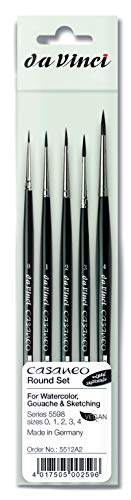
about $43 on Amazon
The exact series in the da Vinci ladder above, and the one carrying the two published inversions we flag: da Vinci lists size 1 at 1.2 mm diameter against 1.7 mm for size 0, and size 4 at 2.5 mm against 2.6 mm for size 3. Buying the range rather than a single number sidesteps that entirely, which is a reasonable way to shop a ladder you cannot trust to run in order.
How to read a size number
Sizes run upward through whole numbers, and downward through a fractional notation. Pro Arte explains the small end directly: brushes smaller than zero are referred to as the number followed by nought, so 5/0 is a size five nought, and the larger the top number, the smaller the brush. Princeton's Velvetouch range runs down to 18/0, published at 0.53 mm wide with 5 mm of hair for the round and 0.56 mm wide with 3 mm of hair for the spotter.
Princeton also publishes the only plain use-based rule we found from a manufacturer: brushes below size 4 are usually for detail work, sizes 4 to 6 are for small areas, and sizes above 6 are for broad spaces. Treat that as a rough map, then check the millimetres.
Anomalies we are publishing rather than quietly fixing
Five figures across Princeton's and da Vinci's own tables run against the direction of their own ladders. We checked the Princeton ones in both the inch and the millimetre blocks, so none of them is a unit-conversion artifact, and we re-fetched the da Vinci ones to rule out a transcription error on our side. They are reproduced above as published, and flagged here:
- Umbria 6250 Filbert: size 8 is published at 14.3 mm wide, size 10 at 12.5 mm. The larger number is the narrower brush. Hair length still increases, 28.5 mm to 34 mm.
- SNAP! 9650 Round: size 3/0 is published at 2.24 mm wide, size 2 at 2.06 mm. The same inversion appears in the 9850 line, where 2/0 and 0 are both 2.08 mm against size 2 at 2.06 mm.
- SNAP! Round 20: published at 16.5 mm in the 9850 line and 11.1 mm in the 9650 line, even though every other shared size in the two ranges matches exactly.
- da Vinci Series 5598 CASANEO, size 1: published at 1.2 mm diameter, against 1.7 mm for size 0. The size above zero is narrower than zero. Hair length still increases normally, 7.5 mm to 8.5 mm, so this is not a whole row shifted out of place.
- da Vinci Series 5598 CASANEO, size 4: published at 2.5 mm diameter, against 2.6 mm for size 3. Again the hair length behaves, 12.0 mm to 14.0 mm. Both 5598 inversions survived a repeat fetch.
Series 673, in contrast, is not on this list. Its whole ladder descends, so it is not an anomaly inside an otherwise ascending table; it is a series that is numbered the other way round. We have treated it as a finding rather than an error, and it has its own section above.
We also excluded one set of figures entirely. Princeton's Velvetouch "Petals" shape publishes zeros for width and length at sizes 6, 8 and 10 in both unit blocks. Those are placeholders, not measurements, so they are not in the tables above.
Related references
This is one of three technical references we keep for painters. The lightfastness ratings reference translates between the ASTM, Blue Wool and manufacturer permanence systems, and the paper weight conversion chart gives lb to gsm by paper type. For what goes on the brush, see our watercolor set guide and oil paint set guide; for gift shopping, our gifts for painters guide.
Frequently asked questions
What size paint brush should I use?
Princeton publishes the plainest general rule we found: brushes below size 4 are usually for detail work, sizes 4 to 6 are for small areas, and sizes above 6 are for broad spaces. That said, the number alone will not tell you the physical size, because the same number is a different brush in every range. Find your brand and series in the tables above and read the millimetres instead. For most painters starting out, one round in the 6 to 8 range, one flat or bright around 8, and one liner covers nearly everything.
Are paint brush sizes standard across brands?
No. Princeton states it on its own site: brush sizes vary by manufacturer and may be labeled based on the width of the hair, such as a quarter inch angle, or a general size, such as a number 6 round. Winsor & Newton says each number does not necessarily equate to the same size brush in different ranges, and that this is particularly noticeable between English, French and Japanese sizes. Rosemary & Co puts it bluntly: there is no universal brush size, and their sizes are not comparable across their own ranges either. Pro Arte agrees that the number is not standard across manufacturers.
How big is a #8 round brush?
Anywhere from about 4.4 mm to 9.1 mm wide, and from 20 mm to 32.5 mm of hair, depending entirely on whose brush it is. Escoda publishes 4.40 mm across four different series. Princeton publishes between 4.73 and 4.9 mm across four series. da Vinci publishes 4.7 mm for its Series 36 red sable and 6.19 mm for its Series 35 kolinsky, measured as hair-bundle diameter rather than width. Rosemary & Co publishes 5.2 mm for its Series 33 kolinsky and 9.0 mm for its Ivory synthetic. That is roughly double the width for the same number on the label.
Does a bigger number always mean a bigger brush?
No, and there is a published counterexample. In da Vinci's Series 673 rigger, the size numbers run backwards: size 0 is 6.5 mm in diameter with 37.0 mm of hair, and size 6 is 2.9 mm with 28.0 mm of hair. Both the diameter and the hair length shrink as the number rises, on da Vinci's own product pages. Two other things break the rule more quietly. Princeton's Umbria Filbert is published at 14.3 mm in size 8 and 12.5 mm in size 10, and da Vinci's Series 5598 publishes size 1 narrower than size 0. Within a single ladder the number is usually an ordering, but it is not guaranteed to be one, and it is never a measurement.
What does the number on a paint brush mean?
It is an index into that manufacturer's own ladder, not a measurement. Sizes run from very small fractional sizes up through the whole numbers. Pro Arte explains the small-end notation: brushes smaller than zero are referred to as the number followed by nought, so 5/0 is a size five nought. Beyond that, the numbering is a convention rather than a specification, and no manufacturer we checked claims otherwise. da Vinci comes closest to claiming a standard exists, but contradicts itself: its catalogue says it complies with international standards on brush type sizes, while its website says the European brush industry has never managed to agree on common standards for brush types and sizes. Its own published dimensions side with the website. A brush stamped 10 by da Vinci carries between 16.0 mm and 31.0 mm of hair depending on which of its series it belongs to.
Where can I find da Vinci brush sizes in millimetres?
da Vinci publishes a diameter, a visible hair length and a total length for individual sizes on its own site, but only on per-size product pages, one at a time. There is no consolidated size table and no downloadable dimension sheet anywhere on davinci-defet.com, which is why comparing two da Vinci sizes normally means opening two product pages. This page reassembles 343 of those published rows across 30 series into readable ladders, including Series 35, which is the only da Vinci round that publishes both a diameter and a hair length across its full range, from 1.7 mm and 10.0 mm at size 3/0 to 14.02 mm and 46.0 mm at size 24.
What is the difference between a bright and a flat brush?
Hair length. Both have a flat ferrule and a square end; the bright, also called a short flat, has noticeably shorter hair. Blick describes brights as having short-length fibers for short controlled strokes with thick or heavy color, against flats with medium to long fibers and large color-carrying capacity. Princeton's own numbers show the effect: in the Umbria range at size 8, the Bright is 15.54 mm wide with 18.5 mm of hair, while the Filbert at the same size is 14.3 mm wide with 28.5 mm of hair. Note that Princeton does not use the word bright in every range; in Velvetouch the short flat is called a Chisel Blender.
What is a rigger brush used for?
Long, thin, continuous lines: rigging on ships, branches, grasses, lettering. It is a pointed round with much longer hair, which holds more paint so the line does not break. Blick distinguishes script brushes as narrow pointed brushes with very long fibers, and liners as typically shorter and narrower, though Rosemary & Co treats rigger, script and liner as the same thing. The dimensions show the family clearly: Princeton's Aqua Elite Rigger size 8 is only 2.79 mm wide but carries 32 mm of hair, against a Round size 8 in the same range at 4.85 mm wide and 23 mm long.
Is a 1 inch brush actually one inch wide?
Usually not exactly, and the variation is real even inside a single brand. One inch is 25.4 mm. Across Princeton's own ranges, brushes labelled 1 inch measure 23.4 mm (Neptune Oval Wash), 23.6 mm (Aqua Elite Stroke), 24.11 mm (Neptune Mottler), 24.24 mm (Velvetouch Wash), 24.91 mm (Neptune Aquarelle) and 25.7 mm (SNAP! Wash). The hair lengths differ far more: 25 mm on the Mottler against 41 mm on the Oval Wash, both labelled 1 inch.
What does 3/0 or 5/0 mean on a paintbrush?
It is a size below zero, read as three nought and five nought, and the bigger the top number the smaller the brush. Pro Arte publishes this convention directly. In practice these are very small: Princeton's Velvetouch Round 3/0 is 0.79 mm wide with 6.5 mm of hair, and its Spotter 18/0 is 0.56 mm wide with 3 mm of hair.
Do brush sizes differ between watercolor and oil brushes?
The numbering convention is shared, but the physical brushes are not comparable. Rosemary & Co's own catalogue makes the point within one company: its Series 33 pure kolinsky watercolour round in size 8 is 5.2 mm wide with 24.2 mm of hair, while its Ivory synthetic for oils in the same size 8 is 9.0 mm wide with 32.5 mm of hair. Same number, a substantially bigger brush, because oil painters push more paint.
Sources
Dimensions are attributed to the manufacturer that published them. Princeton's figures come from the Dimensions blocks on its series pages, which publish inches and millimetres side by side under the column headers Size, Length and Width.
- Princeton Artist Brush Co series pages: Neptune 4750, Velvetouch 3950, Aqua Elite 4850, Umbria 6250, SNAP! 9650 and SNAP! 9850
- Princeton, Brush Anatomy (the sizing paragraph and the size-to-use rule) and Princeton, Brush Shapes
- Escoda product pages for Óptimo 1210, Reserva 1212, Perla 1430 and Versàtil 1540
- Rosemary & Co, Series 33 pure kolinsky pointed rounds, Ivory pointed rounds, Ivory short flats, Ivory long flats, and the note that there is no universal brush size
- Pro Arte, How does paint brush sizing work and Pro Arte Prolene 101 round
- Winsor & Newton, on paintbrush shape and size for watercolour
- da Vinci dimensions: every da Vinci figure on this page was read from da Vinci's own per-size article pages at davinci-defet.com, in the form
/de/artikel/VA-<series>_<size>, each of which carries a server-rendered measurements block giving diameter of the brush body, visible hair length and total length. 343 rows across 30 series. There is no consolidated size table, no per-series chart and no dimension PDF on their site; the on-page size tab renders the same per-article data one size at a time. - da Vinci statements: Explanation of technical terms and symbols, which publishes "Unfortunately the European brush industry has never managed to agree on common standards for brush types and sizes", "The differing numeration often leads to miscalculations when prices are compared", "On our website you will find details of all our brush series, like the diameter, visible hair length and total length", "English producers use numbers for brush sizes that differ from those in Germany. With water colour brushes the difference up to size 6 is one complete number, e.g. the English size 2 corresponds to our size 3" and "During the last years all markets have converged. The effect has been a first standardization of synthetic brush assortments and sizes, which is now also followed by Asian brush producers." The German original of the first reads "Leider hat sich die europaeische Pinselindustrie bis jetzt noch nicht zu einer allgemein gueltigen Standardisierung der verschiedenen Pinselarten und -groessen zusammenfinden koennen." Set against this, da Vinci's printed brush catalogue, page 33, claims compliance with international standards on brush type sizes and advises always comparing the diameter. We cite the catalogue without a deep link because the two statements do not appear on the same page.
- Escoda catalogue, the full-scale shape chart on printed pages 8 and 9, which publishes diameter, width, thickness and length in millimetres per size
- Shape definitions: Blick's brush shape guide and Blick on how a brush is measured, both retailer technical guides rather than manufacturer specifications
What we left out. We deliberately excluded retailer-listed width figures that turned out to be filter bands rather than measurements, which is a common and easy mistake to publish. We have not printed dimensions for Raphael or Isabey, because we could not confirm them from those manufacturers' own tables. On da Vinci we collected 343 published rows across 30 series and have reproduced roughly half of them, choosing the series that demonstrate something rather than printing the whole harvest: Series 7185, 1815, 393, 373, 5530 and 1610 are cited in the text where they support a point but are not given their own ladders. We have not published a hair length for Series 19, 367, 488 or 5599, or a diameter for Series 428, because da Vinci does not publish those fields; nor a ferrule outer diameter for anything, because da Vinci publishes none for any series. The one da Vinci figure we found that does not come from an article page, a 26.0 mm diameter for Series 10 number 50, appears on their editorial page rather than in the product data, so we have left it out of the Series 10 ladder rather than mix two provenances in one column. Series 499, 898 and 899 have no article pages at all, and we could not locate series numbers for CHUNEO, COLINEO, COSMOTOP Mix F or Nova Forte. No da Vinci figure here has been cross-checked against a retailer, so nothing in that section is retailer-reproduced. Winsor & Newton is a partial case worth stating precisely: it publishes millimetres for flats, one-stroke, wash, angled and filbert brushes, where the millimetre value is the size name, and publishes no dimensions at all for any round, including Series 7 and Cotman 111. Silver Brush does publish a full per-size width and length ladder, which we have not reproduced here only because we have not finished checking it. We have not published Escoda's master-catalogue hair lengths as though they were interchangeable with its per-series figures, because they are not. We are not claiming that no brush-sizing standard has ever existed, only that we could not find a current one. And we excluded Princeton's Velvetouch Petals figures because they are published as zeros. Product links on this page are affiliate links; prices are what we saw at publication. See our affiliate disclosure.