Reference · October 2026
How long does oil paint take to dry?
Drying time by pigment, by medium, and by varnish, from Winsor & Newton and Gamblin's published guides. Oil paint cures by reacting with air, so the pigment and the oil change the clock more than anything else.
By Travis Moher · Published October 28, 2026
The quick answer
Thin layers of oil paint are touch dry in 2 to 12 days, per Winsor & Newton. Umbers and siennas dry in about 2 days; titanium white and alizarin crimson take more than 5. Varnish timing depends on the varnish: 6 to 12 months by the traditional rule, at least 3 months per Winsor & Newton, or 2 weeks to 2 months with Gamblin Gamvar.
Oil paint drying time by pigment
Some pigments speed up the drying oil and some slow it down. Winsor & Newton sorts its Artists' Oil Colour range into three groups for thin films.
| Group | Touch dry (thin) | Pigments |
|---|---|---|
| Fast | About 2 days | Umbers, Raw Sienna, Prussian Blue, Cobalt Blues, Permanent Mauve (manganese), Underpainting White |
| Medium | About 5 days | Burnt Sienna, Ochres, Mars colours, Ultramarine Blues, Phthalo (Winsor) Blues and Greens, Cobalt Violet and Greens, Sap Green, Permanent Alizarin Crimson, Cadmiums, Ivory Black, Lamp Black |
| Slow | More than 5 days | Titanium White, Zinc White, Alizarin Crimson, Quinacridones, arylide Yellows and Orange |
Source: Winsor & Newton, “What are the drying times for Winsor & Newton Oil colours?” W&N says oil colours become touch dry in thin films within 2 to 12 days. Thickness and room temperature change the result.
Common colors, two price lines
The same color name can land in a different group in a student line, because the pigment or oil is different. Winsor & Newton publishes groups for both its Artists' Oil and its Winton student range.
| Color | W&N Artists' Oil | W&N Winton | Note |
|---|---|---|---|
| Burnt Umber / Raw Umber | Fast (about 2 days) | Fast | Gamblin calls Burnt Umber a vigorous drier because of its high manganese content. |
| Raw Sienna | Fast | Fast | |
| Burnt Sienna | Medium (about 5 days) | Medium | |
| Yellow Ochre | Medium | Medium | |
| Ultramarine Blue | Medium | Medium | |
| Cadmium reds and yellows | Medium | Slow (Cadmium Hues) | Winton's Cadmium Hues use arylamide pigments, not cadmium. |
| Ivory Black | Medium | Medium | Gamblin says Mars Black dries more quickly than Ivory Black. |
| Alizarin Crimson | Slow (more than 5 days) | Slow (Hue) | W&N lists Permanent Alizarin Crimson as medium in Artists' Oil. |
| Titanium White | Slow | Medium | Gamblin: linseed oil whites dry faster than safflower, poppy, or walnut oil whites. |
| Zinc White | Slow | Medium | |
| Lead (Flake) White | Not in the W&N range | Not in the W&N range | Traditionally called a fast drier; a Smithsonian review found the lead drying effect smaller than often claimed. |
A common shorthand puts cadmiums and ivory black among the slow driers. Winsor & Newton's own chart puts them in the medium group (about 5 days) for its Artists' Oil range, so that is what we show. Lead white is traditionally treated as a fast drier, but Winsor & Newton does not make it, and a Smithsonian conservation review found the drying effect of lead smaller than painters often assume. We list it without a number.
Free to use
Put this chart on your site
Teaching an oil painting class or writing a tutorial? Copy the snippet below to embed the quick pigment chart on your own page. It is self-contained and renders anywhere. Please keep the small credit link.
Click inside the box, select all (⌘A / Ctrl-A), and copy.
When an oil painting is ready to varnish
Touch dry and ready to varnish are far apart with oils. The answer you get depends on whose varnish you use, and the sources do not agree, so here they are side by side.
| Source or varnish | Wait | Detail |
|---|---|---|
| Common traditional rule | 6 to 12 months | Golden's varnish guide: oil paints generally require six months to a year before varnish. |
| Winsor & Newton | At least 3 months | W&N's oil colour guide recommends waiting at least three months. |
| Gamblin Gamvar, thin painting | As little as 2 to 3 weeks | Once dry to the touch and firm in the thickest areas. |
| Gamblin Gamvar, thick texture | 1 to 2 months | Press a fingernail into the thickest paint: firm underneath means ready. |
| Natural resin (dammar) varnish | 6+ months | Gamblin says the long wait matters for dammar dissolved in turpentine. |
The reason for the gap: Gamblin says the 6 month wait matters for natural resin varnishes like dammar, dissolved in turpentine. Its Gamvar uses a mild solvent that Gamblin says cannot dissolve a dry paint film. Gamblin's test is simple: press a fingernail into the thickest paint. If it is firm underneath, it is ready.
Mediums that speed up or slow down drying
| Medium | Effect | Published figure | Source |
|---|---|---|---|
| Winsor & Newton Liquin Original | Faster | Increases drying rate by about 50% | Winsor & Newton |
| Gamblin Galkyd | Faster | Thin layers touch dry in about 24 hours | Gamblin Mediums Guide |
| Gamblin Galkyd Lite | Faster | Thin layers touch dry in 24 to 30 hours | Gamblin Mediums Guide |
| Gamblin Galkyd Gel | Faster | Fast group, 1 to 2 days | Gamblin Mediums Guide |
| Gamblin Solvent-Free Gel and Fluid | Moderate | Moderate group, 3 to 4 days | Gamblin Mediums Guide |
| Winsor & Newton Griffin Alkyd colors | Faster | Touch dry in 18 to 24 hours | Winsor & Newton |
| Gamblin Galkyd Slow Dry | Slower | 1:1 with color keeps it wet-into-wet for at least a day | Gamblin Mediums Guide |
| Stand oil with Gamsol, 50/50 | Slower | Slow group, 4 to 6 days | Gamblin Mediums Guide |
| Poppy oil with Gamsol, 50/50 | Slower | Slow group, 4 to 6 days; poppy is Gamblin's slowest drying oil | Gamblin Mediums Guide |
Gamblin's groups come from one test: 2 parts medium to 5 parts Gamblin Titanium White, applied 1/50 inch thick on coated paper at 70°F, timed to touch dry. Clove oil is also used by some painters to slow drying. We could not find a paint maker that publishes a safe ratio for it, so it is not in the table.
Ready to shop
Two fast mediums, one solvent-free option, and the varnish that skips the long wait. Affiliate links, so we may earn a commission at no cost to you.
 Winsor & Newton Liquin Original, 75 mlW&N says Liquin increases the drying rate by about 50 percent. The common choice for next-day layering.about $11 · Check price
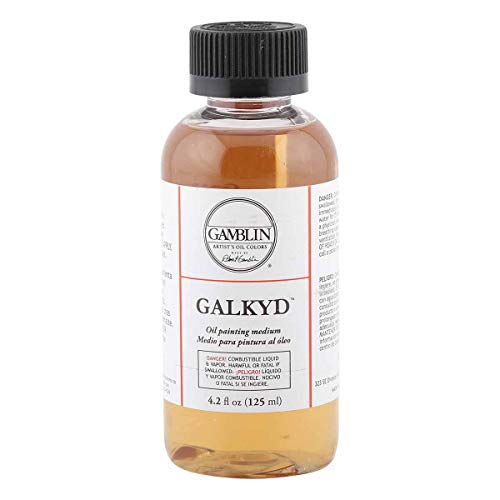 Gamblin Galkyd Painting Medium, 4 ozGamblin's fastest drying medium: thin layers touch dry in about 24 hours. It levels brushmarks when used generously.about $15 · Check price
 Gamblin Solvent-Free Gel, 150 mlSafflower oil and alkyd, no solvent. Gamblin rates it moderately fast, 3 to 4 days, and it holds a brushmark.about $16 · Check price
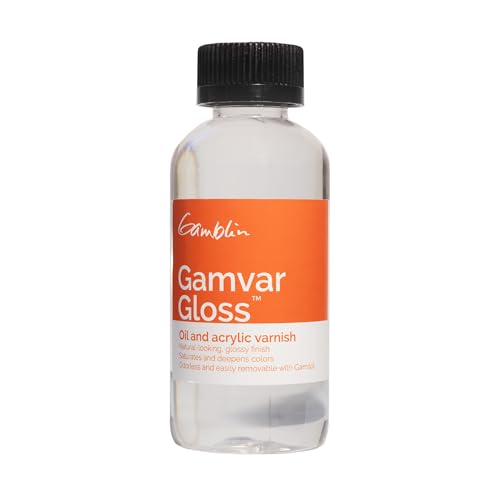 Gamblin Gamvar Picture Varnish, Gloss, 4.2 ozThe varnish that does not need the 6 month wait. Gamblin says thin paintings can take it in 2 to 3 weeks.about $17 · Check price
Prices are Amazon listing prices checked October 28, 2026.
Fat over lean
Fat over lean is the rule that each layer of an oil painting should be more flexible, meaning oilier, than the one beneath it. Gamblin says following it builds a painting that is flexible, so over time there will be less cracking. Lean means more solvent and less oil; fat means more oil or alkyd medium.
Gamblin gives two ways to follow it:
- Same ratio, fatter medium. Use the same amount of medium in every layer, but change the medium: oil thinned with Gamsol at first, then add more Galkyd or drying oil as the layers build. The top layers end up with more oil and less solvent.
- Same medium, more of it. Add very little medium to the first layers and increase the amount with each layer.
Drying speed follows the same logic. Winsor & Newton's version is “slow drying over fast drying”: put fast colors such as the umbers in the underlayers and keep slow colors for the top, so a slow layer is not trapped under a fast one that has already set.
What else changes oil drying time
- Thickness. Thin films are touch dry in days. Gamblin allows 1 to 2 months before varnishing thick texture, because the paint underneath stays soft after the skin feels dry.
- The oil. Gamblin says whites made with linseed oil dry faster than whites made with safflower, poppy, or walnut oil.
- Temperature and humidity. Gamblin notes that temperature, humidity, thickness, and the absorbency of the surface all affect drying rates, and that oil colors dry faster in warm weather.
- Alkyd paint. Winsor & Newton's Griffin Alkyd colors stay workable for 4 to 8 hours on the palette and are touch dry in 18 to 24 hours. For speed, add Liquin or Galkyd to regular oils.
Ready to paint?
Sources
- Winsor & Newton, What are the drying times for Winsor & Newton Oil colours? Pigment groups for Artists' Oil, Winton, and Artisan; Liquin; Griffin Alkyd; the 3 month varnish wait.
- Gamblin, Oil Painting Mediums guide (PDF). Galkyd touch dry times, the fast, moderate, and slow medium groups, and the test method.
- Gamblin, Varnishing Help. Gamvar timing, the fingernail test, and why dammar needs 6+ months.
- Gamblin, Fat-Over-Lean. The rule and both methods.
- Gamblin, Getting the White Right and Gamblin Artist's Oil Colors. White drying rates, linseed vs safflower, Burnt Umber and Mars Black.
- Golden Artist Colors, Varnish Application Guidelines. Six months to a year before varnishing oils.
- Tumosa and Mecklenburg, Smithsonian Museum Conservation Institute. Lead and drying oils.
Questions
How long does oil paint take to dry?
Thin layers of oil paint become touch dry in 2 to 12 days, according to Winsor & Newton. Fast colors such as the umbers dry in about 2 days, medium colors such as the cadmiums and ivory black in about 5, and slow colors such as titanium white and alizarin crimson take more than 5. Thick paint takes weeks to months to firm up all the way through.
How long should an oil painting dry before varnishing?
It depends on the varnish. The traditional rule, which Golden repeats, is six months to a year. Winsor & Newton says at least three months. Gamblin says its Gamvar varnish can go on a thin painting in 2 to 3 weeks and a thickly textured one in 1 to 2 months, once the thickest paint is firm under a fingernail.
How can I make oil paint dry faster?
Use an alkyd medium such as Liquin, which Winsor & Newton says increases the drying rate by about 50 percent, or Gamblin Galkyd, which is touch dry in about 24 hours in thin layers. Paint thinly, lean on fast drying colors such as the umbers in early layers, and keep the room warm with moving air.
What does fat over lean mean?
Each layer of an oil painting should be more flexible, meaning oilier, than the layer under it. Gamblin describes two ways to do it: keep the medium ratio the same and add more oil to the medium as you go, or use the same medium and increase how much you add with each layer. The goal is less cracking over time.
Which oil colors dry slowest?
In Winsor & Newton's Artists' Oil range the slow group is titanium white, zinc white, alizarin crimson, the quinacridones, and the arylide yellows and orange. Gamblin names Radiant White as the slowest drying white in its range, at about five days in thin layers.
Can I speed up oil paint drying with a hair dryer?
Oil paint does not dry by evaporation the way acrylic does. It cures by reacting with oxygen. Gamblin notes oil colors dry faster in warm weather, but the bigger levers are a fast medium such as Galkyd or Liquin, thin layers, and fast drying colors.
Keep reading
- How long does acrylic paint take to dry: minutes instead of days, and when to varnish.
- The best oil paint sets: student and artist grade sets ranked.
- How to clean a painting: why the varnish layer matters years later.
Drying times are the manufacturers' published figures, cited above. Your paint thickness, studio temperature, and humidity will move them. Austin Gallery may earn a commission from product links on this page at no cost to you.