Throat
20 in.
Arm
Double parallel-link
Speed
400 to 1,750 spm, variable
Blades
Pinless, tool-free clamps
Table tilt
45 degrees left and right
Cut depth
2 in.
Pros
- Lowest vibration of any saw here
- Blade moves nearly straight up and down, so it does not push the work forward
- Tool-free clamps for fast inside cuts
- Front-mounted speed and tension controls
Cons
- About $551 plus $107 for the stand
- Blade clamps take practice
- Weak dust blower, no dust port
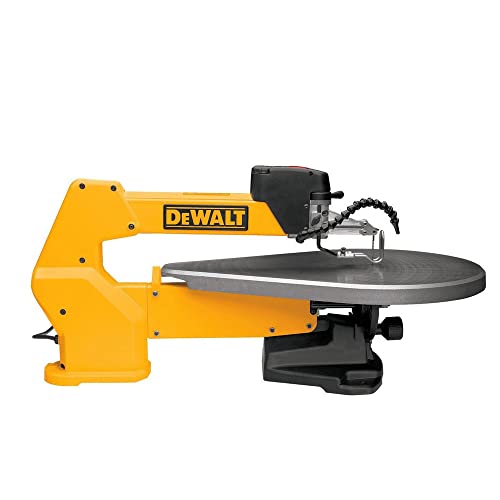
The DW788 wins because of the arm. Its double parallel-link design pivots at the back so the blade moves almost straight up and down at the work, which means the blade does not push the stock toward you on the upstroke and inside corners stay where you put them. Vibration is low enough that you can set a coin on edge on the table at full speed. Speed runs 400 to 1,750 strokes per minute from a front dial, so thin veneer and 3/4 in. hard maple both have a setting.
It was about $551 at the time of writing. The DW7880 stand adds about $107 and is worth it; the saw is heavy and wants to be bolted to something. Pair it with the Olson blade assortment below and you are set for years. It is the only saw on this page we would call a lifetime tool, and the bandsaws in our best bandsaws guide are its natural partner for the rough cuts it should not be doing.
Our Pick
The benchmark scroll saw. A double parallel-link arm that barely vibrates, 400 to 1,750 strokes per minute, tool-free blade clamps, and a 20 in. throat. It is the saw everyone else is measured against.
Anyone who will scroll more than a few hours a month: fretwork, intarsia, portrait cutting, puzzles, and anything with tight inside cuts in 3/4 in. hardwood.
What we don't like
About $551 at the time of writing without the stand, and the DW7880 stand is another $107. The blade holders are finicky until you learn them, and the dust blower is weak.