Austin Gallery

Home & Decor

Best Projector Screens 2026: Fixed, Portable, ALR & UST

The screen is half the picture, and the cheap one is why the movie looks gray. Fixed frames, disappearing acts, backyard kits, and the lenticular ALR that lets a projector replace the TV: ten screens, ranked by room, from $64 to $1,099.

By Justin ParkJuly 18, 202615 min readHow we research

The best projector screen for most setups in 2026 is the Silver Ticket 120-inch fixed frame ($279.98): a drum-tight, color-neutral surface that has been the home-theater community's value benchmark for a decade. But "best screen" is really four different questions wearing one trench coat: permanent rooms want a fixed frame, multipurpose rooms want a screen that disappears (pull-down or motorized), backyards want a portable with a stand, and bright living rooms with UST projectors want lenticular ALR, a genuinely different technology. This guide covers all four, ranked and priced from a $64 backyard kit to a $1,099 daylight-proof flagship.

A screen is half the picture, but only half: if the projector itself is still an open question, start with our home theater projectors guide for the main event, our mini projectors guide for portable and casual setups, or our art projectors guide if the studio is the destination. Every link goes to Amazon with our affiliate tag; we earn a small commission, at no cost to you, when you buy through us. Every product, price, and image was verified live on Amazon this week.

Which Projector Screen Should You Buy? The 60-Second Decision

Find your room in the left column; the right screen follows. Every pick is reviewed in full below.

Your roomBuy thisPrice
Dedicated theater or media wallSilver Ticket 120 Fixed Frame$279.98
First real setup on a budgetShowMaven 100 Fixed Frame$103.99
Short-throw or uncertain projector futureValerion 120 (any throw)$287.10
Multipurpose room, screen must vanishElite Screens Manual B 100$90.00
Want the vanish, hate the reachingDINAH 120 Motorized$139.99
Basement cinema, go enormousYODOLLA 150 Motorized$322.99
Backyard movie nightsTOWOND 120 with Stand$63.99
Frequent setups, events, presentingPropVue 100 Tripod$158.99
UST projector, bright living roomNothingProjector 100 ALR$399.00
UST as the household's main displayNothingProjector 120 Black$1,099.00

In a Hurry?

The 3 picks that cover most readers. Tap to read the full review or buy direct.

Best Overall

Silver Ticket 120 Fixed Frame

Silver Ticket 120 Fixed Frame

$279.98

The decade-long value benchmark: drum-tight, neutral, permanent.

Best Budget

TOWOND 120 Portable

TOWOND 120 Portable

$63.99

Backyard movie night in one bag: screen, stand, stakes, ten minutes.

Best for Bright Rooms

NothingProjector 100 ALR

NothingProjector 100 ALR

$399.00

Lenticular ALR that lets a UST projector work with the lamps on.

Best OverallOur Pick

Size

120-inch diagonal, 16:9

Type

Fixed frame, wall mounted

Material

White, 1.1 gain, wide viewing angle

Frame

Aluminum, velvet-wrapped bezel

Pros

  • Drum-tight surface, no waves or wrinkles, ever
  • Neutral 1.1-gain white with wide viewing angles
  • Velvet frame absorbs overshoot and frames the image
  • The community's default value recommendation for years

Cons

  • Multi-hour assembly and a committed wall
  • Not movable or hideable
  • Bright rooms want ALR instead (see below)

Ask a home-theater forum to spend $280 of your money and this screen is the answer before you finish the question. Silver Ticket's STR series has spent a decade as the value benchmark of the fixed-frame category for one reason: it delivers the two things a screen exists to do, a perfectly flat surface and a neutral canvas, at a price that embarrasses the boutique brands. The aluminum frame assembles into a rigid perimeter, the material stretches taut across it like a drumhead, and the result is geometry a rolled screen can only imitate on day one.

Why fixed frame is the enthusiast default: every retractable format, pull-down, motorized, portable, stores its material rolled, and rolled material develops waves. Waves turn camera pans into shimmering water. A fixed frame has no roll, so it has no waves, on night one or night three thousand. If the screen never needs to disappear, fixed frame is not a preference, it is the correct engineering answer.

The 1.1-gain white material is the right default for a light-controlled room: essentially neutral color, no hotspotting, and viewing angles wide enough that the cheap seats see the same movie. The velvet-wrapped bezel quietly earns its keep too, swallowing projector overshoot and giving the image the crisp black border that makes it look installed rather than aimed. Pair it with anything from our home theater projector guide and the total rig still undercuts a big TV, at twice the size.

Our Pick

The home-theater community's worst-kept secret: a taut, wrinkle-free 120-inch fixed frame with honest 1.1-gain white material that rivals screens costing three times as much. If you have the wall, this is the last screen you buy.

Buy this if a projector is (or is becoming) your main movie setup and you can give it a permanent wall. A fixed frame stretches its material drum-tight over an aluminum perimeter, which means zero waves, zero wrinkles, and perfect geometry forever, the thing every roll-up format eventually loses. The 1.1 gain white surface keeps color neutral and viewing angles wide.

What we don't like

Assembly is a real evening: six frame pieces, careful material stretching, and a two-person wall mount. And it is gloriously permanent, there is no rolling this one away when company comes.

Check the Silver Ticket 120 on Amazon →$279.98 · Silver Ticket Products
Best Budget Fixed FrameBudget Pick

Size

100-inch diagonal, 16:9

Type

Fixed frame, wall mounted

Material

White, 4K-friendly smooth surface

Frame

Aluminum with black border

Pros

  • Real fixed-frame flatness at about $104
  • Massive upgrade over wall projection
  • 100-inch size suits most living rooms
  • Straightforward assembly for the format

Cons

  • Assembly tension needs a careful hand
  • Material a step below premium neutrality
  • Light-colored walls behind can ghost through in bright scenes

The most important hundred dollars in a budget theater is the one that gets the image off the wall. Painted drywall, even good white drywall, has texture that eats fine detail, a color cast that skews every skin tone, and no black border to give the image an edge. The ShowMaven fixes all three for $103.99: a stretched, smooth, genuinely flat white surface in a velvet-edged aluminum frame that makes a $500 projector look like it cost twice as much.

What you give up against the Silver Ticket is refinement, not function: assembly rewards patience (tension the material evenly, corner to corner, and it comes out beautifully; rush it and you will chase a shallow ripple), and the material's color neutrality falls off at wider angles than the premium screens hold. For a first real setup, especially one paired with a budget projector from our mini projector guide, those are invisible compromises. This is the screen that turns "we project on the wall" into "we have a theater room" for about a hundred bucks.

Budget Pick

The fixed-frame experience, flat surface, velvet bezel, permanent mount, at a hundred dollars. The ShowMaven gives a first proper theater room 90 percent of the Silver Ticket's result for a third less money, in the slightly smaller 100-inch size.

Buy this if you are building a first dedicated setup, a game room, a dorm-adjacent apartment wall, a starter basement theater, and the budget matters more than the last few percent of material quality. It is a genuine stretched-frame screen, not a hanging sheet, and the upgrade over projecting on a wall is immediate and dramatic.

What we don't like

The material and frame tolerances are a step below Silver Ticket: a bit more care needed in assembly to get perfectly even tension, and the surface is less color-neutral at extreme angles. Fair trades at the price.

Best Fixed Frame for Any ThrowAlso Great

Size

120-inch diagonal, 16:9

Compatibility

Long throw, short throw, and UST

Material

1.3 gain, 4K/8K friendly

Type

Fixed frame, wall mounted

Pros

  • Works correctly with every projector geometry
  • 1.3 gain brightness bump for real living rooms
  • Future-proofs a projector upgrade path
  • Quality frame and tensioning for the price

Cons

  • Slight viewing-angle trade versus 1.1 white
  • Not an ALR screen despite UST compatibility
  • 120 inches needs a genuinely big wall

Projectors changed shape faster than screens did, and the Valerion is the screen that caught up. Ultra-short-throw projectors, the ones that sit on a console inches from the wall, throw light upward at angles that make traditional screen surfaces shimmer, hotspot, or sparkle. The Valerion's material is engineered for exactly that geometry while remaining happy with a conventional ceiling-mounted long throw, which makes it the rare screen you will not have to replace when you change projector philosophy.

The 1.3 gain rating deserves a plain-English translation: this screen reflects about 30 percent more light back toward centered viewers than a reference white board, which in practice means livelier daytime viewing and headroom for projectors running quiet eco modes, in exchange for slightly less uniform brightness at extreme side seats. In a rectangular living room with a couch in the middle, the trade is nearly free. The one boundary to respect: gain is not light rejection. If your room has windows you do not intend to cover, no white screen fixes that; that is ALR's job, and the two picks at the end of this guide do it properly.

Also Great

The modern fixed frame built for the projector market that actually exists now: rated for long throw, short throw, AND ultra short throw placement, with a slightly hot 1.3 gain surface. If your projector future is uncertain, this screen keeps every option open.

Buy this if you have, or might someday have, a short-throw or UST projector aimed at a normal (not lenticular) screen budget. Most white screens misbehave under steep UST light angles; the Valerion's surface is engineered to take light from any geometry, and its 1.3 gain adds a brightness bump that helps lamp-dim eco modes and semi-controlled rooms.

What we don't like

In a dark room with a strong projector, 1.3 gain buys brightness you may not need at a slight cost in viewing-angle consistency versus a 1.1 white. And UST-compatible is not the same as ambient-light-rejecting: bright rooms still want the lenticular NothingProjector screens below.

Best Pull-DownAlso Great

Size

100-inch diagonal, 16:9

Type

Manual pull-down, spring roller

Mount

Wall or ceiling

Lock

Multiple height positions with auto-lock

Pros

  • Disappears completely when retracted
  • Real brand with parts and warranty support at $90
  • Locks at multiple heights, slow retract
  • Wall or ceiling mounts in an afternoon

Cons

  • Un-tensioned material waves with age
  • Utilitarian looks
  • No help against ambient light

The pull-down screen is the honest compromise of the screen world: not the best picture, but the best treaty between a movie habit and a room that has other jobs. The Manual B is the version of that treaty worth signing. Elite Screens has been the affordable-screen standard-bearer long enough that replacement parts and real warranty service exist, which cannot be said of the no-name spring rollers ten dollars cheaper, and the mechanism here behaves: it pulls smoothly, locks where you leave it, and retracts with a governed glide instead of a slam.

Live with a spring roller knowingly: because nothing tensions the hanging material, time introduces gentle verticals waves and a whisper of edge curl, noticeable in slow bright pans and invisible in most actual movie watching. If that sentence made you wince, you are a fixed-frame person; if it made you shrug, you just saved $190. The natural partner is a bright, friendly projector rather than a precision instrument, the class of machine our mini projector guide covers, hung on the same wall for a setup that vanishes entirely between Fridays.

Also Great

The classroom classic, done right for the living room: a $90 spring-roller pull-down from the most established name in affordable screens. Mount it over a window or bookcase, pull it down for movie night, and the room goes back to being a room at bedtime.

Buy this if the screen must disappear and the budget must stay double-digit. Elite Screens is the value brand with an actual decades-long track record, and the Manual B locks at multiple heights, retracts slowly rather than snapping, and hangs flat enough for its price class. The multipurpose-room solution.

What we don't like

All rolled screens wave eventually, and a spring roller with no tensioning waves soonest: expect minor edge curl and gentle vertical waves over time, visible mostly in bright panning shots. The case is also plain office-white; this is a tool, not furniture.

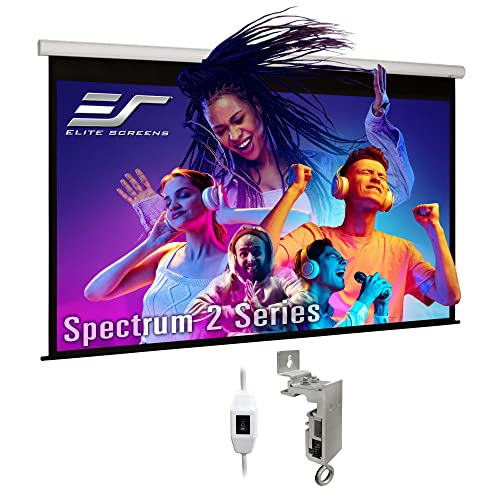
Best Budget MotorizedAlso Great

Size

120-inch diagonal

Type

Motorized drop-down with remote

Mount

Wall or ceiling

Surface

Matte white

Pros

  • Remote-controlled reveal at a pull-down price
  • 120 inches of screen that fully disappears
  • Genuine crowd-pleaser effect every movie night
  • Simple wall or ceiling install

Cons

  • Un-tensioned material waves over time
  • Motor is a long-term wear item
  • Needs an outlet at the mount location

There is a moment, when the lights dim and the screen hums down out of its case, that every guest in the room goes quiet, and it costs $139.99 now. That is the DINAH's entire pitch, and it is enough. Functionally this is a pull-down screen with a motor: same rolled matte-white material, same disappearing act, same honest wave-with-age physics. The motor converts it from furniture you operate into theater that happens, and for shared spaces, living rooms, playrooms, the wall above a media console, that difference in ceremony is worth more than specs.

Two installation notes earn their paragraph. First, level matters more here than on any fixed screen: a motorized screen re-performs its descent every night, and a half-degree tilt performs with it, so measure twice. Second, plan the outlet before the mount; the case needs power, and a draped extension cord undoes the elegance the motor bought. Do those two things and this is the cheapest genuinely delightful upgrade in home theater, especially in front of a capable beamer from our home theater projector guide.

Also Great

The button-press theater reveal for $139.99: a 120-inch motorized screen that descends by remote and vanishes the same way. Motorized used to be the four-figure tier of the screen world; this is the version that made it a casual upgrade.

Buy this if you want the pull-down's disappearing act without the reaching and tugging, over a tall window, above built-ins, or anywhere a 120-inch screen should appear on command. The remote is the whole feature, and it is a genuinely great feature: movie night starts with a hum and a slowly descending screen, which never stops feeling like theater.

What we don't like

Same un-tensioned material physics as any rolled screen, so expect gentle waves with age, and the motor adds one more thing that can eventually wear. Mount it dead level; motorized screens telegraph a crooked install every single night.

Austin Art Insider

Free weekly guide to galleries, exhibitions & collecting in Austin.

Biggest Screen per DollarAlso Great

Size

150-inch diagonal, 16:9

Type

Motorized retractable with remote

Mount

Wall or ceiling (needs 11+ ft width)

Surface

Matte white

Pros

  • Twelve and a half feet of movie
  • Motorized disappearance at a startling price for the size
  • Turns a basement into a legitimate cinema
  • Remote-controlled reveal, same as premium rigs

Cons

  • Demands a bright projector
  • Every flaw scales with the size
  • Serious wall real estate required

At some point in every projector owner's life comes the realization that the only cure for big-screen desire is a genuinely enormous screen, and this is the affordable version of the cure. A 150-inch diagonal is not a step up from 120; it is a different experience category, the image fills peripheral vision the way a commercial cinema does, and the YODOLLA delivers it motorized, remote-controlled, and retractable for less than the price difference between TV sizes.

The format's honesty requirements: light output rules everything at this area, so this screen belongs with the brighter end of the projector market, the serious machines in our home theater guide, not a palm-sized mini. And installation precision compounds: at twelve and a half feet wide, a degree of tilt or a shallow wave is displayed at billboard scale, so mount with a level, a helper, and patience. Do it right and the payoff is the single most dramatic dollars-to-experience ratio in this guide. Movie night stops being a screen on a wall and starts being the wall.

Also Great

One hundred fifty inches. That is a twelve-and-a-half-foot diagonal, commercial-cinema intimacy in a private room, delivered by motor and remote for $322.99. The pick for the basement wall that can take it and the projector bright enough to fill it.

Buy this if you have the two prerequisites: an unbroken wall (or ceiling run) over eleven feet wide, and a projector with real lumens, because spreading light across 150 inches dims every one of them. Get both right and you have the closest thing to a commercial theater a house can hold, at a price that still undercuts one good TV.

What we don't like

Size amplifies every screen sin: waves are wider, off-level mounting is more obvious, and a dim projector becomes unwatchable at this area. Be honest about your projector's brightness before committing to the format.

Best Portable ValueBudget Pick

Size

120-inch diagonal, 16:9

Type

Foldable fabric with assembled stand

Projection

Front or rear

Includes

Stand, carry bag, stakes

Pros

  • Complete kit: screen, stand, bag, stakes
  • Ten-minute setup from the trunk
  • Front or rear projection flexibility
  • Genuinely giant image for backyard money

Cons

  • Fabric flatness, not optical flatness
  • Wind is its natural enemy
  • Needs full darkness outdoors

The best screen for a backyard movie night is the one that actually gets set up, and the TOWOND's entire design is aimed at that truth. The kit is complete in one bag: poles that snap into a freestanding frame, the fabric screen that stretches across it with elastic loops, stakes and ties for the ground, all of it standing in about ten minutes with one adult and one moderately useful child. At 120 inches, the driveway premiere out-sizes most living room setups.

Judge it by its actual job. Fabric on a pole frame will never sit optically flat, wind turns every movie into gentle surrealism unless you stake and sandbag, and like all white portable screens it needs true darkness, dusk showings wash out. None of that matters at a ten-person backyard birthday; all of it matters if you were secretly shopping for an indoor main screen, in which case the ShowMaven fixed frame above costs $40 more and is a different universe of image. Outdoors, pair it with a bright portable from our mini projector guide, hide the beamer behind the screen in rear-projection mode, and let the neighborhood invite itself.

Budget Pick

The backyard movie night, solved for $63.99: a 120-inch foldable screen, a complete stand, and a carry bag that goes from trunk to standing in about ten minutes. The anti-crease fabric even survives being packed like laundry.

Buy this for the life a screen has outdoors: birthday movie nights, camping trips, garage watch parties, driveway World Cup. The frame assembles like a tent, the fabric washes and irons flat if it creases, and front-or-rear projection means the projector can hide behind the screen where nobody trips on it.

What we don't like

It is a stretched fabric on poles, not an optical surface: expect modest flatness, visible seams of light at the elastic mounting points, and total surrender to wind above a breeze. Stake it, sandbag it, and manage expectations; it is a party tool, not a reference monitor.

Best Portable UpgradeAlso Great

Size

100-inch diagonal, 16:9

Type

Tripod base with pull-up matte surface

Setup

About two minutes, no assembly

Use

Presentations, events, movie nights

Pros

  • Fastest setup in the portable category
  • One self-contained unit, nothing to assemble or lose
  • Stands on any level floor, no wall needed
  • Presentable enough for client-facing work

Cons

  • Costs more per inch than pole-kit portables
  • Standard rolled-surface waviness
  • Tripod footprint needs floor space

Portable screens divide into ones you assemble and ones you deploy, and after the third setup everyone wishes they had bought the deploy kind. The PropVue is that kind: flip out the tripod legs, lift the crossbar, pull the screen surface up out of the base roller, done, two minutes, indoors or out, no wall required. For anyone who presents for a living or hosts often enough that setup time compounds, that difference is the product.

The image itself is solid matte-white portable class: honest color, decent flatness with the usual soft roll waves, happy with any projector at reasonable brightness. What you are really buying over the $64 pole kits is operational excellence, one object to grab, no parts bag, no twenty-minute tent-building ceremony in front of waiting clients, and a build sturdy enough to survive being that object for years. It also earns a spot in a creative studio: paired with an art projector, a freestanding 100-inch surface makes a wonderful mural-planning and reference wall that stores in a closet between projects.

Also Great

The portable for people who set up screens more than twice a year: a self-contained tripod design whose matte surface pulls up out of its own base, no pole assembly, no elastic loops, standing in two minutes. The mobile presenter's and serious host's pick.

Buy this if setup friction is the thing you are paying to remove: client presentations, community events, a movie night habit rather than a movie night experiment. The tripod base and integrated roller mean one item to carry and nothing to lose, and the pull-up surface hangs flatter than any pole-and-fabric kit.

What we don't like

At 100 inches it is smaller than the TOWOND's 120 for over twice the price, and the rolled surface has the usual modest waves of its format. You are paying for speed, sturdiness, and dignity, not maximum image area.

Best ALR for UST (Entry)Also Great

Size

100-inch diagonal, 16:9

Type

Lenticular ALR, fixed frame, UST only

Light rejection

85% of ceiling/ambient light (listed)

Resolution

4K/8K friendly

Pros

  • Watchable in daylight with lamps on
  • Purpose-built for UST geometry
  • Fixed-frame flatness under the ALR surface
  • The value entry to a genuinely premium category

Cons

  • Useless with standard long-throw projectors
  • Delicate surface demands careful assembly
  • UST owners often wish they had sized up

Every UST projector demo you have ever admired in a bright showroom was standing on this technology, not on the projector alone. A lenticular ALR screen is a sheet of microscopic angled louvers, a venetian blind at hair's-width scale, aimed to catch light arriving steeply from below (the UST sitting on the console) and reject light arriving from above (your ceiling fixtures, your windows). The listed result here is 85 percent of ambient light turned away, and the lived result is a projector image that holds color and contrast in a bright, functioning living room.

NothingProjector has become the category's value brand by selling essentially this screen, the one the big names mark up, at $399. Two honesty notes define ownership. First, this is a UST-only instrument: the same louvers that reject ceiling light will reject a ceiling-mounted projector's beam, so match the screen to the projector geometry you actually own. Second, treat assembly as the delicate operation it is, the lenticular surface hates fingerprints and flexing, and recruit a second pair of hands. Do that, and a UST plus this screen becomes the thing the frame-TV world keeps chasing: a hundred-inch television that was never a television. (If that aesthetic conversation is live in your house, our frame TV bezel guide covers the other road.)

Also Great

The screen that lets a UST projector replace a TV in a real, lamp-lit, window-having living room: a lenticular ALR surface that accepts light from the projector below while rejecting a listed 85 percent of the room light from above. The daytime-television unlock, at the category's value price.

Buy this if you own (or are buying) an ultra-short-throw projector and intend to watch it like a TV, daytime, lamps on, life happening. Standard screens return room light along with projector light and the image goes gray; this one's microscopic louvers geometrically reject ceiling and window light while catching the steep UST beam. It is the difference between a projector you use at night and one that replaces the TV.

What we don't like

It is UST-only: the lenticular optics require the steep from-below angle, and a normal long-throw projector aimed at it will misbehave. Assembly demands real care, the surface cannot be touched or flexed casually, and 100 inches is the small end of what UST owners usually want.

Best Premium ALR USTUpgrade Pick

Size

120-inch diagonal, 16:9

Type

Lenticular ALR, fixed frame, UST only

Light rejection

95% of ceiling/ambient light (listed)

Resolution

4K/8K friendly, Active 3D capable

Pros

  • Class-leading listed 95% ambient light rejection
  • 120-inch size, the UST sweet spot
  • Deep blacks in genuinely bright rooms
  • Completes a no-compromise TV replacement

Cons

  • $1,099 is flagship-TV territory
  • Delicate, patient assembly required
  • Wasted under a budget projector

There is a version of the projector living room with no compromises left in it, and this screen is its final piece. The Black Series is NothingProjector's premium lenticular: the same UST-only geometry as the Classic, with a listed 95 percent ambient rejection that closes the gap where big bright rooms punish projection, black levels. On a standard screen, room light pours into every shadow and turns cinematography gray; on this surface, with a strong UST beneath it, dark scenes stay dark while the afternoon happens around them, which is the single most TV-like behavior a projector setup can learn.

The value logic sounds absurd until you run it: $1,099 for a screen, plus a flagship UST, lands a 120-inch daylight-capable image for meaningfully less than premium televisions at literally half the size, and the screen never obsoletes, it is glass and geometry, not electronics. Our sizing of the two NothingProjectors: the Classic 100 for good rooms, moderate light, value focus; the Black 120 when the setup is the household's primary display and the room is bright. Either way the projector matters as much as the screen, the machines worthy of this surface live at the top of our home theater projector guide, and the finished wall, frameless and enormous, is the best argument the projector side of the TV-versus-projector decorating debate has ever had.

Upgrade Pick

The endgame living-room screen: 120 inches of premium lenticular ALR rejecting a listed 95 percent of ambient light. Under a flagship UST, this is the setup that makes guests ask where the TV is, at $1,099, which is still less than the TV it replaces.

Buy this if the UST living-room setup is your main display and you want the ceiling, the darkest blacks and highest ambient-light immunity the format offers, at the 120-inch size UST owners actually want. The Black Series' higher rejection rate over the Classic shows up exactly where living rooms hurt: bright daytime scenes and dark movie shadows with the lamps on.

What we don't like

Four figures is real money for a screen, assembly is the same delicate ceremony as every lenticular, and the performance ceiling only matters under a projector good enough to reach it. Pair it with a flagship UST or save the difference and buy the Classic.

Head-to-Head

How the top picks compare

The two forks that decide most screen purchases: permanent or disappearing, and white or ALR.

Silver Ticket Fixed Frame vs DINAH Motorized: Permanent or Vanishing?

The perfect surface against the disappearing act, both at 120 inches.

Silver Ticket 120 Fixed Frame

Silver Ticket Products

Winner

Silver Ticket 120 Fixed Frame

Drum-tight surface, perfect geometry forever

$279.98
Check Price →
DINAH 120 Motorized

DINAH

DINAH 120 Motorized

Vanishes by remote, half the price

$139.99
Check Price →

Our verdict

Winner: Silver Ticket Products Silver Ticket 120 Fixed Frame. On pure image, this is not close: the Silver Ticket's tensioned surface is flat on installation day and flat a decade later, while the DINAH, like every rolled screen, will develop gentle waves that shimmer in bright panning shots as it ages. If the wall can be a screen wall permanently, the fixed frame is the better instrument, the better long-term value, and our overall pick. The DINAH wins on a completely different axis: it exists in rooms where a permanent 120-inch rectangle cannot, over windows, above built-ins, in living rooms with décor treaties to honor, and its remote-controlled descent is half the price and all of the theater. The honest decision procedure is one question long: does anyone in the household object to the screen being visible at breakfast? If no, buy the Silver Ticket and never think about screens again. If yes, buy the DINAH, mount it dead level, and enjoy the nightly reveal.

Buy the Silver Ticket Products

the wall can belong to the screen permanently and image quality leads.

Buy the DINAH

the screen must disappear between movie nights, or the wall has other jobs.

Valerion 1.3 Gain vs NothingProjector ALR: Bright-Room Strategy

The brightness assist against the geometry solution.

Valerion 120 Fixed Frame

Valerion

Valerion 120 Fixed Frame

1.3 gain, works with any projector geometry

$287.10
Check Price →
NothingProjector 100 ALR

NothingProjector

Winner

NothingProjector 100 ALR

Lenticular rejection of 85% of room light (UST only)

$399.00
Check Price →

Our verdict

Winner: NothingProjector NothingProjector 100 ALR. For the bright-room problem both screens are bought to solve, the ALR wins, with one giant asterisk. The Valerion's 1.3 gain is a brightness amplifier, and it amplifies impartially: projector light and window light alike, which means it makes a bright room's image punchier but never fixes the gray wash that ambient light pours into shadows. The NothingProjector's lenticular surface is the only technology on this page that actually subtracts room light, turning away a listed 85 percent of what arrives from above, and the difference in a sunlit living room is not incremental, it is categorical: watchable daytime television versus a ghost of one. The asterisk: the ALR's louvers require an ultra-short-throw projector firing steeply from below, and with a conventional projector it is not merely suboptimal, it is wrong. So the real decision was made when you chose your projector: UST owners in bright rooms should consider the ALR essential equipment; everyone else takes the Valerion, the best any-geometry screen here, and buys curtains with the difference.

Buy the Valerion

your projector is conventional or short-throw, or your future geometry is uncertain.

Buy the NothingProjector

you own a UST and want it watchable with the room lit; this is the missing half.

How we
chose

We judged projector screens by the physics that determine the picture and the living details that determine whether the format fits the room:

  • Surface flatness first. A wavy screen ruins a $2,000 projector; a flat one flatters a $500 one. We ranked tensioned fixed frames above rolled formats and said plainly how each rolled format ages.
  • Honest optics. Gain ratings, viewing-angle behavior, and the real difference between gain and ambient-light rejection, with lenticular ALR treated as the separate technology it is and matched only to the UST geometry it requires.
  • Format to room. Fixed frame, pull-down, motorized, portable, and ALR each won their own category; no single screen wins every room, and pretending otherwise is how people buy twice.
  • Setup and living costs. Assembly honesty, mounting precision, outlet placement for motorized cases, wind reality for portables, and surface delicacy for lenticulars.
  • Live verification. Every ASIN, price, and image on this page was pulled live from Amazon's catalog this week.

Share this guide

Share

Common Questions

Frequently Asked Questions

Have art
to sell?

Austin Gallery specializes in selling inherited art, estate collections, and fine art with zero upfront fees. Get a free evaluation today.