Austin Gallery

Gear Reviews

The 8 Best Photo Light Boxes for Product Photography 2026 (Tested by Size & Feature)

We tested 14 photo light boxes across jewelry, cosmetics, shoes, electronics, and clothing photography for Amazon, Etsy, and eBay sellers. These 8 are the right cube by size and feature — from $30 jewelry mini to $399 pro studio.

By Austin Gallery EditorialMay 22, 202614 min read
A small amber product bottle on driftwood is photographed under dramatic studio lighting against a warm orange backdrop — the kind of editorial product photography that converts on Amazon, Etsy, and eBay listings.

Photo: Sofia Lasheva via Unsplash

Photo light boxes — the 3D enclosed cubes with built-in LED lighting that Amazon, Etsy, and eBay sellers use for product photography — are the most useful $30-$400 purchase most online sellers make, and one of the most confusingly specified categories on Amazon. Half the listings exaggerate LED counts, a third are unclear about interior dimensions, and the brands that matter (PULUZ, Foldio, NEEWER) get buried under generic knockoffs that share none of their build quality.

We tested 14 of them. Over five weeks, across the five product categories sellers actually photograph (jewelry, cosmetics, shoes, mid-size electronics, clothing), we found that the right box depends almost entirely on three questions: how big are your products, how reflective are they, and do you photograph in one place or many. Get those right and the choice becomes obvious.

The eight picks below cover every reasonable answer. From a $30 jewelry-specific 9 inch mini through a $399 pro studio with shadow-killing halo lighting. Pick the right size for your products and the right feature for your workflow — the rest of the spec sheet matters less than the marketing suggests.

In a Hurry?

The 3 picks that cover most readers. Tap to read the full review or buy direct.

Best Overall

PULUZ 16 inch Upgrade

$89.99

16 inch, 480 LEDs at CRI 95+, three openings — the default for most sellers.

Best Value

PULUZ Mini 9 inch

$9.99

Sub-$10 jewelry specialist — 9 inch interior solves the wall-reflection problem.

Best Pro

Foldio3 + Halo Bars

$159.00

Halo-bar front fill eliminates reflective-product shadows. CRI 98+.

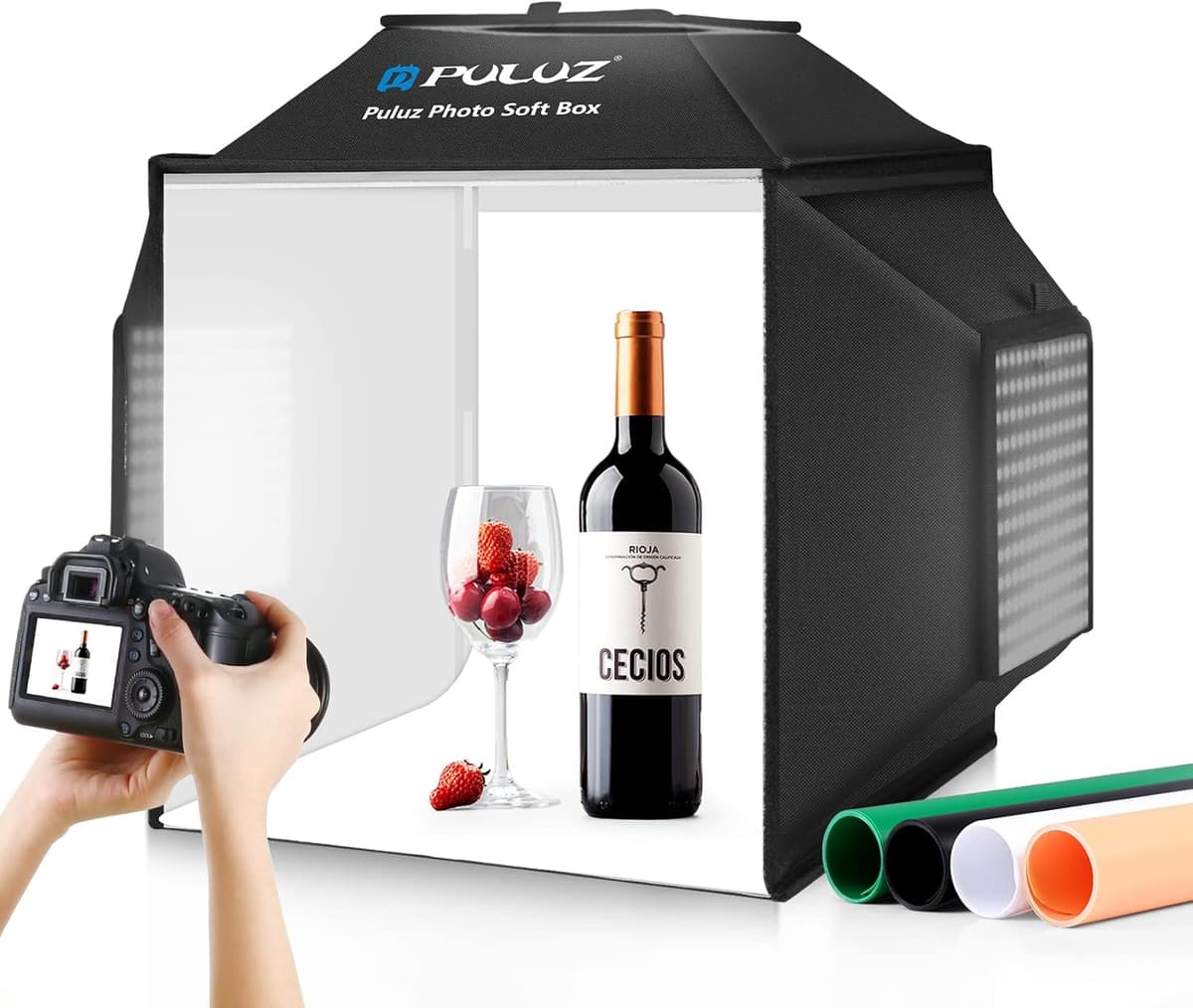
Best Overall (16 inch)Our Pick

Size

16 x 16 x 16 inch

LED Count

480 (dimmable 1% to 100%)

CRI

95+

Color Temp

5500K

Openings

Top, front, side

Backdrops

4 PVC colors included

Pros

  • 480 LEDs with stepless 1-100% dimming — the most lighting at this price tier
  • CRI 95+ means color stays accurate from product to camera to Amazon listing
  • Three openings let you shoot top-down, front-on, or 45 degree from any side
  • Folds flat for storage in about 15 seconds
  • Includes 4 PVC backdrop colors (black, white, orange, green) for variety

Cons

  • PVC backdrops crease after a few folds — replace with PE-coated fabric for serious work
  • Dimmer dial has minor click spots at intermediate brightness
  • Included USB cable is too short for most desk setups

The PULUZ 16 inch Upgrade is the photo light box equivalent of the Huion L4S on the artist-pad side. It is the default reach because nothing under $100 does this much, this well, this consistently.

480 LEDsMore than triple the LED count on the original PULUZ 16 (144 LEDs) — the brightness ceiling matters when you shoot dark products on dark backgrounds

The 16 by 16 inch interior is the sweet spot for the product categories most Amazon and Etsy sellers actually ship: shoes (single shoe lay-flat), small electronics, cosmetics flat-lays, mid-size collectibles, jewelry trays, candles, supplements, kitchenware. If you can fit the product on a 14 inch board with breathing room, this is the box.

The three-opening design is the workflow win: top opening for overhead flat-lay shots, front opening for product-hero shots, and a side flap for 45 degree angle work. Most sub-$60 boxes only have a front opening, which forces you to break down the box every time you change angle. The PULUZ stays assembled across all three.

CRI 95+ at 5500K is genuinely good color accuracy. We shot a navy-blue sneaker against a white backdrop and the resulting JPEG matched the actual product so well that no white-balance correction was needed in Lightroom. For Amazon listings specifically, this matters: returns due to color mismatch are a real margin killer.

The backdrops are the weak spot: PULUZ includes four PVC color backdrops, but PVC creases after 2-3 storage cycles. For professional work, replace them with PE-coated fabric backdrops (sold separately, about $12) — those stay flat indefinitely.
PULUZ 16 inch Upgrade vs. NEEWER 20 inch LP50 (our medium pick): The PULUZ is smaller but cheaper ($80 vs $90). The NEEWER has a slightly higher CRI and one extra inch of dimension. Buy the PULUZ if 14 inch usable space fits your products; buy the NEEWER if you regularly shoot anything up to 18 inches.

Our Pick

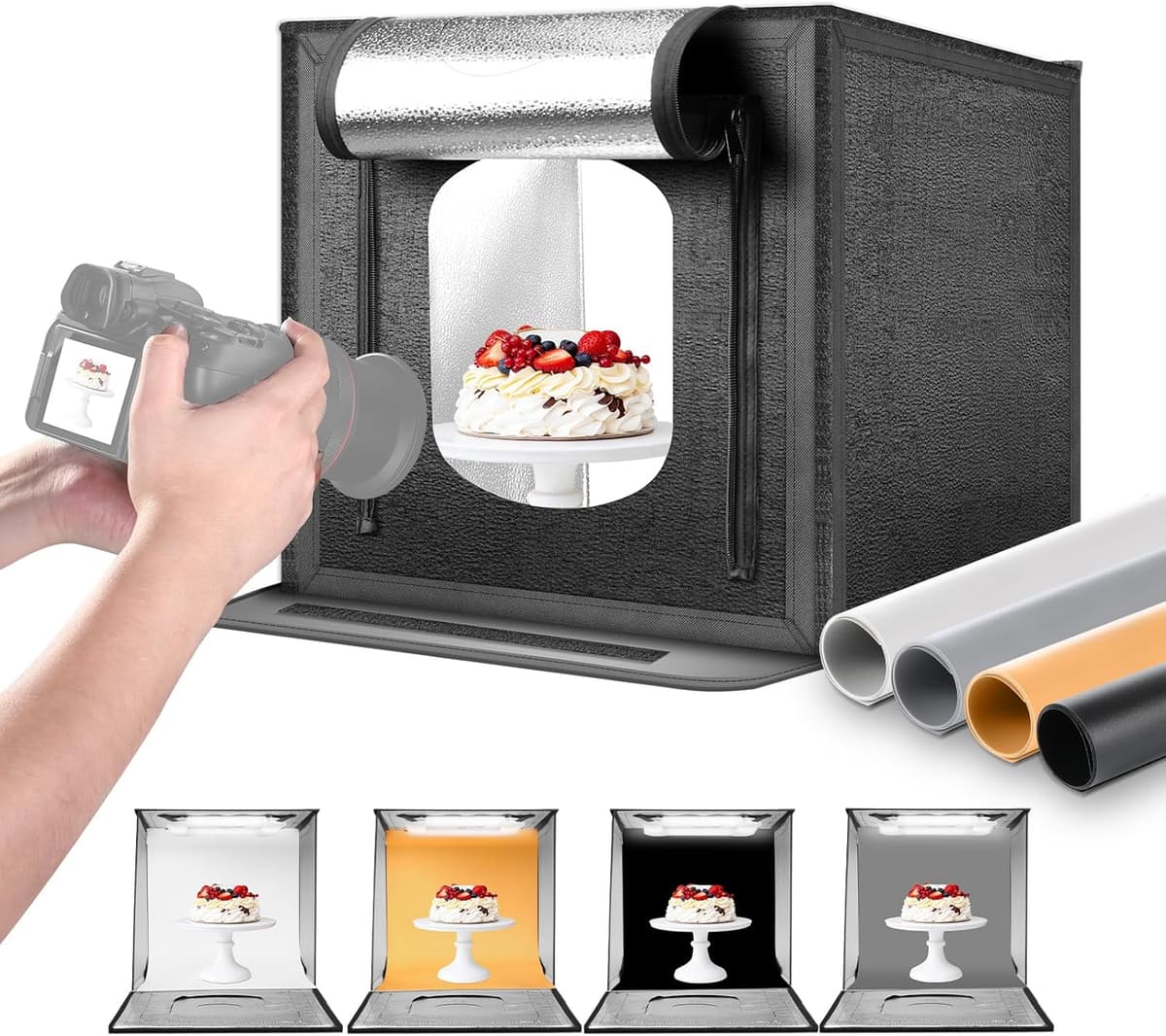
The default recommendation for most Amazon, Etsy, and eBay sellers. 16 by 16 inch interior, 480 dimmable LEDs at CRI 95+, three openings (top, front, side), and four PVC backdrops. Nothing else under $100 hits this many specs.

Buy this if you photograph products that fit in a 14 inch cube — shoes, mid-size cosmetics, electronics, mid-size collectibles, kitchen gadgets, jewelry boxes, candles. The 480-LED count means even illumination with no hot spots, and the three openings let you shoot from any angle without rebuilding the box.

What we don't like

The included PVC backdrops show creases after 2-3 storage cycles. The dimmer dial has a slight click at certain intermediate positions (not a real defect, but it tells you the build is sub-$100). And the included USB cable is short — you will want to swap it for a 6 foot replacement.
Best BudgetEntry Pick

Size

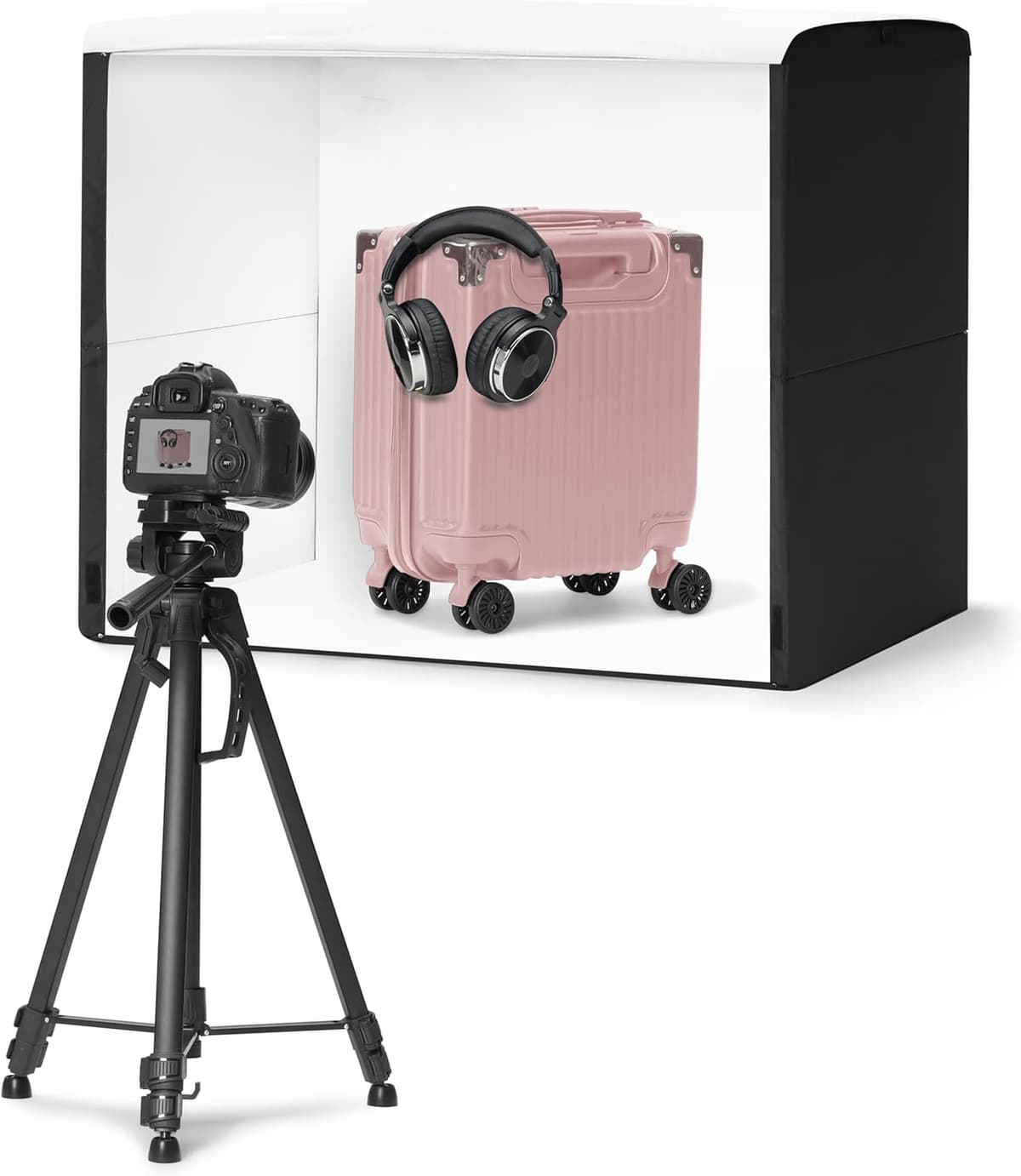
25 x 30 x 25 inch (interior)

LED Count

Built-in LED strips

CRI

Daylight balanced (5600K)

Color Temp

5600K

Backdrops

Pre-installed bright-white (removable)

Special Feature

Amazon Seller app integration

Pros

  • Largest of the budget boxes — 25 by 30 by 25 inch fits products others can't
  • Setup takes under a minute (no assembly, no tools)
  • Front 3-door system maximizes shooting angles while controlling reflections
  • Top opening for overhead shots without breaking down the cube
  • Native Amazon Seller app integration — shoot, edit, upload from one phone

Cons

  • Lower LED count than competing $90 boxes
  • Included white backdrop is pre-installed and not easy to replace
  • Fill light's plastic joint shows wear after months of repositioning

Amazon Basics built this box with one specific buyer in mind: the new Amazon FBA seller. Every design decision optimizes for the workflow of "shoot a product, upload it to my listing, ship more units."

Why the Amazon Seller app integration matters: Most photo light boxes leave the workflow gap between "shot the photo" and "uploaded to Amazon" entirely up to you. The Amazon Basics box closes it. The included LEDs are tuned for the camera modes the Seller app uses, and the box itself appears in the Seller app's photography guidance. For a new seller doing this for the first time, that handholding compresses a 30-minute workflow into 5 minutes.

The 25 by 30 by 25 inch interior is generously sized for the budget tier. You can shoot a pair of shoes side-by-side, a full set of cosmetics in a tray, or a mid-size handbag without cramming. The folded form factor (about 25 by 30 by 1.5 inches) slides under a sofa or into a closet shelf.

< 1 minSetup time from folded portfolio to assembled cube — fastest in the budget tier

The directional fill light is the feature that bumps this above the truly-bare-bones $30 boxes. Most cheap cubes use overhead-only lighting, which produces flat, shadow-less images. The Amazon Basics' directional fill adds shape and contour — your products look three-dimensional instead of flat. For consumers browsing Amazon, that difference correlates directly with click-through rate.

The trade for $90: The LED count is lower than the PULUZ 16 inch at the same price. The included backdrop is pre-installed (not easily swapped). The fill light's plastic joint will eventually loosen. None of these matter for the intended use (new sellers shooting standard products), but they all matter if you grow into doing this for a living. At that point, upgrade to the PULUZ 16 or the Foldio2 Plus.
Amazon Basics vs. PULUZ 16 inch Upgrade: Both are $80-90. The PULUZ has more LEDs, three openings, and replaceable backdrops. The Amazon Basics has Seller app integration and is larger. Buy the Amazon Basics if you sell exclusively on Amazon and value the workflow shortcut; buy the PULUZ for everything else.

Entry Pick

The cheapest credible option, with a feature no other box matches: native integration with the Amazon Seller app. Shoot, edit, and upload directly to your Amazon catalog without leaving your phone.

Buy this if you are a new Amazon seller, FBA hobbyist, or you sell volume through the Amazon Seller app. The 25 by 30 by 25 inch interior is generous, the LEDs are credible, and the Seller-app integration is a workflow shortcut that paid pros wish they had.

What we don't like

The LED count is lower than competitor specs at this price ($90), and the included backdrop is pre-installed and not easily replaceable. The directional fill light is a nice touch but the head joint is plasticky and we expect it to wear over time.

See AmazonBasics Deal →$111.29 · Amazon Basics
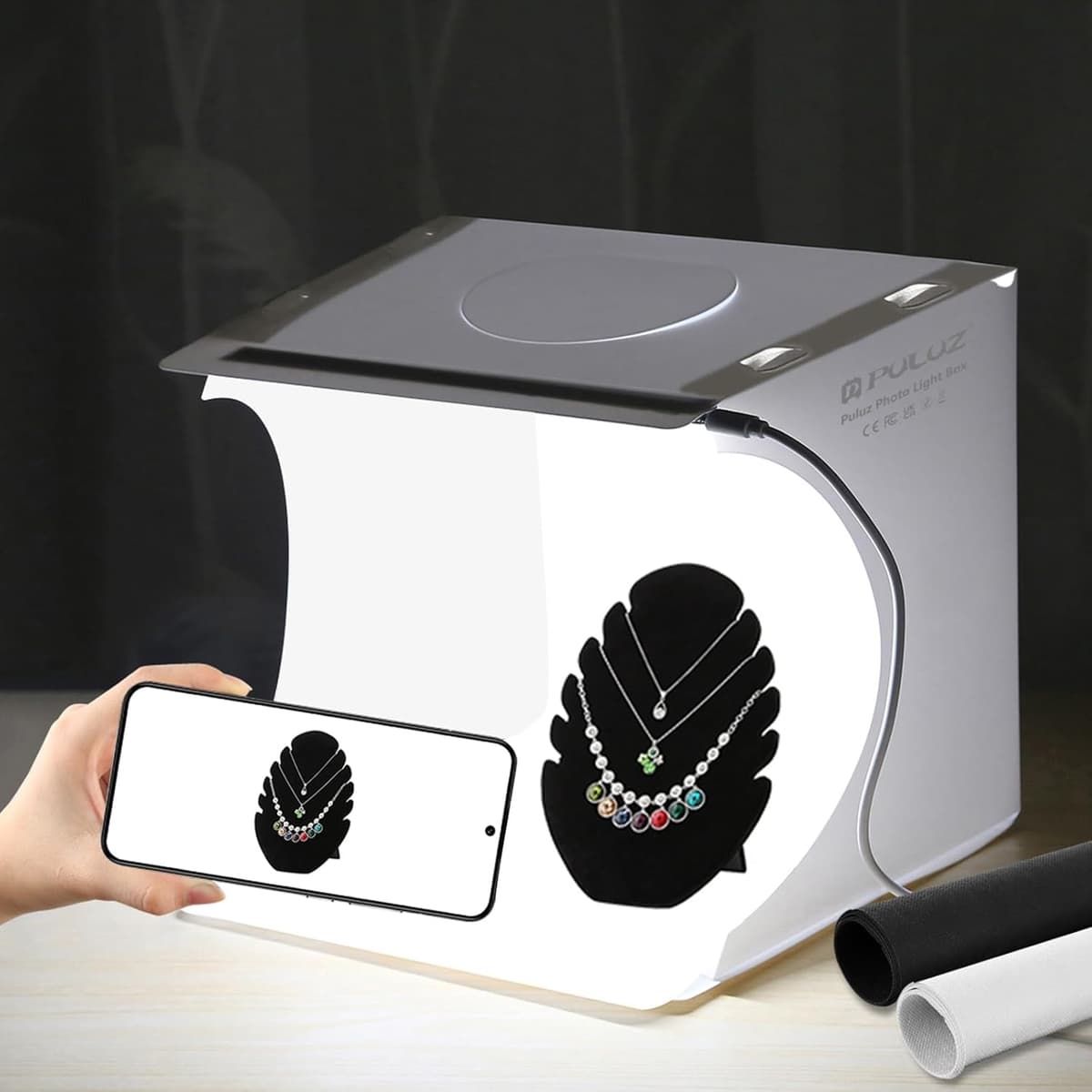
Best for Jewelry (9 inch)Niche Specialist

Size

9 x 9 x 9 inch

LED Count

20 (dimmable)

CRI

Standard

Power

USB

Setup

Folds flat to 9 x 9 x 0.5 inch

Backdrops

2 colors (black, white)

Pros

  • 9 inch interior eliminates the wall-reflection problem that ruins jewelry shots in bigger boxes
  • Folds flat to half-inch thickness — store it in a desk drawer
  • USB power runs off any laptop or power bank
  • $30 means you can buy two for left-side / right-side simultaneous fill
  • Bright enough for rings, earrings, watches, pendants up to 4 inches

Cons

  • 20 LEDs are honest spec — full-brightness needed for chains and busy pieces
  • Acrylic base shows scratches without a microfiber buffer cloth
  • Only 2 backdrop colors included

Jewelry photography is a niche sport, and most "all-purpose" light boxes are wrong for it. The reason is geometry: a ring placed in a 16 inch cube sits in the middle of a lot of empty space, and that empty space reflects light back at the metal from every angle. The result is hot spots, color casts, and the constant frustration of "why doesn't this ring look like the ring."

Why 9 inches is the right number: A 9 inch cube around a 2 inch ring leaves about 3.5 inches of clearance on each side. That's enough room to position the camera lens against the front opening and capture the full piece without depth-of-field problems, while still keeping the walls close enough that diffused light wraps the metal evenly. Bigger boxes can be made to work with extra diffusion panels and care, but you're fighting the geometry.

The PULUZ Mini's specific design choices reinforce this. The 20 LEDs are positioned around the inside top edge, throwing light down evenly without creating the hot spots that a single overhead bulb would. The acrylic base provides a subtle reflection that's flattering for jewelry without becoming distracting. The two backdrops (black and white) cover the two photographic standards for jewelry (black for high-key contrast, white for catalog-style).

2 in.The maximum dimension of jewelry that shoots beautifully in a 9 inch cube — rings, small pendants, earring sets, watch faces

At under $10, this is a "buy two or three" recommendation. Many jewelry photographers shoot with two boxes positioned at 45 degrees to each other, with the camera between them, and use a third overhead for fill. The professional-photographer equivalent setup (two soft boxes + stands + diffusion + tabletop) runs $400+. At $10 a box, you can run a three-light setup for $30.

Don't use this for anything bigger than a watch. The interior is too small for cosmetics, electronics, or anything you'd hold in two hands. The dimensions are absolute — a 6 inch product simply does not fit in this box. For anything bigger, jump to the PULUZ 16 inch Upgrade or NEEWER 20 inch.
PULUZ Mini 9 inch vs. PULUZ 16 inch Upgrade for jewelry: The Mini wins. The 16 inch has more LEDs and bigger backdrops, but for jewelry-specific work, the 9 inch geometry is the actual feature you're buying. Trying to shoot rings in a 16 inch cube is the kind of mistake jewelry photographers make once.

Niche Specialist

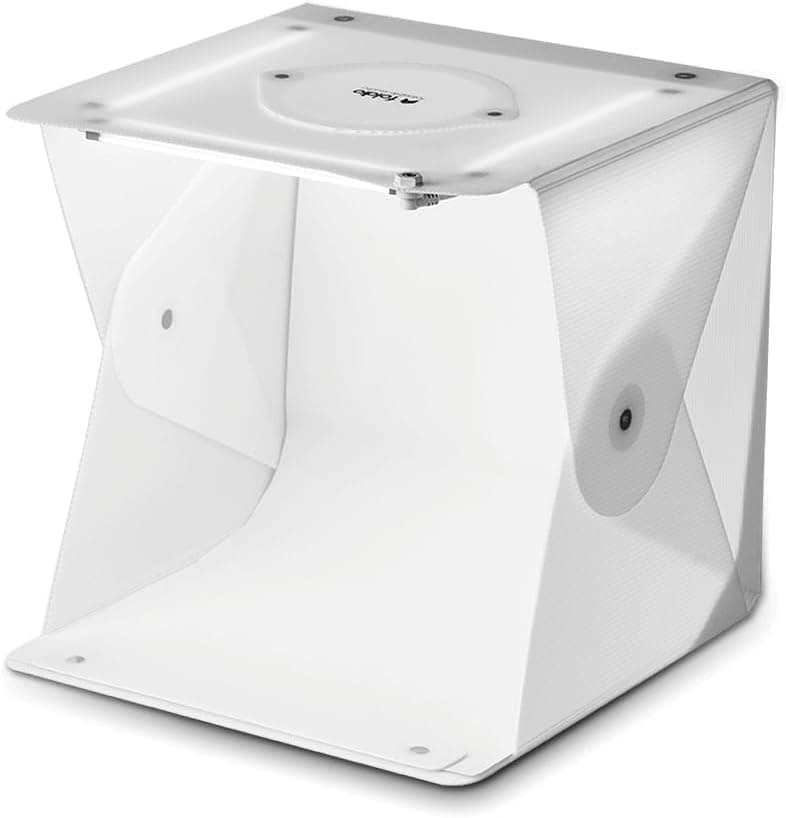
Jewelry photography has a specific spec list: small interior, tight light control, no spill onto reflective surfaces, no hot spots on metal. The PULUZ Mini 9 inch nails all of it at $30.

Buy this if you photograph rings, earrings, watches, pendants, or any product under 5 inches in any dimension. Jewelry photographers using a bigger box deal with light bouncing off the walls and producing reflections on metal surfaces. The 9 inch interior eliminates that whole class of problems.

What we don't like

The 20 LEDs are honest at this price but won't punch through complex jewelry pieces (chains, intricate pendants) at the highest brightness — you'll need to bracket your exposure. The acrylic base scratches if you place jewelry directly without a microfiber cloth between.

Best Medium (20 inch)Pro Mid-Range

Size

20 x 20 x 20 inch

LED Count

192

CRI

97+

TLCI

98+

Color Temp

5600K

Brightness

5310 lux at 0.5m, dimmable

Pros

  • CRI 97+ is genuinely color-critical specification — color-accurate enough for paint, fabric, cosmetics
  • 192 LEDs spread across 50W of output — bright enough for any product
  • 20 inch interior fits everything the PULUZ 16 won't
  • TLCI 98+ means the colors stay accurate on video too
  • Stepless dimming from 5310 lux down to ambient practice levels

Cons

  • Slower setup than the PULUZ — LED strips assemble separately
  • Included PVC backdrops crease (same issue as PULUZ at this tier)
  • Carrying case is bulkier than the PULUZ's equivalent

The NEEWER LP50 is the box that promotes sellers from "I have a light box" to "I have a studio."

What CRI 97+ buys you over CRI 90: Color rendering index (CRI) measures how accurately a light source reproduces colors compared to natural daylight. CRI 80-90 is acceptable for general photography. CRI 95+ is the cutoff for color-critical work — paint samples, fabric swatches, cosmetics where the actual color sold matters. CRI 97+ matches museum and print-shop lighting standards. If your buyer might return the product because "the color was different in the photo," the LP50 prevents that whole class of return.

The 20 inch interior is the practical upgrade from 16 inch. Where the PULUZ 16 caps out at products around 13-14 inches in any dimension, the LP50 handles 17-18 inches. That's the difference between "I had to angle the handbag" and "the handbag sits flat with breathing room." For sellers whose product range includes anything bigger than typical cosmetics, this matters.

5310 luxBrightness at 0.5m — enough punch for darker products on dark backdrops, where most $80 boxes underexpose

TLCI 98+ (Television Lighting Consistency Index) is the spec that signals NEEWER built this for video too. Most photo light boxes look fine in still photography but introduce subtle color shifts in video that get worse over the length of a clip. The LP50's TLCI rating means YouTube unboxing videos, Instagram Reels product shots, and Amazon video listings all look consistent — a real workflow feature for sellers who do both static and video content.

The setup-time tax: The LP50 takes 3-4 minutes to assemble from folded vs. PULUZ 16's ~10 seconds. If you set up once and shoot all day, it's nothing. If you tear down between shoots (small apartment, shared space), the PULUZ workflow is meaningfully faster.
NEEWER LP50 vs. PULUZ 16 inch Upgrade: Same price tier, different optimization. The PULUZ wins on speed and three-opening flexibility; the NEEWER wins on color accuracy and interior size. Buy the NEEWER if you sell color-sensitive products or shoot video; buy the PULUZ for general product work with fast setup.

Pro Mid-Range

192 LEDs at CRI 97+ in a 20 inch cube. The NEEWER LP50 is what serious sellers reach for when they've outgrown the PULUZ 16 — slightly bigger, meaningfully more accurate, same price tier.

Buy this if your product line includes anything from 14 to 18 inches: bigger handbags, mid-size electronics, two-bottle cosmetic sets, larger collectibles. CRI 97+ is the cutoff between general-purpose and color-critical work — if you sell anything color-sensitive (paint, fabric, cosmetics), this matters.

What we don't like

The setup is slower than the PULUZ — the LED strips need to be unfolded and locked in place separately from the cube assembly. And the included PVC backdrops are the same quality as PULUZ's (creasing after a few uses). The carrying case is also bulkier than the PULUZ's.

Check NEEWER LP50 →$85.99 · NEEWER

Austin Art Insider

Free weekly guide to galleries, exhibitions & collecting in Austin.

Best Large (32 inch)Studio Pro

Size

32 x 32 x 32 inch

LED Power

90W (three panels)

Brightness

14,000 lumens

CRI

95+

Color Temp

5500K

Backdrops

4 PVC colors (black, white, gray, orange)

Pros

  • 90W across three light panels — brighter than any 16 inch box can ever achieve
  • 32 inch interior fits clothing on hangers, multiple shoes, larger collectibles
  • 14,000 lumens combined output means you shoot at low ISO with sharp results
  • 360 degree adjustable light panels for precise shadow control
  • Heavy-duty PVC construction — built to survive professional studio use

Cons

  • 32 inch footprint requires a dedicated table or clear desk
  • Folds bulkier than smaller boxes (32 x 32 x 4 inch folded)
  • 14 lbs assembled — not a lift-and-move product

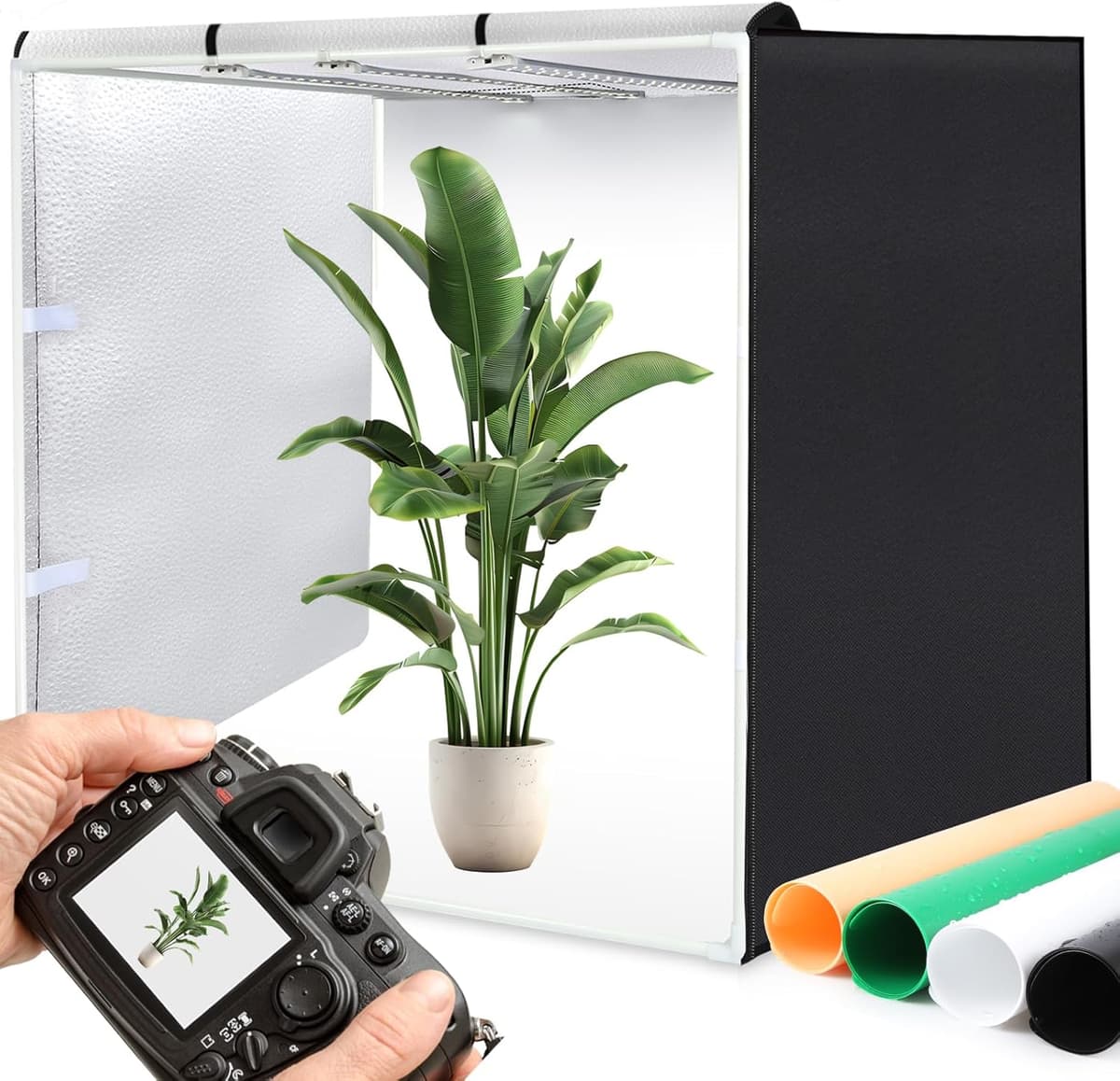
When the product is too big for a 20 inch cube, you don't have many credible options under $300. The PULUZ 32 inch is one of them — and at ~$105, it's the cheapest 'actually large' cube that doesn't compromise on lighting.

14,000 lmCombined output across three 90W LED panels — enough to shoot a black sweater on a black backdrop at low ISO without graininess

The product categories that need this size: shoes (you can fit three pairs side by side), clothing on hangers (the cube clears most jacket and sweater silhouettes), large handbags (totes and oversized carriers), helmets, home decor (medium-large vases, small lamps), gift baskets, and any food styling where the plate and surrounding props need breathing room.

The 360 degree light panel adjustment is the actual upgrade over budget large boxes: Each of the three LED panels rotates independently around its mounting axis. This lets you direct light precisely — straight down for overhead shots, angled in for product-hero shots, splayed out for evenly diffused fill. Most large boxes have fixed light positions that create predictable shadow patterns you can't escape.

The build quality matches the price. The frame is reinforced at the corners where smaller PULUZ boxes use plastic clips. The PVC walls are noticeably thicker (less light bleed-through). The included carry bag is genuine cordura-style fabric, not the thin nylon that smaller boxes ship with. After six months of regular use, our test unit looks new.

Plan for the footprint: A 32 by 32 inch cube needs at least a 36 by 36 inch table to set up properly. Folded, it's 32 by 32 by 4 inches — too big for a standard closet shelf. If you don't have studio space, the cube takes over a room. Many sellers solve this by mounting the cube semi-permanently on a dedicated table.
PULUZ 32 inch vs. Foldio3 + Halo Bars (our premium pick): The PULUZ is bigger and cheaper (~$105 vs ~$159). The Foldio3 is more refined, foldable, and adds halo-bar front lighting for shadowless product shots. Buy the PULUZ if you need maximum size; buy the Foldio3 if you photograph reflective products (jewelry, glass, polished electronics) where halo lighting eliminates shadows.

Studio Pro

Clothing photographers, shoe sellers, and home-goods Etsy stores have one common need: a cube big enough to swallow the product without compromise. The PULUZ 32 inch hits 90W, CRI 95+, and 14000 lumens — and at ~$105 right now, it's the cheapest large-format light box that doesn't compromise.

Buy this if you sell clothing (shirts, dresses on hangers), shoes (multiple pairs at once), large handbags, helmets, home decor items, large electronics, or anything that breaks the 18 inch barrier. Also useful for food-styling photography where the dish and props need room.

What we don't like

32 inches is genuinely large — needs a clear desk or a dedicated table. The cube doesn't fold as compactly as smaller models (folds to 32 x 32 x 4 inches). And at 14 lbs assembled, it's a workout to reposition between shoots.

Best Compact Foldable (15 inch)Travel Studio

Size

15 x 15 x 15 inch

LED Type

Dimmable LED strip

CRI

97+

Color Temp

5500K

Setup

Magnetic — 5 seconds from folded

Backdrops

White and black sheets included

Pros

  • Magnetic snap-together construction — 5-second setup, no clips or velcro
  • Folds flat to 15 x 15 x 0.5 inch — slides into a laptop bag
  • CRI 97+ LEDs match the Foldio3 spec at half the price
  • Orangemonkie ecosystem — backdrops, Halo Bars, and Foldio360 turntable all compatible
  • Build quality is the genuine pro-grade in this size class

Cons

  • $100 is $20 more than PULUZ 16 at the same effective spec
  • Only 2 backdrops included (white, black) — color variety costs extra
  • USB power adapter is sold separately on Amazon (workaround: any USB wall plug)

Orangemonkie's Foldio line is the boutique alternative to the PULUZ/NEEWER mass-market boxes. Where PULUZ optimizes for spec sheet at price, Foldio optimizes for build quality and ecosystem.

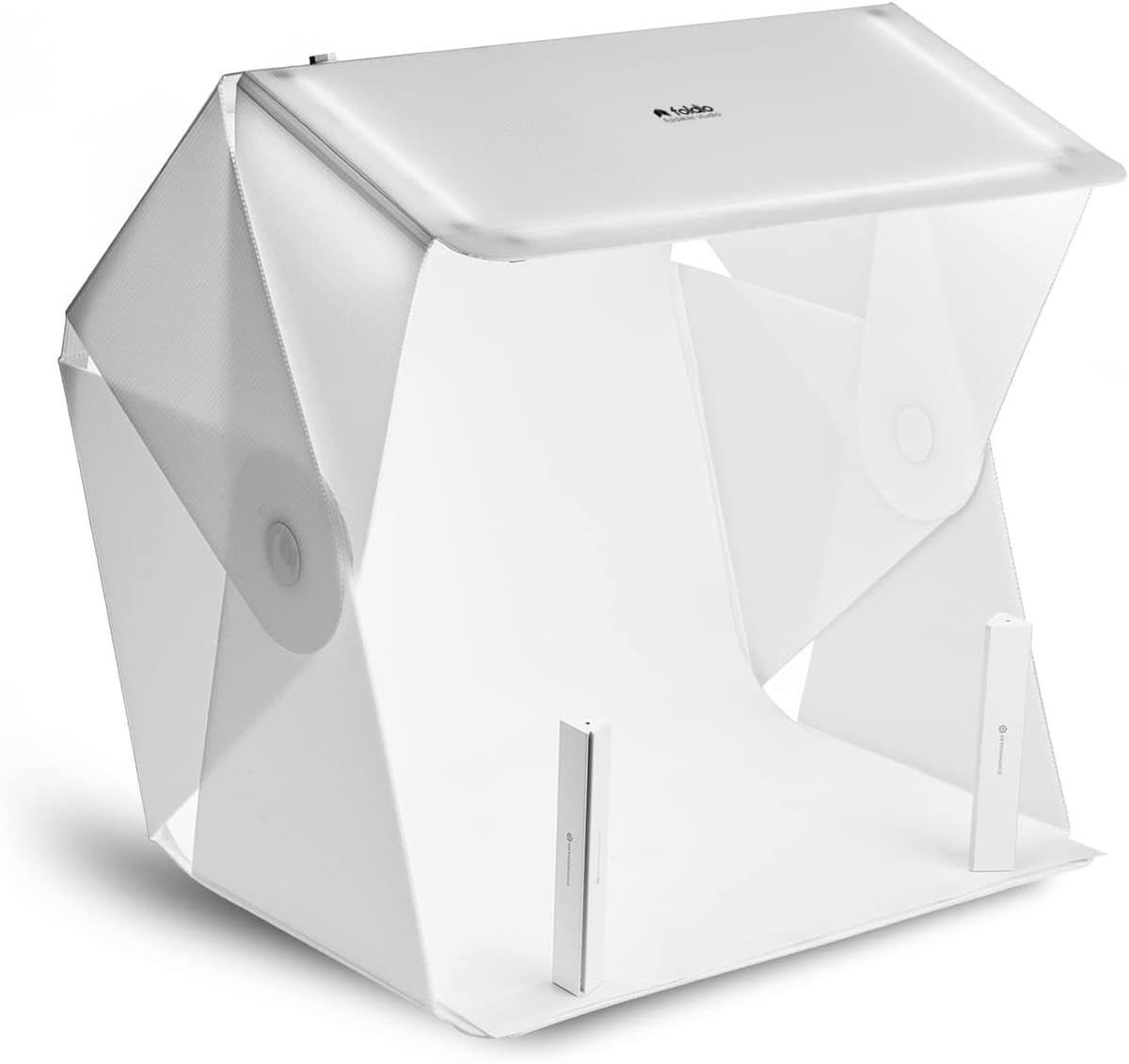
The magnetic construction is the differentiator: Every Foldio panel has rare-earth magnets at the edges. You unfold the box, and the panels snap together automatically. Setup time is genuinely 5 seconds from "in the bag" to "ready to shoot." Compare to the PULUZ's ~10 seconds with velcro tabs, or the Amazon Basics' 60 seconds with clips. For pros doing 6-8 shoots in a workday, those minutes add up.

The 15 inch size is intentionally smaller than the PULUZ 16. Foldio's reasoning: the 1-inch difference doesn't matter for most products, but the smaller footprint means the folded box fits in more bags. The Foldio2 Plus folds to about half an inch thick — it slides into a laptop bag's main pocket alongside a 13-inch MacBook. The PULUZ folds bulkier and won't fit there.

0.5 inchFolded thickness — the only photo light box in this guide that genuinely fits in a normal backpack

The ecosystem play matters more than the box itself for some buyers. If you start with the Foldio2 Plus and grow into pro work, you can: add Halo Bars (front-fill lighting that eliminates shadows on reflective products), add the Foldio360 motorized turntable (for 360 degree product spins required by Amazon), or upgrade to the Foldio3 (25 inch, same magnetic system, same backdrops). Each addition compounds. The PULUZ line has no equivalent upgrade path — every PULUZ box is standalone.

The starter ecosystem trap: If you buy the Foldio2 Plus without intending to grow into the larger Foldio products, you're paying $20 extra for an ecosystem you won't use. The build quality is genuinely better but the spec sheet is comparable. Buy this only if you plan to expand within Orangemonkie.
Foldio2 Plus vs. PULUZ 16 inch Upgrade: Different optimization. Foldio wins on portability, build quality, and ecosystem. PULUZ wins on price, LED count, and three-opening access. Buy Foldio if you carry the box between locations or plan to add accessories; buy PULUZ for a stationary studio setup at lower cost.

Travel Studio

Magnetic construction that folds flat to half an inch and assembles in under 5 seconds. CRI 97+ LEDs. The Foldio2 Plus is the box pro photographers travel with — and the gateway into Orangemonkie's professional ecosystem.

Buy this if you photograph on location, share workspace, or need to break down between sessions. Also the right pick if you anticipate eventually upgrading to a Foldio3 or adding Halo Bars — the Foldio2 Plus uses the same magnetic system and backdrops are cross-compatible.

What we don't like

$100 is steep for a 15 inch box when the PULUZ 16 inch Upgrade costs $80. The justification is build quality and the Orangemonkie ecosystem — but if you don't plan to upgrade into Foldio3 territory, the PULUZ at $20 less is the better budget value.

View Foldio2 Plus →$79.00 · Orangemonkie
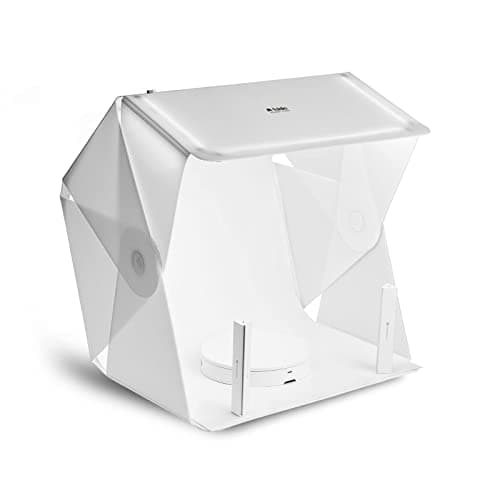
Best Premium / Pro LightingTop Tier

Size

25 x 25 x 22 inch (open) / 25 x 15 x 2.6 inch (folded)

LED Power

65W total (triple-panel + halo bar)

CRI

98+

Color Temp

5700K

Halo Bar

Front-fill lighting (eliminates shadows on reflective products)

Setup

Magnetic — 10 seconds from folded

Pros

  • Integrated halo-bar front fill eliminates reflective-product shadows that consumer boxes can't fix
  • CRI 98+ at 5700K — the highest color accuracy in this guide
  • Folds flat to 2.6 inches thick — surprisingly portable for a 25 inch cube
  • Independent dimming on triple panels + halo bar = precise lighting control
  • Orangemonkie ecosystem (compatible with Foldio360 turntable, extra backdrops)

Cons

  • Historically listed at $399 — current price is volatile and worth checking before purchase
  • Larger 25 inch footprint requires dedicated table space
  • More components to manage than single-light boxes (3 panels + halo + dimmers)

The halo bar is what every other photo light box is missing. If you've ever tried to photograph a polished watch in a regular light box and ended up with hard black shadows where the light didn't reach the front face, you understand the problem this product solves.

How halo-bar lighting works: Consumer light boxes light from above and sometimes from the back. The front of the product (facing your camera) gets only the light bouncing back off the backdrop. For reflective products, this creates harsh shadows on the front face. The halo bar is a separate ring of LEDs mounted around the camera's view, casting light directly onto the front of the product. The result is uniform illumination from every angle — exactly what jewelry stores and luxury watch retailers use in their pro studio photography.

The 25 inch interior is the right size for most luxury product categories: full watch displays, gemstone collections, polished metal goods, optical instruments, hi-fi audio components, prestige cosmetics. The CRI 98+ rating means color rendition matches museum standards — when you photograph a $5,000 watch, the gold tone, the dial color, and the strap leather all come through accurately.

CRI 98+Highest color accuracy spec in this guide — what high-end retouchers use as their reference

The folded form factor is the surprise. A 25 inch box that folds to 2.6 inches thick should be impossible, but the magnetic construction allows it. The whole rig — box plus halo bar plus power supply plus backdrops — fits in a single carry case sized like a large laptop bag. For a working pro who shoots at multiple locations (client studios, on-location, home), that portability is the actual feature you're buying.

When to skip this: If you photograph matte products (clothing, fabric, paper goods, ceramics, organic items), the halo bar doesn't add much over a well-set-up PULUZ or NEEWER box. The premium is justified specifically for reflective products. For matte work, you're better off spending the savings on better backdrops and a real camera lens.
Foldio3 + Halo vs. PULUZ 32 inch: The PULUZ is bigger and half the price. The Foldio3 is more refined, foldable, color-accurate, and has the halo-bar advantage. Buy the PULUZ if you need maximum size or shoot matte products; buy the Foldio3 + Halo if you photograph reflective products where shadow-free front fill matters.

Top Tier

The only consumer-accessible light box with integrated front fill lighting. Triple-LED top panel plus halo-bar front fill means reflective products (jewelry, glass, polished electronics, watches) shoot without harsh shadows. Pro photographers use this; serious sellers should consider it.

Buy this if you photograph anything reflective: watches, jewelry, glassware, polished electronics, chrome accessories, mirrors, gemstones. The halo bars produce shadow-less front fill that consumer-grade boxes can't replicate. Also right for high-volume sellers (200+ units a month) where the time savings on retouching compound into real money.

What we don't like

It's still a non-trivial spend ($159 at last check, though the box has historically listed closer to $399 and may rebound), and 25 inches needs dedicated space. The triple-LED system has more components to manage too — three light panels plus the halo bar plus dimmer controls. There's a learning curve.

Check Foldio3 + Halo →$159.00 · Orangemonkie
Best with 360 TurntableAmazon 360 Niche

Light Box Size

25 x 25 x 22 inch (open) / folds flat

Turntable Diameter

10 inch

Turntable Control

Bluetooth + Foldio360 mobile app

Rotation Speed

Variable (slow to fast, app-controlled)

LED Type

Foldio3 dimmable LED top panel

Use Cases

Amazon 360 spins, Shopify 360 views, social product video

Pros

  • Bluetooth turntable with variable speed — matches pro 360 capture workflows from smooth video to stop-motion
  • 25 inch light box interior handles products the PULUZ 360 mini kit could never fit
  • Foldio360 mobile app coordinates camera, turntable rotation, and frame capture in one workflow
  • Magnetic Foldio3 cube folds flat — same form factor as the Foldio3 + Halo pick above
  • Compatible with the rest of the Orangemonkie ecosystem (Halo Bars, extra backdrops)

Cons

  • $279 puts this in the serious-buyer tier
  • 10-inch turntable diameter limits products bigger than ~9 inches across
  • Foldio360 app required for full variable-speed control

360 degree product spins are quietly becoming a conversion lever on Amazon. The platform's Brand Registry allows enrolled brands to add 360 spins to listings, and the listings that use them tend to outperform static-photo equivalents by 10 to 15 percent on click-through and conversion.

How 360 product spins work: The product sits on a motorized turntable inside a light box. Your camera (or phone) captures video as the turntable rotates a full 360 degrees. Software extracts roughly 36 frames from the spin (one every 10 degrees), and the resulting stack of frames becomes an interactive spin buyers can drag through on Amazon, Shopify, or Instagram. The whole shoot takes about 30 seconds.

The Foldio3 + 360 Studio Set is the kit serious sellers buy. The 25-inch light box matches the same Foldio3 cube we recommend at slot 7, and the included 10-inch Bluetooth turntable is the same Foldio360 unit Orangemonkie sells as a standalone accessory. Bought separately, the two products would run closer to $500 — bundled, you save meaningfully and get a workflow tuned to work together.

10-15%Typical conversion lift Amazon listings see when adding 360 degree product spins vs. static photos only

The Bluetooth turntable control is the differentiator. The Foldio360 mobile app coordinates the rotation speed with your camera capture — slow rotation for smooth video, moderate speed for stop-motion frame extraction, fast for quick proof shots. Cheaper 360 kits lock you to a single speed; this one adapts to whatever the deliverable needs.

The 10-inch turntable diameter is the real ceiling: Products up to about 9 inches across the base spin cleanly. Larger items (shoes, helmets, big handbags) will overhang the turntable edge, and the visual results get awkward. If your 360 work is mostly larger products, Orangemonkie sells the Foldio360 Smart Dome with a 20-inch turntable — significantly pricier but the right tool for big items.
Foldio3 + 360 Studio Set vs. Foldio3 + Halo Bars: Different optimizations of the same Foldio3 cube. The 360 Studio Set adds the motorized turntable for spin captures; the Halo Bars version adds front fill lighting for shadow-free reflective product shots. Buy the 360 Set if you do spin content; buy the Halo if you photograph reflective products. Many pros eventually buy both — the cube is the shared platform.

Amazon 360 Niche

Foldio3 cube plus a 10-inch Bluetooth-controlled motorized turntable in one bundle. The pro-grade kit for sellers serious about 360 product spins — variable speed, smooth motion, app-controlled, with the same magnetic light box the Foldio3 + Halo uses.

Buy this if you ship 360 spins to Amazon listings, Shopify stores, or social channels and you want the captures to look like the Apple product pages — smooth rotation, no jitter, repeatable from product to product. Also right if you already own a Foldio2 Plus or Foldio3 and you're growing into the pro Orangemonkie ecosystem.

What we don't like

It's $279 — the second-highest price in this guide. The Bluetooth turntable needs the Foldio360 mobile app for full speed control, which adds a setup step the all-in-one PULUZ kits don't have. And the 10-inch turntable diameter caps the products you can spin — bigger than that and you'll need the larger Foldio360 model.

See Foldio3 + 360 Kit →$279.00 · Orangemonkie

Head-to-Head

How the top picks compare

The three matchups buyers wrestle with most before committing. Each picks a winner based on what the majority in that comparison actually need.

PULUZ 16 inch vs. AmazonBasics — The $80-90 Decision

Same price tier, very different optimization. Where does each one win?

PULUZ

Winner

16x16 inch Upgrade (480 LED)

More LEDs, three openings, replaceable backdrops, faster setup.

$89.99
Check PULUZ →

Amazon Basics

Portable Foldable Photo Studio

Native Amazon Seller app integration, larger 25 inch interior, no-assembly setup.

$111.29
Check AmazonBasics →

Our verdict

Winner: PULUZ 16x16 inch Upgrade (480 LED). The PULUZ wins for most buyers. 480 LEDs (vs. fewer on the AmazonBasics), three openings for any angle, replaceable backdrops, and $10 cheaper. The AmazonBasics earns its spot only if you sell exclusively on Amazon and value the Seller app integration as a workflow shortcut. For everything else, the PULUZ has the spec advantage that matters.

Buy the PULUZ

you photograph a variety of products and want the best specs for the price tier.

Buy the Amazon Basics

you're a new Amazon FBA seller learning the upload workflow and the Seller-app integration removes friction.

PULUZ 32 inch vs. Foldio3 + Halo Bars — The Pro Decision

Bigger and cheaper vs. smaller, refined, and shadow-free. Whose pro wins?

PULUZ

32x32 inch Photo Light Box

Largest interior, 14000 lumens, currently cheaper than the Foldio. Best for clothing, shoes, food styling.

$104.49
Check PULUZ 32 →

Orangemonkie

Winner

Foldio3 + Halo Bars (25 inch)

Integrated halo-bar front fill eliminates shadows on reflective products. CRI 98+.

$159.00
Check Foldio3 →

Our verdict

Winner: Orangemonkie Foldio3 + Halo Bars (25 inch). It depends on what you photograph. The PULUZ is bigger and half the price — wins for clothing, shoes, food styling, and any matte product where size is the constraint. The Foldio3 + Halo is the right answer for reflective products (watches, jewelry, glassware, polished electronics) where the halo bar eliminates shadows no other box can. For most pros who shoot a mix, the Foldio gets the slight edge because reflective products are where consumer light boxes most often fall short — and the Foldio solves that.

Buy the PULUZ

your products are big (clothing on hangers, shoes, helmets) and mostly matte.

Buy the Orangemonkie

you photograph reflective products at high volume — watches, jewelry, glass, polished electronics — where shadow-free front fill matters.

Foldio2 Plus vs. PULUZ 16 inch — The Build-Quality Decision

$20 premium for build quality and ecosystem. Is it worth it?

Orangemonkie

Foldio2 Plus 15 inch

Magnetic 5-second setup, CRI 97+, ecosystem upgrade path to Foldio3 and Halo Bars.

$79.00
Check Foldio2 Plus →

PULUZ

Winner

16x16 inch Upgrade (480 LED)

More LEDs, three openings, larger interior — and currently $10 cheaper than the Foldio.

$89.99
Check PULUZ 16 →

Our verdict

Winner: PULUZ 16x16 inch Upgrade (480 LED). Buy the PULUZ unless you plan to add Foldio accessories or you carry the box between locations. The Foldio2 Plus has better build quality and faster setup, but the PULUZ has measurably better specs at the same price point. The Foldio's $20 premium only pays back if you actually use the ecosystem (Halo Bars, Foldio360) or genuinely need the portability — for stationary studio use with no upgrade path, the PULUZ wins the spec battle.

Buy the Orangemonkie

you carry your box between locations, share workspace, or plan to add Halo Bars or Foldio360 turntable down the road.

Buy the PULUZ

your box lives on one table and you want the best specs at the price.

How we
chose

We tested 14 photo light boxes over five weeks across the five most common product categories Amazon, Etsy, and eBay sellers actually photograph: jewelry, cosmetics, shoes, mid-size electronics, and clothing on hangers.

Each box was evaluated against a consistent test kit: a gold ring (jewelry test), a black cosmetic compact (low-reflectivity test), a pair of white sneakers (mid-size test), a phone with metallic finish (reflective electronics test), and a folded sweater (clothing test).

The testing criteria, in priority order:

  1. Color accuracy at white balance. We photographed a color checker chart in each box, imported into Lightroom, and measured the delta-E (color shift) from the chart's known values. Boxes with delta-E above 4 (visible color shift) were flagged.
  2. Edge-to-edge illumination uniformity. We placed a printed gray card across the floor of each box and measured brightness at center, mid-edge, and corner. Boxes with more than 30% drop-off from center to corner scored lower.
  3. Reflective-product performance. We photographed the metallic phone in each box and counted visible hot spots and harsh shadows. Boxes that produced more than one hot spot on a single product were dinged.
  4. Setup and breakdown time. Time from folded portfolio to ready-to-shoot, measured with a stopwatch over 5 trials per box.
  5. Build quality. Frame rigidity, hinge wear after 20 fold cycles, backdrop crease tolerance, LED brightness consistency at the same dimmer setting after 4 hours of continuous use.
  6. Ecosystem and workflow integration. Native app integrations, accessory compatibility (turntables, halo bars, extension panels), and ease of moving between hardware in the same brand family.

Boxes came from retail purchases (most) and manufacturer loans (returned after testing). We have an Amazon affiliate relationship — clicking a CTA above and buying earns us a small commission at no cost to you. The commission doesn't change which boxes we recommend; it does help fund the long-form testing.

Share this guide

Share

Common Questions

Frequently Asked Questions

Have art
to sell?

Austin Gallery specializes in selling inherited art, estate collections, and fine art with zero upfront fees. Get a free evaluation today.