Austin Gallery

Coffee

Best Espresso Machines with Grinders of 2026: Bean to Cup, One Box

Freshly ground espresso from a single machine on a single plug: the Barista Express benchmark, a $112 budget shocker, and the one-touch super-automatics, sorted by how much of the craft you want to keep.

By Justin ParkJuly 18, 202615 min readHow we research

The best espresso machine with a built-in grinder in 2026 is the Breville Barista Express ($549.95): the machine that invented the all-in-one category and still defines it, with a burr grinder that doses straight into the portafilter and a steam wand that makes real microfoam. The case for the format is freshness physics: coffee's aromatics decay within minutes of grinding, so a machine that grinds each shot to order beats any machine fed pre-ground, and it does so in one footprint, at one plug, for less than a separate machine and grinder of equal quality.

The category now runs from a $112.62 budget shocker to a $1,299.95 touchscreen appliance, and it splits into two philosophies, semi-automatics that keep you in the craft and super-automatics that remove you from it, which we untangle below. Every product and price on this page was verified live on Amazon at publish time. Every link goes to Amazon with our affiliate tag; we earn a small commission, at no cost to you, when you buy through us. For the wider machine field see our best espresso machines guide and under-$500 roundup, outfit whichever machine you choose from our espresso accessories guide, and browse everything coffee in our coffee hub.

Which Espresso Machine with a Grinder Should You Buy? The 60-Second Decision

Find your budget and temperament, and the machine follows. Every pick is reviewed in full below.

Your situationBuy thisPrice
Want the definitive all-in-one, willing to learnBreville Barista Express$549.95
Testing the waters on the smallest budgetElectactic 20-Bar$112.62
Budget machine you can truly dial inGevi 35-Setting All-in-One$203.95
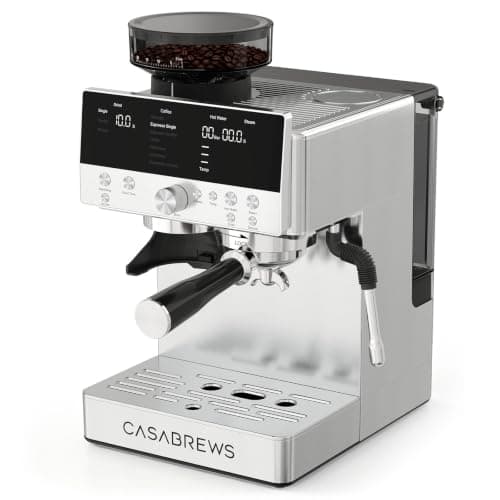
The most machine at a hard $300 ceilingCasabrews MARENZA$299.99
Several espresso drinkers, daily volumeElectactic 15-Bar (77.8oz tank)$339.99
Fresh espresso, zero effort or techniqueDe'Longhi Magnifica Start$599.95
One-touch lattes, milk and allDe'Longhi Magnifica Evo$749.99
Want the craft, fear the learning curveBreville Barista Express Impress$799.95
Daily driver: instant heat, strongest steamBreville Barista Pro$849.95
Whole household, every drink, four profilesDe'Longhi Magnifica Plus$1,299.95

In a Hurry?

The 3 picks that cover most readers. Tap to read the full review or buy direct.

Best Overall

Breville Barista Express

Breville Barista Express

$549.95

The machine that invented the category: burr grinder to 54mm portafilter to real steam wand.

Best Budget

Electactic 20-Bar

Electactic 20-Bar

$112.62

A built-in anti-clog grinder, 20-bar pump and steam wand for barely over $110.

Best One-Touch

De'Longhi Magnifica Evo

De'Longhi Magnifica Evo

$749.99

Complete lattes, milk included, at a single button press, then the carafe stores in the fridge.

Best OverallOur Pick

Grinder

Integrated conical burr, 16 settings, doses into portafilter

Portafilter

54mm stainless

Milk

Manual steam wand

Type

Semi-automatic

Pros

  • The category benchmark for over a decade
  • Grind-to-portafilter workflow mirrors a real cafe
  • Powerful steam wand makes true microfoam
  • Huge community of guides, mods and support

Cons

  • Real learning curve for beginners
  • Grinder is the machine's known upgrade point

Ask what espresso machine to buy in any coffee forum on earth and the Barista Express arrives within three replies. Breville's insight in 2013, packaging a legitimate conical burr grinder and a legitimate espresso machine in one stainless chassis, created this category, and a decade of refinement has kept the BES870XL its reference point. The workflow is the pleasure: beans in the hopper, a twist of the portafilter under the chute to grind and dose, a tamp, and a shot pulled through a 54mm basket with pre-infusion and pressure you can watch on the analog gauge. It is the full barista method, minus the separate $300 grinder.

Why we call it the benchmark: everything else on this page is best understood as a position relative to this machine, either cheaper and simpler (the Electactic and Gevi below), more automated (the Magnificas), or more polished (the Pro and Impress). If you have no constraint pushing you elsewhere, this is the default, and its resale value and accessory ecosystem reflect that.

The honest ledger: 16 grind settings are enough for fresh supermarket beans but can run out of fine adjustment with very light roasts, the steam wand demands practice before latte art happens, and nothing about the machine is automatic. Those are features as much as flaws; this is espresso as a craft with the tedium removed. Pair it with a 54mm accessory kit from our espresso accessories guide and it will anchor a coffee bar for a decade. That is the benchmark's whole argument, and after ten years it still holds.

Our Pick

The machine that defined the category and still owns it. A conical burr grinder doses straight into the 54mm portafilter, a proper 15-bar pump and PID-informed thermocoil pull the shot, and a real steam wand finishes the milk. For over a decade this has been the answer to the question this page exists for.

Buy this if you want genuine cafe-method espresso, grind, dose, tamp, extract, steam, from one machine, and you are willing to spend two weeks learning to dial it in. It rewards the effort with shots and lattes that embarrass machines costing twice as much.

What we don't like

The integrated grinder is good, not great, at the finest end, and the learning curve is real: your first days will produce some sink shots. That is the price of manual control.

Best Budget All-in-OneBest Value

Grinder

Built-in conical burr, anti-clog design

Pressure

20-bar pump

Milk

Steam wand

Type

Semi-automatic

Pros

  • Freshly ground espresso for about $112
  • Anti-clog grinder design targets the classic budget failure
  • Compact footprint fits small kitchens
  • Costs less than most standalone burr grinders

Cons

  • Limited fine-grind adjustment range
  • Budget-grade plastics and steam power

The usual price of admission for an espresso machine with a built-in grinder is $300 and up, which is what makes this Electactic borderline unreasonable. At $112.62 it delivers the entire bean-to-cup pipeline: a hopper-fed conical grinder sitting over a 20-bar pump machine with a steam wand. The grinder is the story. Budget combo machines have historically died by clogging, fines packing the chute until the grinder jams, and Electactic's anti-clog geometry is aimed squarely at that failure mode, which owner reports so far bear out.

Set expectations like an adult and the machine over-delivers. Shots are markedly better than anything from pods or pre-ground because freshness dominates at this price point; the crema is real, and dialing in happens by adjusting dose and grind within a narrower band than premium burrs allow. The wand steams milk to latte warmth and passable texture, if not competition microfoam. What you give up against the Breville is precision, build heft, and headroom to grow. What you keep is a hundred dollars for beans and, crucially, the fresh-ground habit that makes the difference in the first place. It also headlines the budget tier of our best espresso machines under $300 guide, where its price makes even more noise among grinderless rivals.

Best Value

The cheapest legitimate grind-and-brew espresso machine we have found, period. A 20-bar pump, a built-in conical grinder with an anti-clog design, and a steam wand for barely over $110, which is less than many standalone grinders alone. The entry ticket to fresh-ground espresso.

Buy this if you want to find out whether bean-to-cup espresso belongs in your life without committing Breville money. It grinds fresh, pulls genuinely creditable shots for the price, and steams milk; as a first machine or a dorm, office, or RV machine, it is close to unanswerable.

What we don't like

Grind adjustment is coarse-grained compared to premium burrs, the plastics feel like the price, and the steam wand is adequate rather than powerful. All fair at a tenth of the flagship super-automatics.

Best Big-Tank PickAlso Great

Grinder

Built-in conical burr, anti-clog design

Pressure

15-bar pump

Tank

77.8oz removable

Milk

Steam wand

Pros

  • 77.8oz tank is the largest in the budget tier
  • Stainless build with the same anti-clog grinder design
  • Comfortable serving several drinks back to back
  • 15 bars is fully sufficient for proper extraction

Cons

  • Priced above the more polished MARENZA
  • Physically large for a small kitchen

Water capacity is the least glamorous spec in espresso and the one multi-drinker households curse the most. Every latte spends water twice, once through the puck and once as steam, and a typical 45oz tank is realistically three to four milk drinks between refills. The morning failure mode is always the same: the pump growls dry mid-shot or mid-steam, and someone is ferrying the tank to the sink while their espresso dies in the cup. Electactic's answer is blunt and correct: a 77.8oz tank, roughly double the class standard, on a full-size stainless chassis with the same anti-clog conical grinder thinking as their $112 machine.

In use it is exactly what it promises: a volume workhorse. The 15-bar pump holds steady pressure across back-to-back shots (the bar-count arms race is marketing; extraction happens at 9 bars regardless), the grinder keeps pace, and the wand steams pitcher after pitcher without the recovery sulk small machines take. Our reservations are positional rather than functional: at $339.99 it sits above the MARENZA, which is the more refined single-user machine, and its size wants a dedicated stretch of counter, the kind of station our coffee bar ideas guide is written for. But for the specific household this serves, two or more espresso drinkers, every single day, the tank is worth more than polish, and nothing else at the price matches it.

Also Great

Electactic's step-up machine trades headline pump numbers for the things households actually run out of: a huge 77.8oz removable water tank, a stainless body, and a grinder-to-wand workflow built for volume. The pick for the two-latte-each household.

Buy this if your machine serves multiple people daily. A standard 40 to 50oz tank empties mid-steam on the fourth latte of a morning; 77.8 ounces means refilling becomes a twice-a-week chore instead of a daily interruption, and the full-size body earns its counter space.

What we don't like

It occupies awkward pricing ground $30 above the MARENZA, and 15 bars, while entirely sufficient (espresso extracts at 9), reads oddly beside its cheaper 20-bar sibling.

Best Under $250Also Great

Grinder

Built-in conical burr, 35 settings

Pressure

20-bar pump

Milk

Steam wand

Type

Semi-automatic

Pros

  • 35 grind settings, unmatched adjustability under $250
  • Fresh bean-to-cup workflow with real dial-in headroom
  • Steam wand handles daily lattes
  • Meaningful build step up from the $112 tier

Cons

  • Controls have a learning curve of their own
  • Mid-tier plastics in a stainless-look shell

Grind adjustment is where budget combo machines quietly cheat, and the Gevi conspicuously does not. Most sub-$250 grinder combos offer a handful of coarse steps, enough to claim freshness but not enough to truly dial in a bean; when the shot runs sour you nudge the grind finer and sail straight past into bitter, with nothing in between. Thirty-five settings changes the game. The steps are small enough that adjusting one notch moves shot time by a couple of seconds, which is precisely the resolution dialing-in requires and the reason we treat this Gevi as the first machine on the budget ladder that teaches real espresso skills.

The rest of the machine holds its end up. The 20-bar pump delivers stable brewing pressure (espresso only needs 9 at the puck; the headroom is marketing but harmless), shots pour with proper crema, and the wand steams milk for the daily latte without drama. Owners' consistent notes match ours: read the manual, because the button logic is not guessable, and give the grinder a week of small adjustments before judging it. Between the Electactic's price and the MARENZA's polish, this is the value sweet spot of the budget tier, and the machine we would point a curious beginner toward if the extra $90 over the Electactic is painless. It also appears in our under-$300 guide against its grinderless peers.

Also Great

The midpoint machine with a grinder spec that punches up: 35 grind settings, more than twice the Barista Express's 16, feeding a 20-bar pump. For just over $200 it is the budget machine that lets you actually dial in, not just grind fresh.

Buy this if you want real grind adjustment on a budget. Espresso lives or dies by grind size, and 35 steps means you can walk a sour shot toward sweet in small increments instead of leaping past the target, which is exactly the skill the hobby is built on.

What we don't like

The interface takes a manual-reading session to master, and build quality is honest mid-tier: far tidier than the $112 class, clearly below Breville stainless.

Best Under $300Also Great

Grinder

Built-in conical burr

Milk

Steam wand

Build

Stainless steel body

Type

Semi-automatic

Pros

  • The most polished sub-$300 grinder combo
  • Casabrews' proven budget-espresso track record
  • Real steam wand for proper milk texture
  • Stainless build reads far above its price

Cons

  • Fewer grind steps than the cheaper Gevi
  • Close enough to Breville territory to invite the comparison

Casabrews earned the right to attempt this machine. The company's CM5418 became the best-selling budget espresso machine on Amazon by delivering unglamorous competence, a real pump, a real wand, and a low return rate, at $140, and it tops our under-$300 rankings for exactly that reason. The MARENZA is the same philosophy pointed at this page's category: take the proven brewing platform, add a conical burr grinder up top, wrap it in stainless, and price it at the psychological ceiling of budget espresso.

The result is the budget tier's most cohesive package. Where the Electactic feels like an astonishing price and the Gevi like a spec win, the MARENZA feels like a finished product: the grinder doses cleanly, the controls are legible without the manual, the wand steams with more authority than either cheaper rival, and the whole unit sits on the counter looking like it cost more than it did. The strategic question is the one we flag in every tier: at $299.99 you are $250 from a new Barista Express and occasionally less from a sale-priced one, and the Breville's grinder, gauge, and ecosystem are worth the stretch if the budget can flex. If it cannot, nothing under $300 makes better espresso with fewer compromises than this, and the gap between it and the Breville is smaller than the price gap suggests.

Also Great

The most complete machine you can buy for exactly $300: built-in burr grinder, full steam wand, and the build polish Casabrews learned shipping the best-selling budget espresso machine on Amazon. The budget tier's finishing move.

Buy this if $300 is the ceiling and you want the closest thing to the Barista Express experience under it. Casabrews' pedigree matters here: the company's CM5418 earned its sales crown on reliability per dollar, and the MARENZA extends that formula to the grinder-combo format.

What we don't like

At this price you are one honest conversation away from the used or sale-priced Breville question, and the grind adjustment range trails the Gevi's 35 steps.

Best Entry Super-AutomaticAlso Great

Grinder

Built-in conical burr, sealed hopper

Operation

Fully automatic, 3 one-touch recipes

Milk

Manual frother

Cleaning

Automatic rinse cycles

Pros

  • True bean-to-cup at one button press
  • De'Longhi's decades of super-automatic reliability
  • Self-cleaning, near-zero daily maintenance
  • Cheapest entry to the full-auto format

Cons

  • Ceiling on shot quality versus semi-automatics
  • Milk frothing is still a manual step

Everything above this point on the page assumes you want to make espresso. The Magnifica Start assumes you want to have espresso. That distinction defines the super-automatic format, which De'Longhi has led for decades: an internal burr grinder, brew unit, and pump execute the entire shot sequence, grind, dose, tamp, pre-infuse, extract, eject the puck, rinse, from a single button press. Your involvement is beans in the hopper, water in the tank, and choosing among three drink recipes. There is no portafilter in your dishwasher and no learning curve in your first week.

The Start is the format's entry price, and the cuts that get it to $599.95 are intelligently chosen. The core, grinder, brew unit, and auto-clean cycles, is genuine Magnifica; what is missing is automation at the margins: milk is a manual frother rather than the Evo's one-touch carafe, and the recipe list is three rather than seven. For americano and straight-espresso drinkers that missing milk automation is irrelevant, which makes this the value pick of the whole super-auto tier. Be clear-eyed on the trade: a dialed-in Barista Express beats it on peak shot quality, every time. But peak assumes practice, patience, and a free ten minutes, and the Start's proposition, 95 percent as good with 5 percent of the effort, is the one most busy households actually live with. It is the format we recommend most for gifting, too, alongside our gifts for coffee lovers guide.

Also Great

The cheapest ticket into true one-touch espresso from the brand that owns the super-automatic category. Press a button; the Magnifica Start grinds, doses, tamps, brews, and self-cleans. No portafilter, no technique, no learning curve, and a manual frother for milk days.

Buy this if you want fresh-ground espresso with literally zero craft: no tamping, no dialing, no mess. It is the machine for households where the coffee must be good and the process must be invisible, and for offices where nobody owns the machine.

What we don't like

One-touch shots trail a well-pulled semi-automatic's in peak quality, milk is manual-frother rather than automatic at this tier, and bypassing the shot ritual entirely is either the whole point or a dealbreaker.

Austin Art Insider

Free weekly guide to galleries, exhibitions & collecting in Austin.

Best One-Touch LattesAlso Great

Grinder

Built-in conical burr, 13 settings

Operation

Fully automatic, 7 one-touch recipes

Milk

LatteCrema auto-frothing carafe

Cleaning

Auto rinse plus carafe self-clean

Pros

  • Complete lattes and cappuccinos at one touch
  • Milk carafe self-cleans and stores in the fridge
  • Seven recipes cover the whole cafe menu
  • Proven Magnifica platform underneath

Cons

  • Carafe milk trails a manual wand's best texture
  • More components to maintain than the Start

Milk is where most espresso automation quietly gives up, and it is exactly where the Evo doubles down. Every machine so far leaves you holding a pitcher: even the Magnifica Start pulls its shot automatically, then hands the milk problem back to you. The Evo's LatteCrema system closes that last gap. Cold milk goes in a sealed carafe, the carafe clicks onto the machine, and a single button produces a finished, layered cappuccino, espresso, textured milk, and foam cap in the right order and proportion. When the drink is poured, the carafe self-rinses its spout and goes back in the refrigerator, milk and all.

What surprises people is how good automated milk has become. The carafe produces dense, uniform foam adjusted by a dial from cappuccino-stiff to latte-silky; a skilled wand hand still wins on gloss and art-worthy texture (the path our milk frother guide and a good pitcher serve), but against the milk most home baristas actually make, the Evo is startlingly competitive and infinitely more repeatable. The Magnifica platform beneath, 13-setting burr grinder, seven recipes, auto-clean, is the same proven core that appears in our overall espresso rankings. The math against the Start is simple: $150 buys the milk automation. Latte households should pay it without blinking; black-coffee drinkers should not.

Also Great

The Start's automation, extended to the milk. The Evo's LatteCrema carafe froths and pours cappuccinos and lattes at a button press, then detaches to the refrigerator; add seven one-touch recipes and auto-clean, and the entire drink, not just the shot, becomes hands-free.

Buy this if your household drinks lattes and cappuccinos daily and nobody wants to steam milk. The carafe is the entire pitch: it textures milk automatically, layers the drink itself, self-rinses, and stores in the fridge between sessions.

What we don't like

Auto-frothed milk is excellent for what it is but never quite matches wand-steamed microfoam, and the carafe adds parts to wash weekly even with self-rinsing.

Best for LearningAlso Great

Grinder

Integrated conical burr, 25 settings, smart dosing

Tamping

Assisted lever, 22 lb calibrated with 7-degree polish

Portafilter

54mm stainless

Milk

Manual steam wand

Pros

  • Assisted tamp is perfectly level and calibrated, every shot
  • Smart dosing auto-corrects grind amount between shots
  • 25 grind settings out-resolve the standard Express
  • Removes the two most failure-prone beginner skills

Cons

  • $250 premium over the standard Express
  • Redundant for baristas who already tamp well

Breville studied why beginners fail with the Barista Express and built the answer into a lever. The two culprits, decades of them, are dosing (too much or too little coffee in the basket) and tamping (tilted, inconsistent, or wrong-pressure compression). The Impress attacks both mechanically. Pull the front lever and it tamps with a calibrated 22 pounds through a precision path, finishing with a 7-degree polishing spin, the exact technique instructors spend weeks teaching hands to do. Meanwhile the smart dosing system measures each grind and quietly corrects the next one, so the machine converges on the right dose instead of relying on you to.

The result occupies a genuinely clever position: it is not a super-automatic, you still lock in the portafilter, watch the shot, and steam your own milk with a proper wand, but the failure-prone steps are jigged like a woodworker's workshop, repeatable by design. Shots come out consistent in week one instead of week four, and the skills still transfer: everything you learn about grind, ratio, and milk applies to any machine you ever own, which is precisely what one-touch machines cannot claim. Against its own sibling the calculus is honest: the standard Express reaches the same cup ceiling for $250 less if you put in the practice. The Impress is for those who want the craft with the frustration surgically removed, and as a way to learn real espresso it is the best-designed machine on this page. Round out its bench with the 54mm tools in our accessories guide.

Also Great

The Barista Express with training wheels engineered by adults. The Impress adds an assisted tamping lever that presses with calibrated force and a perfect finish, plus smart dosing that corrects itself shot to shot. Manual espresso's two hardest skills, automated away without automating the craft.

Buy this if you want the real semi-automatic experience but the tamping-and-dosing learning curve is what has kept you away. The lever delivers a level, consistent tamp every time, and the dose-correcting grinder means your second shot learns from your first.

What we don't like

It costs $250 over the standard Express for convenience rather than cup ceiling, and enthusiasts who enjoy hand-tamping ritual are paying for a lever they will not use.

Best Premium Semi-AutomaticUpgrade Pick

Grinder

Integrated conical burr, 30 settings

Heating

ThermoJet, 3-second heat-up

Display

LCD with shot timer

Milk

High-power manual steam wand

Pros

  • 3-second heat-up: on-demand espresso, no waiting
  • Strongest steam of any machine on this page
  • 30 grind settings for fine dial-in resolution
  • LCD shot timer replaces guesswork

Cons

  • No analog pressure gauge, which some owners miss
  • Price invites comparison with a machine tier up

The difference between the Express and the Pro is your first fifteen minutes each morning. The Express's thermocoil wants several minutes of warm-up before the group is truly at temperature; the Pro's ThermoJet system reaches brew readiness in about three seconds. That number sounds like a spec-sheet flex until you live with it: espresso stops being a production you plan and becomes something that happens between pouring cereal and finding your keys. The same thermal muscle drives the steam wand, which produces hotter, drier steam that textures milk faster and recovers instantly for a second pitcher, the single most requested upgrade among Express owners with multi-latte households.

Around that core, Breville tightened everything a notch: 30 grind settings nearly double the Express's resolution, the LCD pairs grind and shot-timer feedback in one glance, and the quieter grinder is a small mercy at 6 a.m. What is lost is charm and cash: the analog gauge's needle-watching ritual is gone, and $849.95 is real money, close enough to the one-touch Magnifica Evo and the assisted Impress that your priorities, speed, automation, or guidance, decide among them. Our view: for the experienced or committed home barista pulling multiple drinks daily, the Pro is the best pure semi-automatic on this page and sits high in our overall rankings. For first-timers, the Express or the Impress spends the difference more wisely.

Upgrade Pick

The Express, re-engineered for speed and precision: a ThermoJet heater ready in 3 seconds, an LCD replacing the analog gauge, 30 grind settings, and markedly stronger steam. For the daily-driver who wants the manual craft without the manual wait.

Buy this if you loved everything about the Barista Express except its warm-up time and steam power. The 3-second heat-up transforms the weekday-morning experience, and the faster, drier steam makes microfoam and back-to-back milk drinks noticeably easier.

What we don't like

Purists miss the Express's analog pressure gauge, and at $849.95 the Pro brushes against super-automatic and dual-boiler-adjacent territory where the decision gets genuinely hard.

Best Ultra-Premium One-TouchUpgrade Pick

Grinder

Built-in conical burr

Interface

Color touchscreen, 4 user profiles

Recipes

18+ one-touch, hot and iced

Milk

Automatic steam wand system

Pros

  • Four profiles remember each drinker's exact preferences
  • 18+ recipes span espresso to iced drinks
  • Touchscreen makes the whole menu discoverable
  • Automated milk with premium texture control

Cons

  • Four-figure price
  • Peak-shot ceiling still belongs to manual machines

At the top of the super-automatic ladder, the machine stops being a coffee maker and becomes household infrastructure. The Magnifica Plus's proposition is total: a color touchscreen offers more than eighteen drinks, hot and iced, espresso through cappuccino to long coffee, and four user profiles store each person's precise preferences, so the machine produces your drink, at your strength, with your milk, from one tap of your name. The grinder, brew unit, and milk system execute everything internally and clean up after themselves. It is the closest home espresso comes to having staff.

Living with it confirms the premise. The touchscreen earns its place not as luxury but as discoverability: households actually use the flat white, the cortado, the iced latte, because they can see them, where button machines reduce to two memorized drinks. Milk automation is a half-step beyond the Evo's carafe in texture control, and the profiles end the settings wars that machines shared between a strong-espresso drinker and a milky-latte drinker otherwise suffer. Our honest counsel at this price has two halves. If your household is one obsessive: a Barista Pro plus the full accessory bench costs less and pulls better single shots. If your household is four different coffee orders every morning, no machine on this page, and few anywhere, serves it better, and beside it a burr grinder for the drip pot (see our coffee grinders guide) completes the most self-sufficient coffee corner money buys.

Upgrade Pick

The no-compromise super-automatic: a color touchscreen fronting 18-plus one-touch recipes, automatic milk steaming, and four user profiles that remember exactly how each person in the house takes their coffee. The espresso appliance, perfected.

Buy this if the machine serves a household of different drinkers and the budget reaches four figures. The profiles are the killer feature: each person taps their name and gets their drink, their strength, their milk, without touching a setting.

What we don't like

It costs as much as a Barista Pro plus a vacation, and the same super-automatic ceiling applies: a skilled hand at a semi-automatic can still out-pull it on a single perfect shot.

Head-to-Head

How the top picks compare

The two matchups that decide most purchases: budget ladder or benchmark, and craft or button.

Casabrews MARENZA vs Breville Barista Express: Is the Benchmark Worth $250 More?

The budget tier's best finished product against the category's founding machine.

Casabrews MARENZA

Casabrews

Casabrews MARENZA

The most polished grinder combo under $300

$299.99
Check Price →
Breville Barista Express

Breville

Winner

Breville Barista Express

Better burrs, pressure gauge, stronger steam, decade-proven

$549.95
Check Price →

Our verdict

Winner: Breville Breville Barista Express. The Breville wins on the compounding advantages: a better burr set with more useful adjustment, a thermocoil and steam wand with genuine authority, an analog pressure gauge that teaches you extraction as you use it, and a decade of proven durability with an accessory and community ecosystem no budget brand can match. Espresso rewards precision, and every point of precision the Express adds shows up in the cup and in how fast you improve. The MARENZA's case is nonetheless the strongest the budget tier has ever fielded: Casabrews' reliability track record is real, the build reads far above its price, and the fundamental workflow, fresh grind, real tamp, real steam, is the same craft in a cheaper chassis. If $300 is a hard ceiling, buy the MARENZA and enjoy it without regret; the gap is smaller than the internet claims. If the budget can stretch and the machine will be used daily for years, the Express's $250 premium amortizes to pennies a shot and buys the machine you will not outgrow.

Buy the Casabrews

$300 is the ceiling and you want the most complete machine under it.

Buy the Breville

you will pull shots daily for years and want the machine you never outgrow.

Barista Express vs Magnifica Evo: Craft or Button?

The two philosophies of home espresso, at their most popular price points.

Breville Barista Express

Breville

Winner

Breville Barista Express

Higher shot ceiling, real steam wand, the full craft

$549.95
Check Price →
De'Longhi Magnifica Evo

De'Longhi

De'Longhi Magnifica Evo

One-touch lattes, milk automated, zero technique

$749.99
Check Price →

Our verdict

Winner: Breville Breville Barista Express. We give the Express the win because it makes better espresso, and this is an espresso guide: with two weeks of practice its shots and wand-steamed milk beat the Evo's automated output, and the gap widens as your skill grows, which is a compounding return no automation matches. But this is the rare matchup where the loser is the right buy for possibly half of readers, so answer the temperament question honestly. The Express demands participation every single time; there is no busy-morning mode, and a household member who will not learn it will not use it. The Evo demands nothing, produces a genuinely good latte for anyone who can press a button, cleans itself, and never has an off day. Choose by your worst morning, not your best Sunday: if fifteen minutes with a portafilter sounds restorative, the Express will reward you for a decade; if it sounds like a reason to stop at the drive-through, the Evo's consistency is worth more than the Express's ceiling.

Buy the Breville

the craft appeals and you want the highest quality your practice can reach.

Buy the De'Longhi

you want excellent, identical lattes at one button press, forever.

How we
chose

We judged grind-and-brew espresso machines on the questions owners live with, not the spec sheet:

  • Grinder quality and adjustability first. The integrated grinder is the reason this category exists, so grind-setting resolution (16 vs 35 steps matters), clogging resistance, and dosing accuracy weighed heaviest.
  • Shot quality against effort. We rate semi-automatics on their ceiling and super-automatics on their consistency, and we say plainly which philosophy each machine serves.
  • Milk capability. Steam wand power, recovery time, and, on automatics, frother texture, since most home espresso becomes a latte or cappuccino.
  • Daily livability. Heat-up time, tank capacity, cleaning burden, and noise: the factors that decide whether a machine gets used in year two.
  • Verified listings. Every product, price, and image was checked live on Amazon at publish time; we link only to in-stock listings we confirmed ourselves.

Share this guide

Share

Common Questions

Frequently Asked Questions

Have art
to sell?

Austin Gallery specializes in selling inherited art, estate collections, and fine art with zero upfront fees. Get a free evaluation today.