Austin Gallery
Home & KitchenJuly 22, 202613 min read

Best Cutting Boards 2026: Boos Maple to $19 Plastic

The cutting board is secretly a knife decision: every edge you own lives or dies on this surface. We ranked the real Boos maple, the end-grain walnut your Japanese steel deserves, the teak that forgives neglect, and the plastic that belongs in every kitchen anyway, with the sanitation science most guides get backwards.

By Justin Park · How we research

Which Cutting Board Should You Buy?

Your situationBuy thisPrice
One proper wood board for everythingBoos Chop-N-Slice 16x10$48.95
Protecting expensive knivesSonder End-Grain Walnut$169.99
The counter-resident prep stationBoos CB 20x15$109.95
Raw meat and dishwasher dutyOXO 2-Piece Plastic$27.95
Holiday roasts and turkeysTeakhaus XL Carving$113.69
Outfitting cheap, or a fleetGorilla Grip 3-Pack$19.49

The cutting board is the most underrated purchase in the kitchen, because it is not really a board decision: it is a knife decision. Every stroke of every knife you own ends on this surface, and the difference between wood and glass, between end grain and bargain plastic, is the difference between honing twice a year and wondering why your good chef's knife died young. Every board below was verified in stock at a live price, and the wood-versus-plastic sanitation debate, which most guides get backwards, is settled with actual science in the first editorial break.

The short version of the market: wood (Boos maple, walnut, teak) is kindest to edges, naturally bacteria-hostile, and repairable for decades, in exchange for hand washing and a monthly minute of oiling. End grain is wood's premium form, vertical fibers that part around the edge and heal behind it. Plastic is the dishwasher-safe raw-meat specialist that should be a supporting player, never the whole cast. The correct kitchen runs one good wood board and one plastic set, which together cost less than most single premium boards: the $48.95 Boos plus the $27.95 OXO set is the whole answer for most homes.

This guide completes our buy-once kitchen pillar alongside the chef knives, knife sets, and cast iron skillets that the boards will spend their lives next to. Every link goes to Amazon with our affiliate tag; we earn a small commission, at no cost to you, when you buy through us.

In a Hurry?

The 4 picks that cover most readers. Tap to read the full review or buy direct.

Best Overall

Boos Chop-N-Slice 16x10

Boos Chop-N-Slice 16x10

$48.95

Real Illinois maple at the size and price most kitchens actually need.

Best End-Grain

Sonder Alfred Walnut

Sonder Alfred Walnut

$169.99

Vertical walnut fibers that part around your edge and heal behind it.

Best Plastic

OXO 2-Piece Set

OXO 2-Piece Set

$27.95

The dishwasher-safe raw-meat station every kitchen should run.

Best Budget

Gorilla Grip 3-Pack

Gorilla Grip 3-Pack

$19.49

A three-board fleet that solves cross-contamination for under $20.

Best OverallOur Pick

Material

Hard rock maple, edge grain

Size

16 x 10 x 1 inch

Knife feel

Soft, edge-preserving

Care

Hand wash, oil monthly

Made in

USA (Effingham, Illinois)

Pros

  • Genuine Boos maple at an entry price
  • Ideal daily-driver size and heft
  • Gentle on expensive knife edges

Cons

  • Edge grain scars faster than end grain
  • Needs the standard wood-care routine

John Boos has been milling maple in Illinois since 1887, and the Chop-N-Slice is the company's handshake offer. The wood is the same hard rock maple as the four-figure butcher blocks, the thickness is a solid stay-put inch, and the 16 by 10 footprint is the goldilocks of daily cooking: room to break down a chicken, small enough to rinse in a normal sink.

Why it wins overall: wood boards protect the edge of every knife you own, and this is the cheapest board from a legendary maker that does the job at full quality. A $48.95 board that preserves a $190 knife is not an accessory; it is insurance.

The care routine is real but small: hand wash, dry standing up, oil it monthly. Do that and this board outlives trends, kitchens, and possibly you. Pair it with the picks in our chef knife guide and you have the two-piece foundation every serious kitchen is built on.

Our Pick

The most board-per-dollar in the American wood canon: real Boos hard maple, an inch thick, at the 16 by 10 size that fits every counter and most sinks, for $48.95. The company that supplies butcher blocks to professional kitchens, at its most accessible.

Buy this if you want one proper wood board that does everything: kind to knife edges, heavy enough to stay put, big enough for real prep, and small enough to wash without a wrestling match. It is the right first serious board and, for many kitchens, the last.

What we don't like

Edge-grain maple shows knife marks faster than end-grain, and like all wood it wants monthly oiling and zero dishwasher exposure. No juice groove on this model.
Best Premium MapleThe Full Boos

Material

Hard rock maple, edge grain

Size

20 x 15 x 1.5 inch

Weight

Substantial: stays put, stays out

Care

Hand wash, oil monthly, sandable

Made in

USA

Pros

  • Prep-station acreage for a whole meal
  • Mass eliminates board slide entirely
  • Thick face can be sanded back to new for decades

Cons

  • Too big for sink washing
  • Claims its counter space permanently

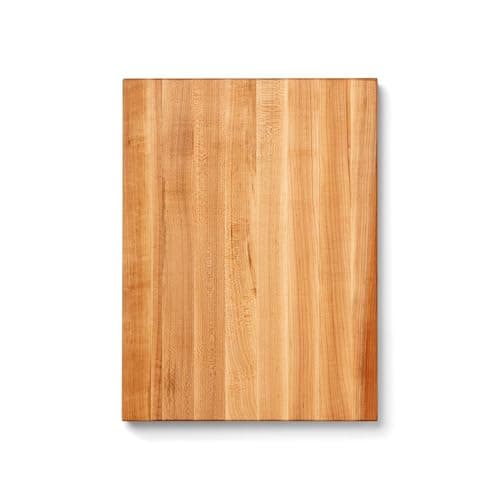
There is a moment in every cook's life when the cutting board becomes the workbench, and this is the board for it. Twenty by fifteen means the onions, the herbs, and the protein all live on the board at once, mise en place style, instead of shuttling to bowls. An inch and a half of maple means the board greets your knife with that soft, dead-quiet thunk that makes cheap boards feel like cafeteria trays.

The practical commitments are real: it washes propped in the sink, it wants its monthly oil, and it will annex its stretch of counter forever, which most owners come to consider a feature. Every few years, a sheet of sandpaper and fresh oil returns the surface to showroom. If your knives came from the forged tier, this is the landing pad they deserve.

The Full Boos

The board serious home cooks mean when they say they want a Boos: 20 by 15 inches of inch-and-a-half-thick maple that turns a stretch of counter into a permanent prep station. Big enough to break down anything, heavy enough that it simply does not move.

Buy this if you cook daily and want a board that lives on the counter rather than in a cabinet: the mass kills all sliding, the acreage holds a whole meal's prep at once, and the thick maple face will absorb a decade of work and sand back to new.

What we don't like

At this size and weight, washing happens with the board propped in the sink, not in it. It permanently claims its counter space, and it costs $109.95.

The Statement BlockBuy It for Life

Material

Hard rock maple

Size

20 x 15 x 2.25 inch

Build

Full chopping block thickness

Lifespan

Generational with basic care

Made in

USA

Pros

  • Chopping-block mass takes cleaver-grade work
  • A lifetime surface, restorable forever
  • Anchors a kitchen like furniture

Cons

  • Heavy enough to be a permanent installation
  • Far more block than most kitchens need

Above a certain thickness a board stops being equipment and becomes a place, and 2.25 inches of Illinois maple is comfortably past the line. The CCB is the domestic version of the blocks Boos builds for butcher shops: mass that swallows cleaver blows, a surface that flattens dough without skating, and the visual weight that makes a kitchen island look finished.

The buy-it-for-life math is straightforward: this block, oiled occasionally and sanded every few years, is a permanent purchase in a category where $20 boards get landfilled annually. It is also, frankly, a luxury: the CB Series at $109.95 does 90 percent of this for a third of the price. But every kitchen has one piece that is about intention as much as function, and for cooks, this is the one. It belongs on the same shortlist as our buy-it-for-life gift picks.

Buy It for Life

The countertop monument: 2.25 inches of solid Boos maple that is less a cutting board than a piece of kitchen architecture. This is the block that anchors the room, takes cleaver work without flinching, and gets handed down rather than replaced.

Buy this if the kitchen is the center of your home and you want the workstation to announce it: serious volume cooking, whole-animal butchery, dough work, and decades of daily service on a surface that can be sanded back to perfect indefinitely.

What we don't like

$295.95 and roughly the weight of a small dog: it goes where it goes and stays there. Total overkill for a kitchen that preps one meal a day on a corner of counter.

Best End-GrainThe Knife's Best Friend

Material

American black walnut, end grain

Feature

Juice groove, dual inner handles

Knife feel

The softest landing wood offers

Care

Oil monthly minimum, never soak

Made in

USA

Pros

  • End grain measurably preserves knife edges
  • Scars close up and vanish into the checkerboard
  • Heirloom looks with working-board features

Cons

  • Demands a real oiling habit
  • Premium price and real weight

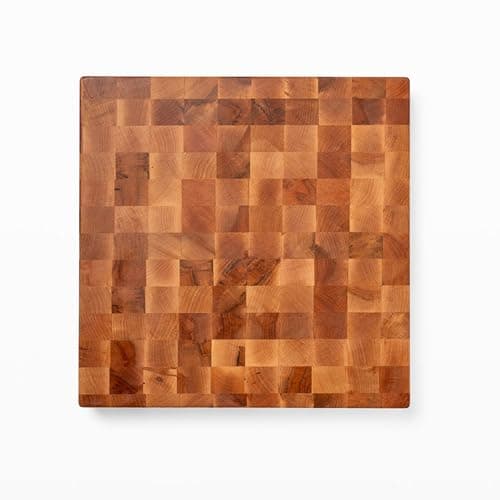
End grain is the reason butcher blocks were always built the way they were. Stand the wood fibers vertically and a knife edge slips between them like a hand into wheat, instead of chopping across them like a fence. The edge stays sharper longer, the wood closes around each cut, and years of daily work read as patina rather than damage. The Alfred is the best Amazon-available execution of the idea: thick black walnut, USA made, with the juice groove and recessed handles that separate working boards from decor.

The honest contract: end grain gives your knives the best surface there is, and asks for monthly oil in return. Skip the oil in a dry climate and cracks are a when, not an if. Buy this board with the bottle of board oil, or do not buy it.

For the cook who just invested in the Japanese steel tier, this is the matching decision: the hard, chip-prone edges that reward careful owners are exactly the edges end grain protects best.

The Knife's Best Friend

The end-grain thesis executed beautifully: American black walnut, checkerboard end-grain construction, made in the USA, with a juice groove and inner handles. The board that treats knife edges best, wears its scars invisibly, and looks like furniture doing it.

Buy this if you own knives worth protecting: end grain's vertical wood fibers part around an edge instead of resisting it, which measurably slows dulling, and the self-healing surface hides years of work. Also the definitive wedding-tier kitchen gift.

What we don't like

End grain is thirstier than edge grain: skip the oiling routine and the board will crack, and $169.99 buys a board you must actually care for. Heavy enough that it mostly lives out.

Check the Sonder Alfred on Amazon →$169.99 · Sonder Los Angeles
Best End-Grain ValueUnder $80

Material

Walnut, end grain

Format

Set with board plus companion piece

Knife feel

End-grain soft landing

Care

Oil monthly, hand wash only

Value

End grain under $80

Pros

  • True end-grain benefits at $79.99
  • Handsome walnut checkerboard look
  • Set format adds a serving piece

Cons

  • Lighter build than artisan boards
  • Import-tier consistency, inspect on arrival

The interesting question about budget end grain is what survives the price cut, and the answer is: the part that matters. End grain's edge protection comes from fiber orientation, not brand prestige, and the Thetchry's vertical walnut construction delivers it. Your knife lands soft, the surface closes over its history, and the checkerboard face looks far above its receipt.

What the $90 saving costs is mass and refinement: this board is thinner and lighter than the Sonder, without the deep juice groove and furniture-grade finishing, and quality control at the import tier means giving it a once-over on arrival. Oil it like you mean it and it is a superb first end-grain board, and an easy gift that reads twice its price. Pair it with anything from our hostess gift guide and you have the dinner-party-circuit answer sorted.

Under $80

The end-grain experience at half the artisan price: real walnut, checkerboard construction, and the same edge-protecting physics for $79.99. Finishing and thickness trail the Sonder, but the core benefit your knives feel is fully present.

Buy this if end grain's knife-preserving physics is the goal and the artisan premium is not: it delivers the soft landing and self-healing surface at a price where the required care routine feels proportionate.

What we don't like

Thinner stock and simpler finishing than the USA-made tier, and imported walnut boards at this price vary more piece to piece. The oiling contract applies in full.

Austin Art Insider

Free weekly guide to galleries, exhibitions & collecting in Austin.

Best Carving BoardThe Roast Specialist

Material

Solid teak, edge grain

Feature

Deep juice groove, generous capacity

Size

Extra large carving format

Care

Low maintenance: teak self-oils

Sustainability

Plantation-grown teak

Pros

  • Groove genuinely contains a roast's juices
  • Teak forgives neglected oiling schedules
  • Whole-turkey scale with room to work

Cons

  • Silica in teak is slightly harder on edges
  • A big board to store between holidays

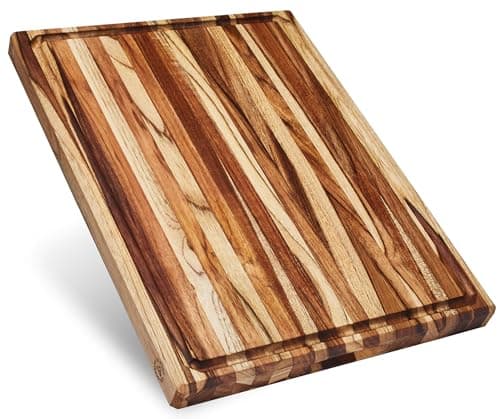
Every household discovers the carving-board gap the same way: a resting roast, a flat board, and a river of juices heading for the floor. The Teakhaus fixes it with capacity engineering: a groove deep and long enough to hold what a brisket actually releases, on a slab big enough that carving happens on the board instead of over the sink.

Teak is the right wood for the job for an unglamorous reason: its natural oils resist moisture on their own, so the board that appears twice a year for holidays does not crack from the neglect between appearances, the way a forgotten maple board might. Between this and daily-driver duty, though, keep the maple Boos in the rotation: teak's trace silica dulls edges marginally faster, which matters at three-meals-a-day frequency and not at all at roast-carving frequency.

The Roast Specialist

The board Thanksgiving is carved on: extra-large edge-grain teak with a deep juice groove that actually holds a roast's worth of drippings. Teak's natural oils make it the most forgiving hardwood to own, and Teakhaus is the reference brand.

Buy this if roasts, briskets, and holiday birds are part of your year: the size holds a whole turkey with workspace to spare, and the groove saves the counter, the floor, and the gravy. Teak's oil content also forgives the oiling lapses maple punishes.

What we don't like

Teak's silica content is mildly harder on knife edges than maple or walnut: a fine trade for a carving board, a consideration for a daily chopper. Extra large means extra storage.

Best Teak Daily BoardThe Handsome Workhorse

Material

Teak, edge grain

Format

Reversible: groove face and flat face

Size

Extra large daily format

Care

Teak-easy, occasional oil

Feature

Juice groove one side

Pros

  • Reversible faces cover prep and carving
  • Teak forgiveness for imperfect owners
  • Serious size for $89.99

Cons

  • Edge grain shows work faster than end grain
  • Teak's silica edge-wear footnote applies

Most kitchens want one big wood board that does not demand a relationship, and this is that board. Flat face up, it is a generous daily prep surface; flipped, the juice groove handles Sunday's roast. Teak's built-in oils mean the finish survives owners who will never own board cream, and Sonder's finishing gives it looks that justify living on the counter.

The positioning against this guide's other wood is honest: the Boos maple is kinder to edges for heavy daily chopping, the end-grain Alfred is kinder still, and the Teakhaus out-carves it on capacity. The Highland's pitch is that it does 85 percent of all three jobs in one handsome, forgiving slab, and at $89.99 that all-rounder honesty is exactly what a lot of kitchens actually need.

The Handsome Workhorse

The big teak board for everyday life: edge-grain construction with a juice groove on one face and a flat working face on the other, sized for real prep at $89.99. Teak's easy-care nature in a reversible format that earns daily counter residency.

Buy this if you want one large, low-maintenance wood board that handles daily chopping and doubles as the roast and serving board: the reversible faces split the difference, and teak shrugs off the humidity swings and oiling lapses that stress maple.

What we don't like

Same teak-versus-edges footnote as the Teakhaus, and edge grain here means visible knife tracks sooner than the end-grain boards above. Big enough to need a storage plan.

Check the Sonder Highland on Amazon →$89.99 · Sonder Los Angeles
Best PlasticThe Raw-Meat Station

Pieces

2: large prep and small task board

Material

Odor-resistant polypropylene

Grip

Non-slip edges, juice-catching border

Care

Fully dishwasher safe

Role

Raw protein and dishwasher-cycle duty

Pros

  • Dishwasher sanitization for raw-meat work
  • Non-slip edges fix plastic's danger problem
  • Two sizes cover prep and quick tasks

Cons

  • Hardest surface here on knife edges
  • Must be replaced once deeply scarred

The correct kitchen runs two boards, and this is the second one. Wood for produce, bread, and everything the knife loves; plastic for the chicken thighs, because the ability to run the board through a 150-degree dishwasher cycle after raw-poultry contact is the one sanitation argument plastic wins outright. OXO's version earns the slot with details: rubberized edge grips that anchor the board to the counter, a shallow moat that catches meat juices, and polypropylene that resists the onion-and-garlic ghosting cheap boards absorb.

The lifecycle honesty: plastic boards are consumables. Once knife scars deepen enough to shelter residue past a dishwasher's reach, replace the board; at $27.95 for two, the replacement economics work. The full wood-versus-plastic sanitation science, including why wood is not the bacteria trap folklore claims, is in the editorial break below.

The Raw-Meat Station

The best-engineered plastic boards in the mainstream: two sizes, non-slip edge grips, odor-resistant polypropylene, and true dishwasher tolerance. This is the raw-chicken station every kitchen should run alongside its wood, for $27.95.

Buy this as the second board system, not the only one: raw meat and fish prep that ends in a dishwasher cycle is the workflow plastic exists for, and OXO's grippy edges fix the slide that makes cheap plastic boards genuinely dangerous.

What we don't like

Plastic is the hardest common surface on knife edges, and once deeply scarred it should be replaced rather than babied: the deep-groove bacteria problem is real, and the fix is the price of replacement.

Best Budget PlasticThe $19 Fleet

Pieces

3 graduated sizes

Material

BPA-free plastic, reversible faces

Grip

Non-slip border rims

Care

Dishwasher friendly

Price

$19.49 for the fleet

Pros

  • Three-board fleet for under $20
  • Grippy rims keep every size planted
  • Enables clean board-per-job separation

Cons

  • Flexier build than the OXO tier
  • Shallow channels overflow under big roasts

The three-board fleet is the budget answer to cross-contamination, and it works better than one expensive board ever could. Dedicate the big one to raw meat, the middle one to produce, the small one to the lemon-and-garnish jobs, and the food-safety separation that restaurants enforce with color codes happens in your kitchen by default.

Gorilla Grip's contribution to the formula is the rim: a grippy border on both reversible faces that keeps even the lightweight small board planted under a rocking knife, the failure point where bargain plastic usually earns its reputation. Build quality is honest for $19.49, thin but true, and the consumable economics are the whole point: scar one up, recycle it, snap in a replacement. For dorms, first apartments, and as the supporting cast around one good wood board, it is the easiest recommendation in the guide.

The $19 Fleet

Three graduated sizes with grippy borders for $19.49: the fleet approach to plastic boards, where the right size is always clean and cross-contamination gets solved by dedicating boards to jobs. The best-selling budget set on Amazon, for rational reasons.

Buy this to complete a kitchen cheaply or to implement the dedicate-a-board system: one for raw proteins, one for produce, one for the small jobs, all dishwasher-tolerant, all replaceable without a thought.

What we don't like

Thinner and flexier than the OXO boards, with juice channels that overflow under a genuinely wet roast. The same scar-and-replace lifecycle applies, just cheaper.

Best Small BoardThe Counter Resident

Material

Hard rock maple, edge grain

Size

10 x 10 x 1 inch

Role

Quick tasks, bar and cheese duty

Care

Hand wash, oil monthly

Made in

USA

Pros

  • The perfect always-on-counter size
  • Real Boos maple at the entry price
  • Doubles as a cheese and serving board

Cons

  • One onion fills it
  • Standard wood-care routine still applies

Track a week of kitchen cutting and the small jobs outnumber the big ones two to one: the lime for the tacos, the apple after school, the salami before dinner guests arrive. Those cuts happen wherever is closest, which is how countertops get scarred and plates get sawed on. The 10 by 10 Boos is the fix: permanently out, instantly grabbed, and made of the same Illinois maple as the flagship boards, so the ten-second job is as pleasant as the hour-long one.

It moonlights beautifully as a serving board, cheese at its natural station, and at $36.95 it is the cheapest real Boos on Amazon, which also makes it the smartest small gift in the kitchen category: pair it with something from our coffee lover guide and the morning-ritual person in your life is fully equipped.

The Counter Resident

The board that never gets put away: ten inches square of real Boos maple for the lemon wedge, the apple, the sausage slice, and the cheese-and-crackers moment. Small boards do half a kitchen's cutting, and this one does it on the best surface made.

Buy this as the always-out board for the ten-second jobs that otherwise land on plates and countertops: it saves the big board for real prep, doubles as a serving piece, and delivers the Boos experience for $36.95.

What we don't like

Ten by ten is genuinely small: a single onion's dice fills it. Same maple care routine as its big siblings, in miniature.

Head-to-Head

How the top picks compare

The two real decisions board shoppers face: which philosophy of wood, and whether wood or plastic deserves the daily slot.

Boos Maple vs Sonder End-Grain Walnut: Which Wood Wins?

The $48.95 edge-grain benchmark against the $169.99 end-grain flagship.

Boos Chop-N-Slice Maple 16x10

John Boos

Winner

Boos Chop-N-Slice Maple 16x10

The reference maple surface at a third of the price

$48.95
Check Price →
Sonder Alfred End-Grain Walnut

Sonder Los Angeles

Sonder Alfred End-Grain Walnut

The kindest surface a knife edge can land on

$169.99
Check Price →

Our verdict

Winner: John Boos Boos Chop-N-Slice Maple 16x10. The Boos wins as the recommendation for most kitchens because it delivers the decision that matters, a proper hardwood surface that protects knife edges, at a price that requires no deliberation, from the maker the entire category is measured against. The Sonder is genuinely superior in the ways end grain is always superior: the edge lands softer, the surface hides its history, and the walnut checkerboard is furniture-beautiful. But those are refinements on top of a benefit the Boos already provides, at a $121 premium plus a stricter oiling contract. Buy the Boos first; buy the Sonder when your knives are worth guarding jealously or the board doubles as a gift, where its unboxing presence is unmatched.

Buy the John Boos

you want the right wood board settled for under $50.

Buy the Sonder Los Angeles

you own premium knives, or the board is a statement or gift.

Wood vs Plastic for the Daily Board: Boos vs OXO

The $48.95 maple daily driver against the $27.95 dishwasher-safe set.

Boos Chop-N-Slice Maple (Wood)

John Boos

Winner

Boos Chop-N-Slice Maple (Wood)

Edge-preserving, bacteria-hostile, restorable for decades

$48.95
Check Price →
OXO Good Grips 2-Piece (Plastic)

OXO

OXO Good Grips 2-Piece (Plastic)

Dishwasher sanitization and zero maintenance

$27.95
Check Price →

Our verdict

Winner: John Boos Boos Chop-N-Slice Maple (Wood). Wood wins the daily slot, and the science is on its side: the maple surface is measurably gentler on every knife you own, the research shows bacteria die on wood while surviving in plastic's knife scars, and a Boos can be sanded back to new for decades while plastic boards are quiet consumables. The OXO's dishwasher argument is real but narrower than its reputation: it decisively wins raw meat and fish duty, where a sanitizing cycle after each use is the correct protocol, and that is exactly the role it should hold. The honest answer is that this is not either-or: at $76.90 combined, the pair is the complete, evidence-based board system. But if a kitchen buys only one, it should be the wood.

Buy the John Boos

you are choosing one daily board and your knives matter.

Buy the OXO

you are adding the raw-meat station a wood-only kitchen is missing.

How we
chose

We ranked these cutting boards by what the surface does to your food, your knives, and your routine:

  • Knife-edge friendliness first. The board's core job is receiving an edge without dulling it, so materials were ranked by hardness and grain orientation: end grain, then edge-grain hardwood, then quality plastic, with glass and stone disqualified entirely.
  • Sanitation by the research. We applied the actual food-science findings, wood's demonstrated bacteria die-off and scarred plastic's groove problem, rather than the folklore, and matched each board to its safe role.
  • Verified live prices and stock. Every board was checked against Amazon's live catalog data at publish time: real price, in stock, real product images.
  • Care burden honesty. A board that demands more upkeep than its owner will give becomes firewood, so we flagged every oiling contract and credited teak and plastic for forgiving imperfect humans.
  • The two-board system. No single board is the right answer for a whole kitchen. We ranked picks by how well they fill their role in the wood-plus-plastic setup the evidence supports.

Share this guide

Share

Common Questions

Frequently Asked Questions

Have art
to sell?

Austin Gallery specializes in selling inherited art, estate collections, and fine art with zero upfront fees. Get a free evaluation today.