Austin Gallery
Studio EssentialsSeptember 30, 2026Updated September 30, 202610 min read

Wacom Cintiq vs XP-Pen Artist Pro: Which Pen Display to Buy

The Cintiq 16 and the Artist Pro 16 Gen 2 now share a QHD screen. We compare manufacturer specs, pens, drivers, warranty, and price, then name the cheaper and pricier options.

By Austin Gallery · How we research

★ Our Top Pick

XPPen Artist Pro 16 (Gen 2) Pen Display

XPPen Artist Pro 16 (Gen 2) Pen Display

QHD laminated screen, 99% DCI-P3, remote included, $200 under Wacom.

$499.99rated 4.6/5 in our review

Not sure yet? Compare all 6 picks below ↓

Buy the XP-Pen Artist Pro 16 Gen 2 (about $500 at the time of writing) for most artists: it has the same 16 inch 2560 x 1600 screen as the Wacom Cintiq 16, equal or wider color coverage on the maker's spec sheet, twice the listed pressure levels, a shortcut remote in the box, and an 18-month warranty from XP-Pen's store. Buy the Wacom Cintiq 16 (about $700) if you work in a studio pipeline or simply want the most dependable drivers and pen in the business. That is the decision; the rest is the evidence.

The gap between these brands used to be screen quality. It is not anymore. Both panels are QHD, bonded or laminated to cut parallax, and cover 99% of DCI-P3 per their makers. What still separates them is software (Wacom's drivers remain the reference) and ecosystem (Pro Pen 3's grips, weights, and decades of EMR refinement). Whether that is worth $200 depends on how much a driver hiccup would cost you.

Below: both displays in full, a spec table from Wacom's and XP-Pen's own pages, a note on the iPad Pro, and four alternates from a $300 XP-Pen to the $2,499 Cintiq Pro 17. See also our best pen displays guide. Every product link goes to Amazon with our affiliate tag; we earn a small commission, at no cost to you, when you buy through us.

Winner for Most ArtistsOur Pick

Screen

16 in, 2560 x 1600, fully laminated

Color gamut

99% sRGB, 97% Adobe RGB, 99% DCI-P3

Surface

Anti-glare, anti-fingerprint etched glass

Pen

X3 Pro, battery-free, 16,384 levels, 60 degree tilt

Controls

Wireless shortcut remote

Stand

Built-in foldable stand

Weight

About 1.79 kg

Warranty

18 months (XP-Pen US store)

Pros

  • About $200 less than the Cintiq 16
  • Fully laminated QHD panel, same resolution as the Cintiq
  • 16,384 pressure levels, twice Wacom's figure
  • Shortcut remote and stand included
  • Longer warranty than Wacom's one year in the US

Cons

  • Driver polish trails Wacom
  • Smaller pen and accessory ecosystem
  • Warranty terms can vary by seller

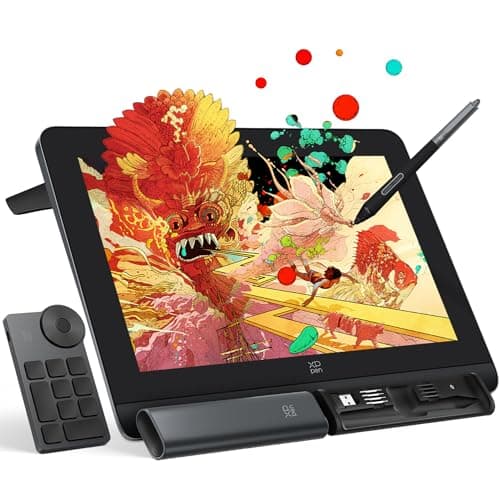
On the spec sheet, the XP-Pen Artist Pro 16 Gen 2 is the better display, and at $499.99 against $699.95 it is also the cheaper one. Both have a 16 inch 2560 x 1600 panel. XP-Pen lists 99% sRGB, 97% Adobe RGB, and 99% DCI-P3 coverage; Wacom lists 100% sRGB and 99% DCI-P3. Both are laminated or bonded to cut parallax, both have etched anti-glare glass, and both pens are battery-free with 60 degrees of tilt. XP-Pen adds a wireless shortcut remote and a built-in stand, and weighs about 1.79 kg to the Cintiq's 2.0 kg.

About the 16,384 vs 8,192 pressure levels: more levels do not mean a better line past a point. Both pens have far more steps than a hand can control. What you feel is the pressure curve, the initial activation, and how the driver handles it in your app. Treat the pressure number as a tie and judge the drivers.

Where Wacom still earns its premium is software. XP-Pen's drivers have improved a great deal, but studios that run on specific Photoshop, Toon Boom, or Blender setups on managed machines still standardize on Wacom because updates rarely break it. If you are one artist on your own computer, that risk is small and the $200 is real. It sits alongside the Cintiq 16 in our best pen displays guide.

Our Pick

The Artist Pro 16 Gen 2 wins for most artists because it matches the Cintiq 16's screen and beats it on paper for about $200 less at the time of writing. XP-Pen lists a 16 inch 2560 x 1600 fully laminated panel with 99% sRGB, 97% Adobe RGB, and 99% DCI-P3 coverage, the battery-free X3 Pro pen at 16,384 pressure levels with 60 degrees of tilt, a wireless shortcut remote in the box, and an 18-month warranty on US store purchases.

Buy it if you are a hobbyist, student, or freelance illustrator who wants a QHD, wide-gamut pen display without paying the Wacom premium, and you work in mainstream desktop apps such as Photoshop, Clip Studio Paint, or Krita.

What we don't like

Drivers are good but not Wacom-level across every app and OS update, which matters most in studio pipelines. The pen ecosystem is smaller, with fewer alternate pens and nibs. And XP-Pen's warranty length can differ outside its own store, so check the terms for an Amazon purchase.

Winner for Studio ReliabilityThe Challenger

Screen

16 in, 2560 x 1600, direct bonded

Color gamut

99% DCI-P3, 100% sRGB

Surface

Anti-glare glass

Pen

Pro Pen 3, battery-free, 8,192 levels, 60 degree tilt

Stand

Built-in, 20 degree adjustment

Connections

USB-C (DisplayPort Alt Mode), mini HDMI

Weight

2.0 kg (4.5 lb)

Warranty

1 year (US)

Pros

  • Industry-standard pen and drivers
  • Pro Pen 3 with customizable grip and weight
  • Direct bonding, 99% DCI-P3, QHD
  • USB-C or mini HDMI connection

Cons

  • About $200 more than the XP-Pen
  • One-year US warranty
  • No shortcut remote included
  • Older 1080p Cintiq 16 is still listed, so check the model

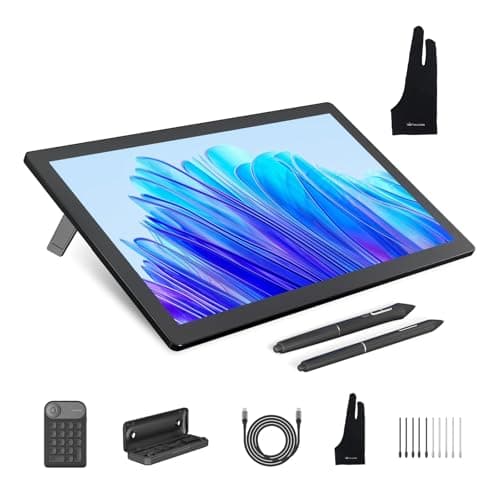
The Cintiq 16 you want is the current QHD model with Pro Pen 3, and that distinction matters on Amazon. The original Cintiq 16 (DTK1660) is still listed: a 15.6 inch 1080p screen with the older Pro Pen 2. The newer model we link has a 2560 x 1600 panel, direct bonding, 99% DCI-P3, and Pro Pen 3, per Wacom's own specs. Read the title before you buy.

What the extra $200 buys: Wacom's driver track record, its electromagnetic resonance (EMR) pen technology that Wacom has refined for decades, and Pro Pen 3's modular design with swappable grips and weights. It does not buy a sharper or wider-gamut screen than the XP-Pen.

For a working illustrator or animator, that software stability is worth real money: a driver that breaks the week of a deadline costs more than $200. For a hobbyist, it is harder to justify. The Cintiq 16 is the top pick in our best drawing tablets guide for exactly the buyer who values reliability first. Whichever you buy, a monitor calibrator is what turns a wide-gamut panel into accurate color.

The Challenger

The Cintiq 16 wins for professionals who need the industry-standard pen and drivers. Wacom lists the current model (DTK168) with a 16 inch 2560 x 1600 display, 99% DCI-P3 and 100% sRGB coverage, direct bonding for near-zero parallax, anti-glare glass, and the battery-free Pro Pen 3 at 8,192 levels with 60 degrees of tilt. It costs about $200 more than the XP-Pen and carries a one-year US warranty.

Buy the Cintiq if you work in a studio or pipeline that standardizes on Wacom, you want Pro Pen 3's swappable grips and weights, or you have been burned by driver problems before and want the safest bet.

What we don't like

About $200 more for the same resolution and similar gamut. Half the pressure levels on paper (which matters little in use). A one-year US warranty is short at this price. And there is no shortcut remote in the box.

Austin Art Insider

Free weekly guide to galleries, exhibitions & collecting in Austin.

Cheaper Option

Screen

14 in, fully laminated (listing)

Color gamut

123% sRGB area ratio (listing)

Pen

X3 Pro, battery-free, 16,384 levels (listing)

Controls

Mini Keydial (listing)

Pros

  • About $400 less than the Cintiq 16
  • Same pen as the Pro 16
  • Compact and portable

Cons

  • Smaller working area
  • Narrower color gamut than the 16 inch models

If $500 is still too much, this is the XP-Pen to buy. You keep the pen and lamination and give up size and gamut. For line art, comics, and sketching that is a fair trade; for color-critical work, save for the Pro 16.

The same X3 Pro pen and 16,384 pressure levels in a smaller 14 inch fully laminated display for about $300 at the time of writing. The listing states 123% sRGB (area ratio).

Buy it if your budget stops at $300, you draw on a small desk or travel, or you are moving up from a screenless tablet.

What we don't like

Smaller canvas and a narrower gamut than the Pro 16. Lower resolution than the 16 inch models.

The Huion Alternative

Screen

15.8 in, 2560 x 1440, fully laminated

Color gamut

99% sRGB, 90% Adobe RGB

Pen

PenTech 4.0, battery-free, 16,384 levels

Warranty

1 year (US)

Pros

  • Cheapest 16 inch class QHD display here
  • Fully laminated
  • Established brand with active driver updates

Cons

  • Narrower Adobe RGB coverage
  • Slightly lower resolution

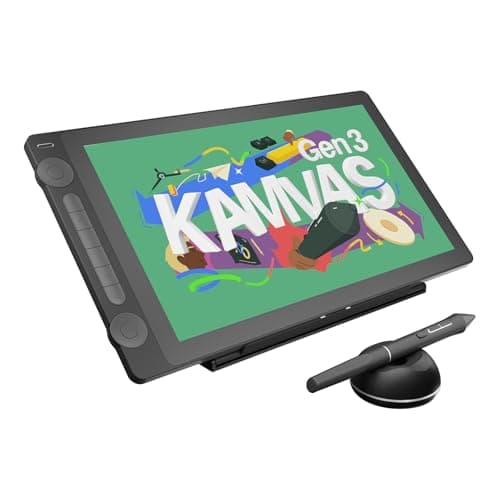
The Kamvas 16 Gen 3 is the reason Wacom and XP-Pen both keep their prices honest. It is about $41 cheaper than the XP-Pen with a similar pen and lamination, but a narrower gamut. Compare the full range in our best pen displays guide.

Huion's answer to both: a 15.8 inch 2560 x 1440 fully laminated display with the PenTech 4.0 pen at 16,384 levels, for about $459 at the time of writing. Huion lists 99% sRGB and 90% Adobe RGB, a narrower gamut than the XP-Pen, and a one-year warranty.

Buy it if you want the cheapest QHD-class 16 inch display from an established brand and work mostly for screens rather than print.

What we don't like

Slightly smaller and lower resolution than the other two, with less Adobe RGB coverage. One-year warranty.

Bigger 4K Step Up

Screen

4K UHD touchscreen (listing)

Color gamut

96% Adobe RGB (listing)

Pen

PenTech 4.0, 16,384 levels (listing)

Controls

Keydial Mini (listing)

Pros

  • 4K resolution and touch
  • Wide Adobe RGB coverage
  • Far cheaper than a Cintiq Pro

Cons

  • Demands a strong GPU
  • Large desk footprint

For artists who have outgrown 16 inches, this is the value route to 4K. It costs about a third of the Cintiq Pro 17 and gives you a larger, touch-enabled panel. The trade is Wacom's pen and driver pedigree.

A 4K touchscreen pen display with PenTech 4.0 and a Keydial Mini, for about $878 at the time of writing. The listing states 96% Adobe RGB and 1.07 billion colors. The most screen per dollar above the 16 inch class.

Buy it if you want 4K and a bigger canvas without Cintiq Pro money, for illustration, concept art, or photo work.

What we don't like

Needs a capable computer to drive 4K. Costs more than the Cintiq 16, so buy it for size and resolution, not as a Wacom substitute.

Pricier Pro Option

Screen

17 in class, 4K, 120 Hz touchscreen (listing)

Pen

Pro Pen 3

Best

Working professionals

Pros

  • 4K at 120 Hz for smooth strokes
  • Multi-touch and Pro Pen 3
  • Wacom's pro drivers and support

Cons

  • About $2,499
  • Overkill outside professional work

The Cintiq Pro 17 is where the Wacom premium is easiest to justify, because nothing at XP-Pen's price matches its 120 Hz 4K panel with Pro Pen 3. It is the pro pick in our drawing tablets guide. For almost everyone else, the Cintiq 16 or the XP-Pen Artist Pro 16 is the smarter spend.

Wacom's professional line: a 4K, 120 Hz touchscreen with Pro Pen 3, for about $2,499 at the time of writing. The display studios buy when color and screen size affect output and income.

Buy it if drawing is your profession and a Wacom-standard studio pipeline plus 4K and 120 Hz directly affect your work.

What we don't like

More than three times the Cintiq 16's price and far beyond what hobbyists need.

Head-to-Head

How the top picks compare

One matchup: XP-Pen for value, Wacom for studio reliability.

Wacom Cintiq 16 vs XP-Pen Artist Pro 16 Gen 2

Same 16 inch QHD resolution and similar gamut; XP-Pen is about $200 cheaper, Wacom has the better drivers and pen ecosystem.

Wacom Cintiq 16 (QHD)

Wacom

Wacom Cintiq 16 (QHD)

Industry-standard drivers and Pro Pen 3

$649.95
Check Price →
XPPen Artist Pro 16 Gen 2

XP-Pen

Winner

XPPen Artist Pro 16 Gen 2

Same resolution, wider listed gamut, remote included, longer warranty

$499.99
Check Price →

Our verdict

Winner: XP-Pen XPPen Artist Pro 16 Gen 2. The XP-Pen Artist Pro 16 Gen 2 wins for most artists. It matches the Cintiq 16's 2560 x 1600 resolution and 99% DCI-P3 coverage, lists 97% Adobe RGB, adds a shortcut remote, weighs less, and carries a longer warranty from XP-Pen's store, all for about $200 less at the time of writing. The Cintiq 16 is the right buy when driver stability and the Wacom pen ecosystem are worth that $200 to you, which is most often true in professional studios.

Buy the Wacom

Buy the Cintiq 16 if you work in a Wacom-standard studio, rely on specific pro apps and plugins, or want Pro Pen 3's modular grips and the safest drivers.

Buy the XP-Pen

Buy the Artist Pro 16 Gen 2 if you are a solo artist, student, or freelancer who wants the best screen for the money.

How we
chose

Pen displays are sold on spec sheets, so we started there and then weighed what the specs do not show:

  • Manufacturer specs only. Resolution, gamut, pressure, tilt, weight, and warranty for the two main contenders come from Wacom's and XP-Pen's own product pages. Alternate-model specs marked "listing" come from the Amazon listing.
  • Like-for-like sizing. We compared the 16 inch QHD models from each brand, since that is where most buyers cross-shop.
  • Drivers and ecosystem count. A display is only as good as the software that runs the pen, so we weighed Wacom's driver record against XP-Pen's price advantage rather than scoring specs alone.
  • Warranty and total cost. Included accessories (remote, stand) and warranty length are part of the price.
  • Verified listings only. Every price and image was checked against the live Amazon catalog on the day of publication. Treat prices as a snapshot.

Share this guide

Share

Common Questions

Frequently Asked Questions

Have art
to sell?

Austin Gallery specializes in selling inherited art, estate collections, and fine art with zero upfront fees. Get a free evaluation today.