Austin Gallery
Home & DecorJuly 2, 2026Updated July 2, 202611 min read

Best Cord Hiders for Wall-Mounted TVs & Frame TVs (2026)

Framed paintings do not have cords. The dangling cable is the last 10 percent between a wall-mounted TV and real wall art, and it costs $15 to $67 to fix, from a paintable on-wall cover to a code-compliant in-wall kit with recessed power.

By Justin Park · How we research

Here is the thing nobody tells you when you finish a Frame TV wall: you can pick the right TV for displaying art, hang it on a flush mount, snap on a gallery bezel, and the whole illusion still dies at a single power cord dangling to the outlet. Framed paintings do not have cords. The cord is the last 10 percent, and it is the cheapest part to fix.

There are two honest ways to do it. On-wall covers are paintable channels that stick over the cord: ten-minute install, renter-safe, and near-invisible once painted the wall color. In-wall kits route cables through the wall cavity itself for a true zero-cord look, and the good ones include rated recessed power precisely because you should never run a TV's ordinary power cord inside a wall. We picked the best of both, from ~$15 to ~$67. Every link goes to Amazon with our affiliate tag; we earn a small commission, at no cost to you, when you buy through us.

In a Hurry?

The 3 picks that cover most readers. Tap to read the full review or buy direct.

Best Overall

D-Line Cord Cover Kit

D-Line Cord Cover Kit

~$27

157 listed inches of rounded, paintable channel. Paint it and it reads as wall.

Best True-Invisible

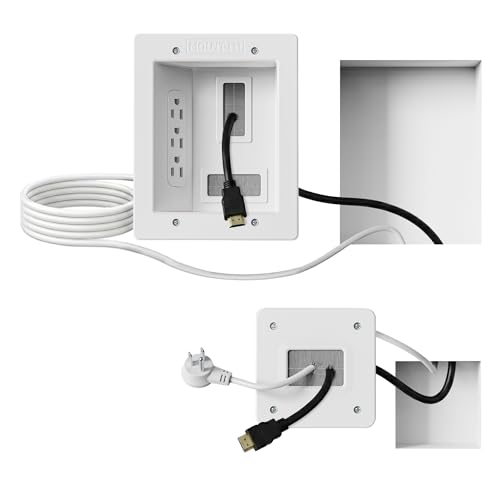
Mount-It! In-Wall Kit

Mount-It! In-Wall Kit

~$67

Cables inside the wall with rated recessed power. Zero visible cord.

Best Budget

Delamu Cord Hider

Delamu Cord Hider

~$15

157 listed inches of paintable channel for about $15. The renter's fix.

Best OverallOur Pick

Length

157 in total (listed)

Finish

Paintable, self-adhesive

Profile

Rounded (half-moon) channel

Install

No drill, cut-to-size

Pros

  • Rounded profile hides better than square raceways once painted
  • Listed 157 in covers a TV drop plus a soundbar run
  • Self-adhesive: no drilling, renter-friendly
  • Cuts to length with a hand saw or heavy scissors

Cons

  • Still visible up close, even painted
  • Adhesive can lift paint when removed
  • Larger cord bundles can crowd the channel

The fastest route from dangling cord to clean wall is a paintable cover, and D-Line's rounded channel is the best-looking version of the idea. The kit gives you a listed 157 inches of channel with adhesive backing and the fittings to turn corners. You cut a piece to the height of your cord drop, stick it, snap the lid over the cables, and paint.

157 inthe kit's listed total channel length. A wall-mounted TV drop is typically a few feet, so one kit handles the TV, a soundbar run, and spare

The detail that matters is the profile. Square raceways announce themselves with hard shadow lines; D-Line's half-moon shape rolls light off its curve, and once it is painted the wall color it reads as a subtle ridge rather than a plastic strip. On a bezel-dressed Frame TV hung gallery-style, that difference is the whole game.

Paint is the trick: unpainted white channel on a colored wall defeats the purpose. Buy the kit, then paint it with the wall's exact color before or after mounting. The paint step takes ten minutes and is the difference between hidden and merely tidied.

Our Pick

The on-wall cover that actually disappears. A listed 157 inches of D-Line's rounded, paintable channel with self-adhesive backing: stick it under the TV, run the cords inside, paint it the wall color, and from across the room it reads as wall. No tools, no holes, renter-safe.

Buy this if you want the cord gone this afternoon without opening the wall. It is the right answer for renters, plaster or brick walls, and anyone who wants 90 percent of the in-wall look for a tenth of the effort. The half-round profile casts less shadow than boxy channels, which is what sells the illusion once painted.

What we don't like

Painted or not, it is still a shape on the wall; look for it and you will find it. And adhesive strength cuts both ways: it grips well on smooth painted drywall but can pull paint on removal, so peel slowly and warm the adhesive first.

The ClassicAlso Great

Kit

Channels + elbows, tees, couplers

Size

Mid-size (CordMate II) channel

Mount

Self-adhesive

Finish

Paintable

Pros

  • Full fitting set routes real paths, not just drops
  • Legrand build quality, crisp snap-fit lids
  • Mid-size channel fits multiple cords
  • The proven, decades-standard raceway system

Cons

  • Squarer profile is more visible than D-Line's curve
  • Best along trim; more noticeable mid-wall
  • Fittings take patience to align cleanly

Cord problems are rarely just vertical. The outlet is behind the couch, the TV is on the far wall, and the run has two turns in it. This is the job the CordMate II kit was built for: channel lengths plus proper elbows, inside and outside corners, and couplers, so the whole route looks like trim instead of tape-and-hope.

Legrand (Wiremold) has owned this category for decades and it shows in the details: lids snap shut and stay shut, fittings meet square, and replacement pieces will still exist years from now. Choose it over the D-Line when your run hugs baseboards and door frames; choose the D-Line when the cover has to sit exposed on an open wall under a TV you are trying to pass off as art.

Also Great

The raceway everyone's parents' house already has, for a reason. Legrand is the name in wire management, and the CordMate II kit brings channel plus the elbows, tees, and couplers to route around corners and along baseboards, not just straight down from the TV.

Buy this if your cord run is more than a straight vertical drop: down from the TV, along the baseboard, around a door frame to the outlet. The included fittings make turns look finished instead of hacked, and the mid-size channel swallows a TV power cord plus an HDMI with room to spare.

What we don't like

It is a squarer, more utilitarian profile than the D-Line, so it hides less well on an open wall even after painting. It is happiest along baseboards and trim lines where a crisp rectangular shape looks intentional.

Best True-Invisible In-WallUpgrade Pick

Type

In-wall, recessed power relocation

Power

Recessed outlet behind TV (listed)

Walls

Standard drywall cavities

Look

Zero visible cords

Pros

  • Completely invisible: nothing on the wall but the TV
  • Rated power relocation, built for the no-cord-in-wall rule
  • Recessed outlet lets the TV sit flush against the wall
  • One-time install that permanently upgrades the room

Cons

  • Requires cutting drywall; not for renters
  • Needs a clear stud bay between TV and outlet height
  • Hire an electrician if any step feels uncertain

Covers hide the cord; this removes it from view entirely. The kit puts one recessed plate behind the TV and one lower on the wall near an existing outlet. In between, cables drop through the empty wall cavity. From the room, there is nothing: no channel, no painted ridge, just a screen floating on the wall.

The clever part is the power design, and it is worth understanding. Electrical code does not allow running a TV's ordinary power cord inside a wall; cords are not rated for in-wall use. Kits like this exist precisely to solve that: the listed recessed-power design uses rated in-wall wiring between the two plates, so you plug the TV into a proper recessed outlet up top while the code-rated connection lives inside the wall. Follow the kit instructions and your local code, keep low-voltage runs to in-wall rated cables, and hire an electrician if any of it feels unfamiliar; it is a short, inexpensive visit.

The Frame TV endgame: flush mount + snap-on bezel + this kit is the full recipe. See our Frame TV mounts guide for the flush-mount half; this kit finishes the wall below it.

Upgrade Pick

The only true zero-cord look. Two holes in the drywall, a recessed power connection behind the TV, and every cable travels inside the wall cavity. This is the finish our Frame TV readers are actually picturing: a screen on the wall with nothing beneath it at all.

Buy this if you own your walls and want the cord gone, not covered. It is the completion piece for a Frame TV art wall: pair it with a flush mount and a snap-on bezel and the illusion is total. Comfortable-with-a-drywall-saw DIYers can fit it in about an hour; everyone else, one electrician visit.

What we don't like

It requires cutting two holes in drywall, so it is out for renters, and it needs a wall cavity clear of studs, insulation batts, and fire blocking on the chosen path. Signal cables like HDMI still need in-wall rated versions for a to-code install.

Austin Art Insider

Free weekly guide to galleries, exhibitions & collecting in Austin.

Best BudgetBudget Pick

Length

157 in total (listed)

Finish

Paintable, self-adhesive

Install

No drill, cut-to-size

Use

TV drops, desk and wall cords

Pros

  • About $15 for a listed 157 in of channel
  • Paintable and renter-friendly like pricier kits
  • Enough length to do several rooms' worth of cords
  • Huge review base for a budget pick

Cons

  • Lighter plastic, less positive lid snap than D-Line
  • Needs careful cuts for clean joints
  • Thick cord bundles test the lid's grip

If the goal is simply no more dangling cord, $15 gets you there. The Delamu kit is the volume favorite in this category: a listed 157 inches of white paintable channel, adhesive backed, cut to length with scissors or a fine saw. Stick, load, snap, paint.

Where the extra $12 for the D-Line goes is feel and finish: crisper lid engagement, a rounder profile, cleaner joints. Across the room, painted, the two look close. For a primary living-room wall where the TV is playing art, we would spend up; for every other cord in the house, this is the one to buy in multiples.

Budget Pick

The same on-wall idea at half the price. A listed 157 inches of paintable, self-adhesive channel that gets a TV cord off the wall for about $15. The finish and fit are a notch below D-Line, but painted and mounted it does the visible part of the job.

Buy this if the budget is the budget: a first apartment, a bedroom TV, a rental where the whole install might come down in a year. It is also the sensible pick for hiding low-stakes cords everywhere else in the house once the living-room TV is sorted.

What we don't like

The plastic is lighter and lids seat less positively than the D-Line's, so it rewards careful cutting and a patient install. Fully loaded with a thick cord bundle, the lid needs firm seating along its length.

Head-to-Head

How the top picks compare

The real decision on a TV-as-art wall: paint a cover over the cord, or put the cord inside the wall. Here is the call.

Paint-Over Raceway vs In-Wall Kit - Which Cord Fix Wins?

Ten minutes and paint, or two drywall cuts and total invisibility.

Cord Cover Kit (157 in, Paintable)

D-Line

Cord Cover Kit (157 in, Paintable)

No-drill, renter-safe, near-invisible painted

~$27
Check Price →
In-Wall Cable Concealer Kit with Recessed Power

Mount-It!

Winner

In-Wall Cable Concealer Kit with Recessed Power

True zero-cord look, rated recessed power

~$67
Check Price →

Our verdict

Winner: Mount-It! In-Wall Cable Concealer Kit with Recessed Power. For the TV-as-art wall this guide exists for, the in-wall kit wins: a painted raceway is very good, but only an empty wall is perfect, and the Mount-It!'s rated recessed-power design gets you there without breaking the no-cords-in-walls rule. The D-Line is the smarter buy when the wall is not yours to cut, the wall is plaster or brick, or you want the fix done in the next half hour. Both cost less than the bezel on most Frame TVs.

Buy the D-Line

you rent, cannot cut drywall, or want a near-invisible fix today with nothing but scissors and paint.

Buy the Mount-It!

you own the wall and want the cord genuinely gone: flush TV, empty wall, gallery finish.

How we
chose

We judged cord hiders by how completely they finish a TV-as-art wall, not by feature lists:

  • Invisibility once installed. The whole point is a wall that reads as gallery, not as cable management. We favored rounded, paintable profiles for on-wall covers (they shadow less than square channels) and true recessed in-wall routing for the zero-cord look.
  • On-wall vs in-wall, honestly split. These are different commitments: an adhesive cover is a ten-minute renter-safe job, an in-wall kit means cutting drywall you own. We picked winners in both lanes instead of pretending one answer fits every wall.
  • Electrical code respected. A TV's ordinary power cord is not rated to run inside a wall. In-wall picks had to include a rated power-relocation design (recessed outlet with in-wall rated wiring), and our guidance stays inside the kit instructions and local code, with an electrician recommended whenever there is doubt.
  • Real capacity. A modern TV drop is rarely one cord: power plus HDMI plus a soundbar run. Channels had to swallow a realistic bundle with the lid seated.
  • Finish quality per dollar. Paintability, lid engagement, and clean joints separate a cover that disappears from one that merely tidies. We flagged where the budget pick trades finish for price.

Share this guide

Share

Common Questions

Frequently Asked Questions

Have art
to sell?

Austin Gallery specializes in selling inherited art, estate collections, and fine art with zero upfront fees. Get a free evaluation today.