Austin Gallery

Coffee

Best French Presses (2026): Tested for a Clean, Grit-Free Cup

The French press is the most forgiving way to make genuinely good coffee — but the choice comes down to managing sludge, and to two upgrades worth paying for: filtration and heat retention. The iconic Bodum design classic, double-filter presses that kill the grit, insulated stainless, and budget — all tested.

By Justin ParkUpdated June 7, 202612 min readHow we research

The French press is the most forgiving way to make genuinely good coffee: no paper, no machine, no electricity — just coffee and hot water steeped together, then pressed apart. Because nothing filters out the oils, it pulls a heavier, fuller-bodied cup than a drip machine or pour-over. The catch everyone runs into is the same one: sludge — the fine grit that ends up at the bottom of the cup. Almost every choice in this guide comes back to managing that, and to two upgrades worth paying for: filtration and heat retention.

These are the best French presses of 2026 — tested for a clean cup, full body, heat retention, and durability. They span the field the way the best guides do: the iconic Bodum design classic, a premium double-filter press that all but eliminates grit, the same filter in budget glass, an insulated stainless press that stays hot and won't break, and an honest budget pick. Every link goes to Amazon with our affiliate tag — we earn a small commission, at no cost to you, when you buy through us. The single biggest lever on cup quality isn't the press at all: it's the grind, so see our best coffee grinders guide too, and browse the rest on our coffee guide.

In a Hurry?

The 3 picks that cover most readers. Tap to read the full review or buy direct.

Best Overall

Bodum Chambord

$40

The iconic chrome-and-glass design classic — rich, full-bodied coffee from a press refined over 70 years.

Cleanest Cup

Espro P7

$145

Patented double micro-filter all but eliminates sludge — the grit-free, stays-hot enthusiast's press.

Best Value

Espro P3

$40

Espro's clean-cup double filter in glass, at the price of a basic Chambord — the smart buy.

Best Overall (& Design Classic)Our Pick

Capacity

34 oz (8 cup)

Material

Borosilicate glass + chrome steel

Filter

Single stainless mesh

Best

The classic all-rounder

Pros

  • Iconic, timeless design
  • Rich, full-bodied cup
  • Borosilicate glass + chrome frame
  • Replaceable parts, ~$40

Cons

  • Single filter lets fine grit through
  • Glass can crack if dropped
  • Loses heat as it sits (glass)

If a French press exists in your mind's eye, it's the Bodum Chambord: the cylindrical glass beaker, the polished chrome cage, the domed lid and that little ball-topped plunger knob. The shape dates to mid-century Europe and has been refined rather than redesigned ever since — which is exactly why we'd buy it first. It brews the way a press should: full-immersion steeping pulls out a heavy, full-bodied cup with all the oils a paper filter would strip away, and the stainless mesh filter is easy to rinse and replace. For around forty dollars, it's the most complete answer to "which French press should I buy."

Why we frame this as design, not just gear: at Austin Gallery we choose objects the way we choose art — for form as much as function — and the Chambord earns its place. Chrome-plated steel and borosilicate glass, a silhouette essentially unchanged for seventy years, parts you can replace instead of landfill. It's a quietly perfect industrial-design object that happens to make excellent coffee. See more gear chosen this way in our most beautiful coffee gear guide.

The honest trade-off is filtration. A single mesh filter lets some fine particles ("fines") slip into the cup, and glass loses heat faster than insulated steel as the pot sits. Both are easily managed — grind coarse and even (a good burr grinder matters more here than the press itself), and decant once it's brewed so it doesn't over-extract or go cold. If grit genuinely bothers you, jump to the double-filter Espro picks below. But for most people, the Chambord is the press to own. Explore the rest of the lineup on our coffee guide.

Our Pick

The one everyone pictures — and for good reason. The Bodum Chambord pairs a borosilicate glass carafe with that chrome-plated steel frame in a shape that has barely changed since the 1950s. It makes a rich, full-bodied cup, it's a genuine piece of industrial design, and at around forty dollars it's the press we'd buy first.

Buy this if you want the definitive French press: the classic look, a clean stainless mesh filter, the full-bodied flavor that makes people love press coffee, and a frame that's been refined over seventy years. It's the press to own if you care how it looks on the counter as much as how it brews — an object you'd be happy to leave out.

What we don't like

It's a single mesh filter, so you'll get some fine sediment in the cup if you grind too fine (the fix is a coarse grind — see below). The glass carafe can crack if dropped or thermally shocked, and replacement beakers are an extra cost. But as the all-around press, it's the benchmark.

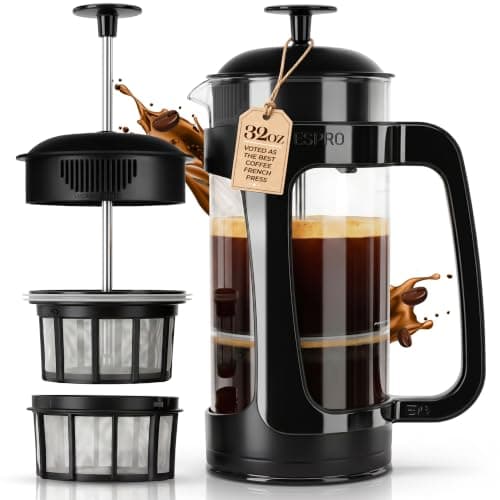
Best Filtration (No Grit/Sludge)Best Premium

Capacity

32 oz

Material

Double-wall stainless steel

Filter

Double micro-filter (patented)

Best

Cleanest, grit-free cup

Pros

  • Double filter = near-zero grit
  • Stays hot (double-wall steel)
  • Stops over-extraction at the press
  • Premium, durable build

Cons

  • Expensive (~$145)
  • More parts to clean
  • Can't see the brew (steel)

The single biggest complaint about French press — the sludge — is exactly the problem Espro set out to solve, and the P7 is its best answer. Instead of one mesh screen, the plunger carries two stacked micro-filters and a rubber gasket that seals tightly against the carafe wall as it descends. The result is a cup that's dramatically cleaner than any single-filter press: the fine particles that normally settle into muddy "mud" at the bottom are caught before they ever reach your mug. If you've read James Hoffmann or spent any time in r/coffee, this is the press that keeps getting recommended for clarity.

It also fixes over-extraction. In a normal press, grounds keep steeping in the brewed coffee, slowly turning it bitter. The P7's tight double-filter seal effectively isolates the grounds below the filter once you plunge, so the coffee above stops extracting — your last cup tastes like your first. Combined with the double-wall stainless body that keeps it hot for ages, it solves the two real weaknesses of the format at once.

The cost is the obvious catch: at around $145 it's roughly four Chambords, the multi-piece filter takes a little more rinsing, and the steel body means you lose the pleasure of watching the bloom through glass. But if a clean, grit-free, still-hot cup is what you're after — and you grind on a quality burr grinder to feed it — the P7 is the best French press we've used. Want the same filtration for far less? See the P3 next.

Best Premium

The press for people who hate sludge. Espro's patented double micro-filter strains the coffee twice and seals against the wall, so almost no fines reach the cup — the cleanest, grit-free brew a press can make. Wrapped in double-wall stainless that keeps it hot. The enthusiast's answer.

Buy this if the muddy bottom-of-the-cup sludge is exactly what's stopped you loving French press. The two stacked micro-filters and the rubber seal that wipes the carafe wall produce a remarkably clean cup — closer to pour-over clarity but with press body. Add double-wall stainless heat retention and it's the press to spend up on.

What we don't like

It's expensive (around $145), the double-filter assembly has more pieces to clean, and the stainless body means you can't watch the brew like you can through glass. But for the cleanest possible press coffee that stays hot, it's the best there is.

Best Filtered ValueBest Value

Capacity

32 oz

Material

Glass + plastic frame

Filter

Double micro-filter

Best

Clean cup on a budget

Pros

  • Double filter at ~$40
  • Far less grit than single-mesh
  • See the brew through glass
  • Best value in the guide

Cons

  • Glass loses heat (not insulated)
  • Less rugged than steel P7
  • Multi-piece filter to clean

The P3 is the value sweet spot of this entire guide: it gives you Espro's double micro-filter — the thing that kills the sludge — for about the price of a standard Bodum Chambord. The trick is the body: instead of the P7's double-wall stainless, the P3 uses a straightforward glass carafe and plastic frame, which strips the cost down to around forty dollars while keeping the filtration that actually matters. You get the cleaner, grit-free cup that makes Espro worth recommending, at no premium over an ordinary glass press.

What you give up versus the P7 is heat retention and ruggedness: glass cools faster than insulated steel, so you'll want to drink it promptly or decant, and the glass-and-plastic build isn't as bombproof as the all-metal model. It also has the same multi-piece filter to rinse. But if you've been on the fence about whether double filtration is worth it, the P3 is the cheapest honest way to find out — and most people who try it never go back to a single mesh. Feed it a coarse, even grind from a burr grinder and it punches far above its price.

Best Value

Espro's clean-cup filter, at Chambord money. The P3 puts the same patented double micro-filter into a glass carafe for around forty dollars — so you get the near-grit-free brew without the premium price. The smartest value pick in the whole guide.

Buy this if you want the double-filter clean cup but don't want to spend on stainless. It's the same filtration principle as the P7 — two micro-filters that catch the fines — in a simple glass body at the price of a classic Chambord. The best way to taste what double filtration does without paying premium.

What we don't like

The glass carafe loses heat faster than the P7's insulated steel (decant or drink promptly), it's a touch less robust than the all-steel model, and you still have a multi-piece filter to clean. But for clean-cup filtration at this price, nothing beats it.

Best Insulated (Stays Hot)Also Great

Capacity

36 oz

Material

Double-wall 18/10 stainless

Filter

Dual mesh screen

Best

Heat retention & durability

Pros

  • Stays hot for an hour-plus
  • Nearly unbreakable steel
  • Dishwasher safe
  • Polished, buy-it-once build

Cons

  • Expensive (~$140)
  • Less grit-free than Espro P7
  • Can't see the brew

Glass French presses have one real enemy beyond grit: they go cold, and they break. Frieling's double-wall stainless press answers both. The vacuum-style double-wall carafe insulates like a thermos, keeping a full pot genuinely hot for well over an hour rather than the twenty-or-so minutes you get from glass — so the second and third cups of a slow morning taste as warm as the first. And because the whole body is 18/10 stainless steel, it survives the drops, knocks, and dishwasher cycles that eventually claim every glass beaker.

It's not cheap at around $140, and it's worth being clear about filtration: Frieling uses a fine dual-mesh screen, which is excellent, but it isn't Espro's patented sealed double-filter — so for the absolute cleanest, grit-free cup the P7 still wins. The steel body also hides the brew. But if your priorities are coffee that stays hot and a press that will outlive your kitchen, the Frieling is a superb, near-permanent buy. Pair it with a coarse grind from a good grinder and it's faultless.

Also Great

The press that keeps your coffee hot — and won't shatter. Frieling's polished double-wall stainless carafe holds heat far longer than glass and survives drops that would break a Chambord. A heavy, dishwasher-safe, buy-it-once press for anyone who sips slowly.

Buy this if you drink your press coffee over a long, slow morning, or if you've broken a glass carafe before. The double-wall 18/10 stainless construction keeps coffee hot for an hour-plus, shrugs off knocks, and is dishwasher safe. A polished, durable, essentially permanent press.

What we don't like

It's expensive (around $140), it's a single (if dual-screen) mesh filter rather than Espro's sealed double-filter, so it won't match the P7 for grit, and the steel hides the brew. But for heat retention and sheer durability, it's the one to beat.

Austin Art Insider

Free weekly guide to galleries, exhibitions & collecting in Austin.

Best BudgetBest Value

Capacity

12 oz (3 cup)

Material

Borosilicate glass + plastic frame

Filter

Single stainless mesh

Best

Cheapest great cup

Pros

  • Excellent coffee for ~$15
  • Same glass + filter as pricier Bodums
  • Light and simple
  • Great single-serve size

Cons

  • Plastic frame (less premium)
  • Small (12 oz)
  • Single filter lets grit through

Here's the truth the "cheap vs expensive French press" videos keep arriving at: the coffee a French press makes depends far more on the beans, the grind, and your technique than on how much the press cost. The Bodum Brazil makes that case for fifteen dollars. It uses the same borosilicate glass carafe and the same stainless mesh filter as Bodum's pricier models — the only real downgrade is the frame, which is plastic instead of chrome. The cup in your hand is essentially identical to what the forty-dollar Chambord pours.

So what does paying more actually buy? Design and durability (the Chambord's chrome and look), heat retention (Frieling's insulated steel), or filtration (Espro's double filter) — real upgrades, but none of them about whether the base coffee is good. The Brazil's limits are honest: a plastic frame, a small 12-oz size, and a single mesh filter that needs a coarse grind to stay clean. But as a first French press, a dorm or office press, or simply proof that excellent press coffee is inexpensive, it's the budget pick we'd hand anyone. Grind it coarse on a burr grinder and it'll surprise you.

Best Value

Proof that great press coffee is cheap. The Bodum Brazil makes the same full-bodied cup as its fancier siblings using the same borosilicate glass and stainless mesh — just in a plastic frame, for about fifteen dollars. The honest budget answer to 'do I need to spend more?'

Buy this if you want to find out whether you love French press without spending much, or you need a small single-serve press. Same glass carafe and stainless filter as the pricier Bodums, same rich coffee, in a simple plastic frame. The smart first French press — and a genuinely great cup for the money.

What we don't like

The plastic frame feels less premium than the Chambord's chrome (and it's the design, not the coffee, you're saving on), it's small at 12 oz, and it's a single mesh filter so the same grind rules apply. But as proof you don't need to spend a lot, it's perfect.

Head-to-Head

How the top picks compare

The two questions every French-press buyer actually asks — clean cup, and is premium worth it.

Single Filter vs Double Filter (Espro)

The sludge problem — and the hardware that solves it.

Espro P3 / P7

Winner

Espro Double Filter

Near-zero grit, stops over-extraction

$40–$145
Check Price →

Bodum Chambord

Single Mesh

Classic, simple, full-bodied — but some grit

$40
Check Price →

Our verdict

Winner: Espro P3 / P7 Espro Double Filter. If sludge is what's stopped you loving French press, the double filter wins decisively. A single stainless mesh — like the classic Bodum Chambord's — lets fine particles slip through, leaving the muddy layer at the bottom of the cup that's the format's signature annoyance; the fix is a coarse, even grind, which helps a lot but never fully eliminates it. Espro's double micro-filter strains the coffee twice and seals against the carafe wall, catching the fines before they reach your mug for a remarkably clean, grit-free cup, and the tight seal also isolates the grounds after you plunge so the coffee stops over-extracting and turning bitter. The catch is parts and price (more to clean; the P7 is $145), but the P3 delivers the same double-filter benefit in glass for about $40 — the same money as a Chambord. Choose the Chambord if you love the classic design and will dial in a coarse grind; choose Espro (start with the P3) if a clean, sludge-free cup is the thing you care about most.

Buy the Espro P3 / P7

a clean, grit-free cup matters most to you.

Buy the Bodum Chambord

you want the design classic and will grind coarse.

Cheap vs Expensive — Does It Matter?

What you actually get for $15 vs $145.

Bodum Brazil

Winner

Budget Bodum

Same glass + filter, same great coffee

$15
Check Price →

Espro P7 / Frieling

Premium Press

Filtration, heat retention, durability

$140–$145
Check Price →

Our verdict

Winner: Bodum Brazil Budget Bodum. Here's the answer the comparison videos keep reaching: for the coffee itself, the cheap press is just as good. The $15 Bodum Brazil uses the same borosilicate glass and the same stainless mesh filter as the pricier Bodums, so with good beans, a coarse grind, and decent technique it pours a cup that's essentially identical to a $40 Chambord. You genuinely do not need to spend more to make great-tasting French press coffee — which is why the budget pick 'wins' on pure value. What the extra money buys is specific, real upgrades that aren't about base flavor: a sealed double filter for a grit-free cup (Espro), double-wall stainless that keeps coffee hot for an hour-plus and won't shatter (Frieling / P7), and timeless design and durability (the Chambord's chrome frame). So spend up only for the thing you actually want — clean cup, hot cup, or beautiful buy-it-once press — and put your first dollars into a good burr grinder, which improves the coffee more than any press will. If you just want a great cup cheaply, the Brazil is all you need.

Buy the Bodum Brazil

you just want great coffee and to spend little.

Buy the Espro P7 / Frieling

you want clean filtration, heat retention, or a forever press.

How we
chose

We judged French presses on the things that actually decide your cup — not marketing:

  • Filtration (the sludge test). The #1 French-press complaint is grit. We favored presses that keep fines out of the cup — Espro's sealed double-filter is in a class of its own here.
  • Body & extraction. A press should pull a rich, full-bodied cup, and ideally stop over-extracting once plunged so the last cup isn't bitter.
  • Heat retention. Glass goes cold in ~20 minutes; double-wall stainless stays hot for an hour-plus. We matched material to how slowly you drink.
  • Durability & cleaning. Glass can break; steel survives drops and dishwashers. We weighed longevity and how fussy the filter is to rinse.
  • Design & value. Austin Gallery's eye is for objects worth owning — and great press coffee is cheap, so we cover $15 to $145 and say plainly what more money buys.

Share this guide

Share

Common Questions

Frequently Asked Questions

Have art
to sell?

Austin Gallery specializes in selling inherited art, estate collections, and fine art with zero upfront fees. Get a free evaluation today.