Austin · Field Guide
Where to Find Local Art in Austin
The museums worth your afternoon, where the working artists actually are, and the one weekend to plan around — a gallery's guide to seeing, meeting, and collecting local Austin art.
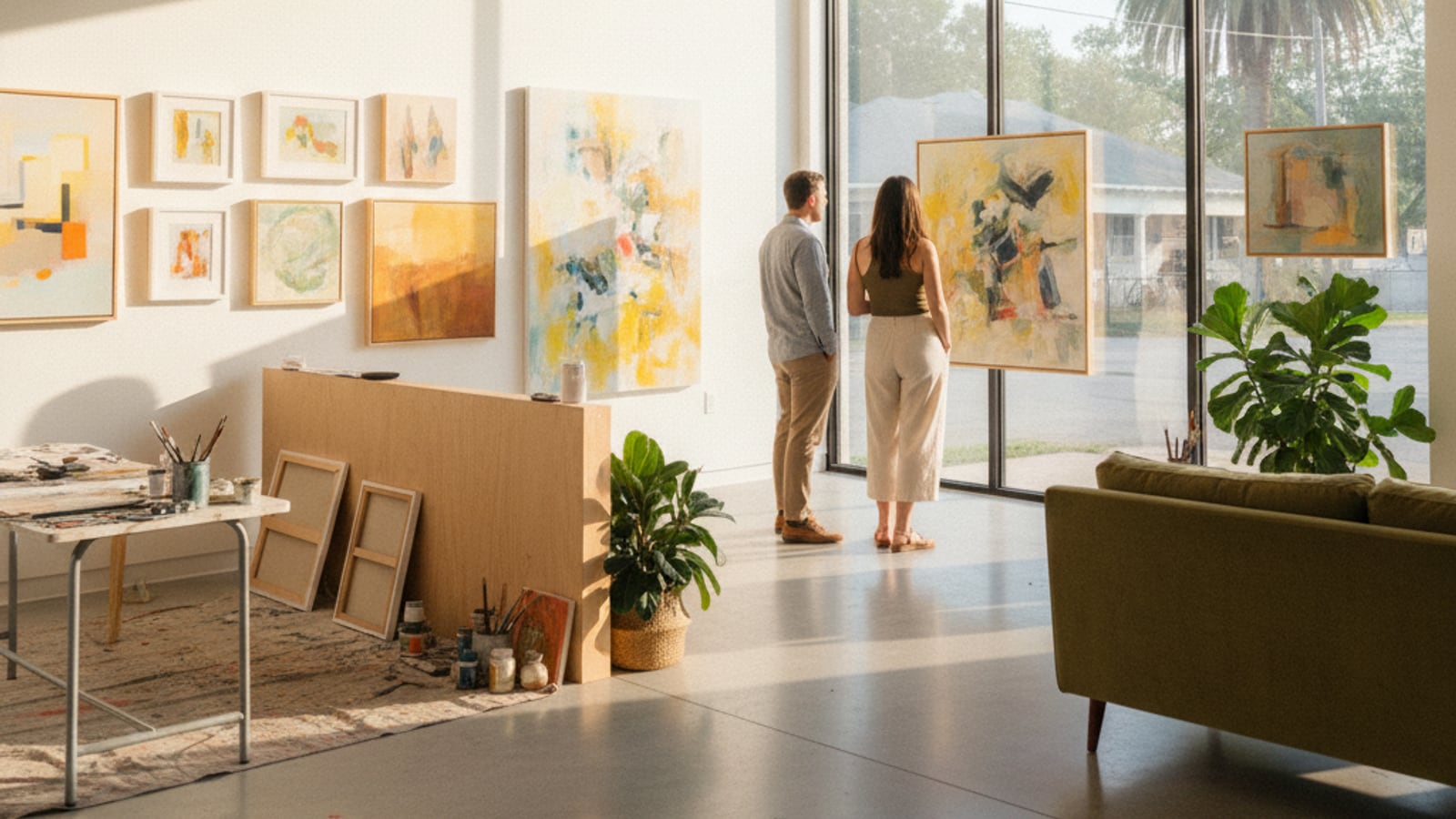
Austin has an art scene that rewards the curious. It isn't concentrated in one glossy gallery district the way it is in some cities — it's spread across museum walls, converted warehouses on the east side, open studios, and one extraordinary weekend in November when hundreds of artists simply open their doors. That diffuseness is the charm: the best way to find Austin's art is to go looking for it. Here's the field guide we'd give a friend who wanted to start.
At a Glance
- Museums
- Blanton · The Contemporary Austin · Mexic-Arte
- Studios
- Canopy + Big Medium, east side
- Plan around
- Austin Studio Tour — November (free)
- To collect
- Buy what you love, direct from artists
Start with the museums
If you want a fast, free-to-cheap orientation to the city's visual art, three institutions do most of the heavy lifting.
The Blanton Museum of Art, on the University of Texas campus, is the big one — a deep collection spanning European, modern, contemporary, and Latin American art, plus Ellsworth Kelly's luminous standalone building, Austin, which is reason enough to visit on its own. The Contemporary Austin runs two very different spaces: the Jones Center downtown for changing contemporary exhibitions, and Laguna Gloria, a lakeside villa whose grounds double as one of the loveliest sculpture parks in Texas. And Mexic-Arte Museum, on Congress Avenue, is the city's home for Mexican, Latino, and Latin American art, and a downtown anchor worth building an afternoon around.
A gallery's tip
Go to a museum to train your eye, not to buy. Spend an hour really looking — what holds you, what you walk past — and you'll start to learn your own taste. That's the single most useful thing a new collector can do, and it's free.
Where the working artists actually are
Museums show you the canon; studios show you the present tense. In Austin, a lot of that energy clusters on the east side, and the organization to know is Big Medium — the local arts nonprofit that has spent years building the infrastructure that lets working artists, well, work.
Big Medium runs Canopy, a roughly four-acre complex on the east side built into a former Goodwill warehouse: dozens of small artist studios, several galleries, and a café, all in one place. It's one of the rare spots where you can wander, see work in progress, and meet the people making it. Big Medium also organizes the Texas Biennial and the studio tours below — if you follow one art organization in Austin, follow them.
Museums show you the canon. Studios show you the present tense.
The one weekend to plan around: the Austin Studio Tour
If you do nothing else on this list, do this. Each November, the Austin Studio Tour — the long-running, free, self-guided tour organized by Big Medium, encompassing the East (EAST) and West (WEST) sides over consecutive weekends — opens hundreds of artists' private studios to the public.
It is the single best way to experience Austin's art: you drive or bike a route, walk into real working studios, see the full range from emerging to established, talk to the artists directly, and often buy work straight from the maker at studio prices. Pick a neighborhood, grab the map, and give yourself an afternoon. You'll leave with a list of names you'll want to follow for years.
Coming in from out of town for a tour weekend? Browse Austin vacation rentals on the east side to stay close to the EAST route and skip the cross-town drive between studios.
Plan it
Tour weekends get busy. Scan the catalog ahead, star five or six studios near each other, and route them — then leave room to wander into the ones you pass. The unplanned stops are usually the best ones.
How to start collecting Austin art
You do not need money or expertise to start collecting — you need to start. The on-ramps, roughly cheapest to deepest: the studio tour and local art markets (buy a small piece you love directly from an artist); gallery openings around town, which are free, social, and the fastest way to learn the scene; and building a relationship with a gallery whose eye you trust to bring you work over time.
The only real rule is the one every seasoned collector repeats: buy what you love and can live with. Value follows conviction far more reliably than the other way around. And if you ever inherit a piece or want to know what something is worth, that's a different conversation — we offer free, no-obligation art appraisals for exactly that.
Help us point the light
This guide is the start of how we want to use this gallery's platform locally: not just to sell, but to see. We run a free Austin Artist Spotlight series — dedicated features on the city's working artists, written with the same eye we bring to the artists we represent, at no cost to them. If you're an Austin artist, submit your work. If you know one whose work deserves a wider audience, send them our way. The more of the city's art we can point people toward, the better.
Questions, answered
What's the best way to see local art in Austin for free?
How do I start collecting art in Austin on a budget?
Keep Reading
Community
Austin Artist Spotlights
Our free spotlight series on Austin's working artists — and how to get featured.
Austin
Austin Local Guides
Art classes, local life, and selling art in Austin.
Appraisal
Free Art Appraisal
Inherited or own a piece? Get a free, no-obligation appraisal.
Plan a day
Austin Hotel Day Passes
Turn a gallery day into a full Austin day: 13 hotel pools and spas you can book by the day, from $25.
Plan a day
Austin Wellness Retreats & Spas
The 14 best wellness escapes in and around Austin, from $50 day passes to destination resorts.